

We brew our lower-alcohol porters and stouts on our smaller, seven-barrel system. We want to be able to iterate on the changes we’re making to each batch, and we also want to keep the beer fresh, of course. We get more of an opportunity to improve our beers with the smaller batch size.
We are known for making higher-ABV beers. The barrel-aged beer often outsells the non-barrel-aged. We make the higher-ABV beers on the 15-barrel system, so we can designate a portion of the batch for barrel aging.
A Focus on Malt
The base malt for most of our lower-alcohol English-style brown ales and porters—West End Squirrels and Uptown Squirrel—is Crisp Maris Otter No. 19. It provides a touch more richness than we can get from our standard base malt.
We also liked the beers when we made them with standard two-row—but when we brewed Uptown Squirrel for the first time with Maris Otter, that batch won a gold medal and Best American Beer at the 2024 Brussels Beer Challenge.
We do our best to differentiate our stouts from our porters, but in all honesty, those differences can be nuanced. Roasted barley (unmalted) is an important component of most stouts—at least in some small quantity—but it doesn’t belong in a porter. In our porters, we lean toward the chocolate malts more than the heavily roasted ones, with a splash of something like Briess Midnight Wheat, which has a softer character than some of the roasted barley malts. It imparts complexity without harshness because it doesn’t have a husk.
We’ve used Crisp Chocolate in the past, and it was quite good. Our current go-to is Simpsons Export Pale Chocolate (200–250°L) for its more delicate light-roast character. We use Simpsons Export Brown Malt (36–45°L) as well. We always add our dark malts to the full mash, not just at the end. We want the full flavor of the grain, not just the color. We sometimes use a small amount of Weyermann Carafa Special II for color adjustment.
For crystal malts, we prefer the English varieties from Simpsons and Crisp. A layer of medium-dark or dark crystal in the 5 to 10 percent range tends to work well. Flaked wheat and oats add just enough mouthfeel and body to the beer, while biscuit malt is there for depth and complexity, adding a bready toastiness that plays really well with the chocolate.
We’ve tried a few darker malts, including coffee malts, that didn’t work out how we’d hoped. When we’re doing smaller batches, we like to try one new malt at a time to see whether we like the results.
With our hop choices, we’re just trying to balance these beers. For bittering, any high-alpha hop, such as Columbus, works well. For the late addition we use something classic, Noble or Noble-adjacent. Willamette has been a favorite for many years.
Fermentation
We use Fermentis SafAle S-04 for the English-style lower-ABV beers. Because of its low attenuation, this yeast is not well suited for the higher-ABV beers, which could end up too thick and cloying. But that residual body and moderate sweetness are essential to our lower-ABV porters.
In the bigger porters such as Hello Darkness, we blend in a more attenuative, neutral yeast strain such as Chico to improve attenuation while retaining some of the English-style complexity.
For a seven-barrel batch, a 500-gram pack of dry yeast is adequate for a 5 percent ABV beer. But for a higher-ABV beer at the same volume, we need to pitch two to three times that amount.
Hitting our target starting gravity for the high-ABV beers can be a challenge. If our gravity is low, we either increase boil time, or we add brewer’s crystals or dry malt extract (DME). The important part is creating the right starting conditions for a healthy fermentation with a precise balance of volume, gravity, and adequate yeast.
We ferment the lower-ABV beers on the cold side—we want to restrain the esters a bit. Our set point for the smaller beers is 66°F (19°C); it’s 68°F (20°C) for the imperials.
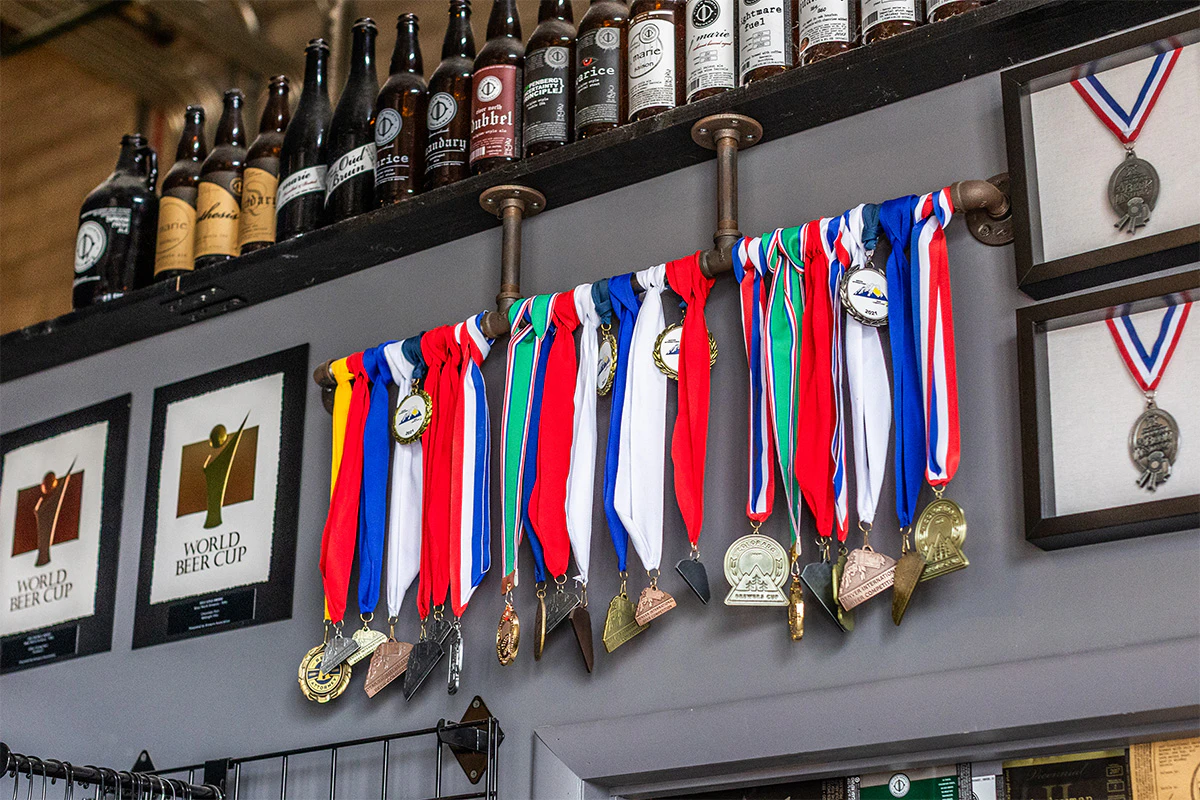
Approach to Competitions
We send both bottles and cans to competitions. It’s about what beer we have ready—or planned to have ready, weeks or months in advance of each competition.
If it’s a beer that needs to be fresh and we don’t have a fresh batch, we won’t enter it. If we have two different batches of the same beer, we taste them side by side and pick the best.
We think bottles judge a little better because they retain more carbonation during packaging. A lot of brewers have a love-hate relationship with the Meheen bottler, but it’s a double-evac, pre-purge, counterpressure filler. For all its quirks, to us, it is indispensable. The fills are low-oxygen all the way through.
We’ve made many changes based on competition feedback over the years. We read through the judging sheets religiously. Some of the big adjustments have been carbonation, mouthfeel, attenuation, and body. All variables are fair game for reevaluation, especially when we see parallel feedback from more than one competition.
Adding Coffee
Combining two of the greatest beverages in the world is one of our favorite things to do (although coffee is still second place to beer, of course).
We always use whole beans, working with our friends at Logan House Coffee in Denver. They have a few shops around town and roast their own beans. When we’re planning a beer with coffee, we try to meet up, taste some of the freshly roasted blends, and choose our favorite.
It’s important to work with a roaster you know and trust—one who will get you beans that are fresh and roasted to the level that suits the beer. If we taste a few coffees, and we feel like they are not capturing the desired flavor profile, then Logan House has the expertise to change the blend and roasting parameters for next time.
Achieving the right coffee character has become a moving target. We are trying to re-create some of the flavors that have been favorites in the past, but certain origins are becoming more difficult to source. The coffee we use is almost always a blend of beans from several origins in the medium-roast range. Dark-roast coffee is a go-to for sipping first thing in the morning, but that doesn’t necessarily translate as well into the beer. There’s not enough complexity, or it can have an ashy character.
Four to eight pounds of coffee per barrel—roughly two to four ounces per gallon, or 15 to 30 grams per liter—is the sweet spot, depending on the base beer style. An imperial porter would be on the higher side, while a brown ale needs less to impart a balanced character.
We‘ve used beans as soon as the day after roasting, and the beer wasn’t too astringent or oily. Freshly roasted beans off-gas CO2 for several days after roasting, which also may benefit the beer’s shelf life.
We rarely add beans to a tank mid-fermentation. Once the beer reaches terminal gravity, we transfer onto the fresh beans in a purged tank. Depending on the production schedule, we rest the beer on the beans for 24 to 48 hours at room temperature or up to four days at cold temperatures. Both methods yield exceptional coffee character.
Very Strong Imperial and Barrel-Aged Porters
For our strongest porters—such as Dark Sorceress, part of our Decennial and Vicennial Series—we can reach 15 to 18 percent ABV in primary fermentation under the right conditions.
Achieving those levels requires the addition of simple sugars during fermentation. Sometimes we’ll stagger the extra fermentable additions in two stages, if we’re worried about the health of the yeast. Timing is everything. If we add the sugar too late, the yeast may not be healthy enough to complete fermentation—but all is not lost in that scenario. We can age these under-attenuated batches in barrels and use them as blending components to help balance barrel-aged versions of the beer.
Picking the right yeast is one of the most critical parts of the process. If treated properly, many different strains can successfully ferment these beers—with a very high pitch rate, most strains can far exceed their stated ABV range. For these higher-ABV beers, we typically use a blend of strains—American and English, American and Belgian, or multiple Belgian strains. We add oxygen through a carbonation stone within 18 hours of starting fermentation. Using a yeast nutrient such as Servomyces is also key.
We mostly use dry yeast for the big beers. We’re a small brewery, so keeping many different strains on hand and healthy at any given time can be difficult. When we started these projects years ago, we had a ready supply of Belgian strains from batches that were already in the tank. Since then, we’ve broadened the styles we make, so dry yeast is an important tool for us.
Most of these beers are ready for barrels in about three weeks. The time spent aging in barrels depends on the beer and the barrel itself—12 months to (we presume) infinity. Colorado has such a dry climate, volume loss through evaporation can be rapid. With some of the older, two-to-three-year-old barrels, we’ll top them off with fresh beer—especially if it’s a double-barrel-aged project.
We’re fortunate in Colorado to have many great local distillers. We reach out to them directly if we can, to ask what they have fresh or will have soon. Sometimes, the distillers we know well will contact us about some upcoming exceptional or unique barrels. If the schedule allows, we brew a special batch specifically for those barrels, and we are ready to fill those barrels in just a few weeks.
If we ever get barrels that are too dry to fill, we don’t rehydrate them. The barrel character will be muted or, even worse, musty and unpleasant. It’s better to find a different barrel.
Watch & Learn!
For more about the methods and philosophy behind River North’s robust and flavorful award-winning beers, check out our video course Brewing Impactful High-Gravity Beers with River North.
