

There’s something stunning about a properly reddish-amber beer, shining like a bright jewel on the bar amid the golds, browns, and blacks.
The name gives it away: Amber is about color before it’s about style—in fact, its stylistic influences have been myriad. It’s a colorful liquid meant to fill a gap, to turn bipolar options into a spectrum. It’s meant to look enticing in someone else’s hands—now you want one, too—and to be a visible example of beer’s diversity. It’s what turns a flight of tasters into a rainbow.
Yet it’s not just about looks. Between the absence and presence of dark roast lies a thick swatch book of options—a kaleidoscope of malts through which today’s commercial brewers, busy making ever-paler IPAs and ever-inkier stouts, rarely get to peer. And, thanks to meaningful differences in how they’re malted, the flavors of these malts vary more than their colors; they can range from the lightest drizzle of heavenly honey on toast through all the Dante-esque levels of caramel depth to devilish dark fruits, and more. Even as breweries seek ways to appeal to wider audiences, these flavors tend to be far more food-friendly and approachable than hop bombs and pastry stouts.
That color also says nothing about hops or yeast choices, allowing the brewer a free hand to pull from existing influences or attempt something new. You can go herbal and spicy or juicy and ester-driven, bitter and dry or round and fulsome, clean and understated or big and fruit-punchy. It might taste like Düsseldorf, it might taste like London, it might taste like the West Coast… or it might taste like 1985.
What does an American amber ale taste like? You can guess, but you don’t know until you take a sip. Within that color lie nearly limitless options—many more options than the pioneering brewers had 40 years ago, when American red and amber ales began to ascend.
Their Influences Are Legion
The narrative of these ales runs from the earliest days of microbrewing through the brewpub boom of the 1990s—and by then, it was practically obligatory for every small brewery to make one.
“I think the simple reason is, it’s drinkable as fuck, and it doesn’t look like yellow beer,” says John Mallett, the longtime head of operations at Michigan’s Bell’s Brewery, now retired. “And at the time, that was important—people drink with their eyes. They’re going to a pub, they want to have something different, and they can see it’s different.”
Mallett paints a picture of drinking craft beer in the ’90s: “You go to a standard brewpub, they’ve got a burger, they’ve got wings. They’ve got a stout that’s black—oh my god!—and they’ve got an amber, they’ve got a pale ale, and then they’ve got some kind of very light wheat beer. … That was the menu at so many of these pubs at the time—it was formulaic, not well executed. ‘But boy, look at this range of beers that we have! Four of them, all different colors!’”
Yet for American drinkers—and brewers, too—those were still the early days of learning what beer could do. “People were on a tasting journey,” Mallett says. “I’m sure you did the same. I did the same. … You really kind of moved around, and the amber certainly looked different, tasted different, was different than everything else.”
A decade earlier, options were even fewer. For the microbrewing pioneers of the 1980s, the whole point was to brew, drink, and sell something that tasted—and looked—different than industrial pale lager. It was about flavor, but color came with it. Again and again, inspiration from Britain and Europe merged with American ingredients, especially Cascade hops and clean-fermenting American ale yeast. But it wasn’t for the sake of innovation—it was just what they knew, and what they could get.
At first, British ales were the strongest influence on the burgeoning American ale scene. Amber-colored ESBs peppered the lineups of the early microbreweries, including Colorado’s Boulder Brewing in 1979. And many pale ales still lived in a very reddish place.
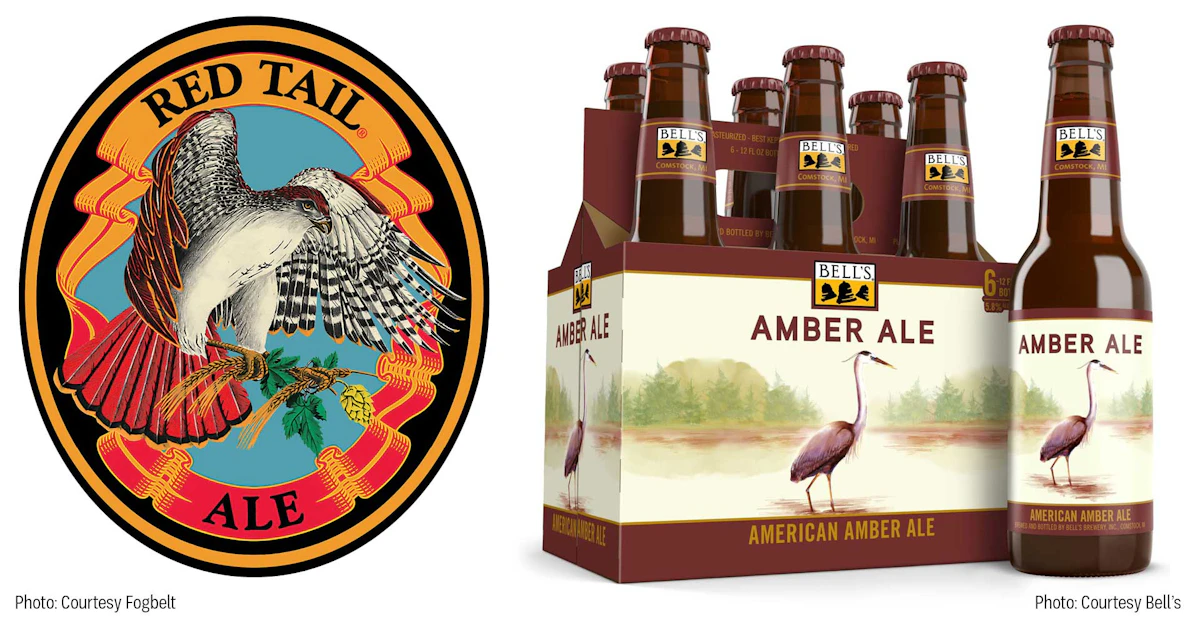
When Larry Bell launched Kalamazoo Brewing out of his homebrew shop in 1985, he debuted with Great Lakes Amber Ale. Later, as Bell’s Amber, it would become an archetype of the American style and fuel the brewery’s growth well into the ’90s.
But why an “amber”?
“I don’t think anybody would’ve known what an ESB was,” Bell says. “A lot of my inspiration, a lot of my homebrewing, came from British brewing books. I don’t know if they call them anything ‘amber’ in there, but that just seemed to be the term in the day.”
Bell also had studied with Bill Newman, who founded Newman’s Brewery in Albany, New York, in 1980. Among other British-inspired ales, Newman brewed an Albany Amber Ale. Growlers had yet to gain currency, so Newman sold his ales in bag-in-a-box polyurethane cubitainers—as did Bell, in his early days.
Full Sail came a few years later—opening in 1987 in Hood River, Oregon—but its Full Sail Amber Ale was influential throughout the 1990s and beyond. Jeff Alworth, in The Beer Bible, quotes Full Sail brewmaster James Emmerson as saying that English ESB was the source material for American amber; he refers to Full Sail Amber as an “American ESB.” They didn’t label it as such, either, but the color is easy for anyone to grasp.
Yet England wasn’t the only influence on American ambers and reds—far from it. A much-overlooked influence on the American ales of that time doesn’t hail from Derby or Dorset or even Dublin—it hails from Düsseldorf.
In 1984, the Widmer Brothers didn’t launch with Hefeweizen—they launched with an Alt. Now owned by AB Inbev via the Craft Brew Alliance, Widmer no longer brews Alt regularly—but the brand’s Drop Top Amber Ale is a core beer.
When Alaskan Brewing opened in 1986, altbier was the inspiration behind what would become the brewery’s hugely successful Alaskan Amber. Besides being a big seller, the beer enjoyed a nearly annual subscription to gold medals from the Great American Beer Festival until the mid-’90s.
Its category tells part of the story. After the earliest GABF competitions were straight-up people’s choice awards—Sierra Nevada Pale Ale won the first in 1983—the judging of broad style categories began in 1987. That first year, there was a category for Ales—but there was no specific category for amber ales, nor was there any specific category for ESBs.
There was, however, a category for Alts. Alaskan won gold that first year, in 1987, and again in three of the next four years. Then, in 1994 and 1995, Alaskan Amber jumped categories and instead won golds in American Amber Ale.
For any brewer looking for perspective on the style, Mallett recommends a trip to the Rhine Valley. “Altbier in Düsseldorf,” he says. “I mean, goddamn—you can drink a lot of beer in Düsseldorf. It’s so delicious. That’s amber ale! Drinking those beers from the source should make somebody rethink, ‘why I don’t like amber.’ Great malt character.”
Nor were London and Düsseldorf the only source material for the early American ambers. Odell conceived its flagship 90 Shilling in the Scottish style, and well before that was Grant’s Scottish Ale at Yakima Brewing. (Bert Grant himself was Scottish-born.) Famously, it was Belgian pale ale that inspired Fat Tire Amber—which, in a sign of the times, is no longer amber at all.
As these American ambers evolved, brewers gradually and more confidently embraced a homegrown kind of flavor—namely, hops. Anderson Valley Boont Amber Ale, for example, started with English varieties but moved more American, at times getting whole-leaf Cascade, Columbus, or Mt. Hood via hopback. (“Amber ales are epic,” that beer’s webpage says today. “They are the bedrock of what we now know as craft beer. …”)
More to the point: American brewers—whether by necessity or personal taste—always added their own thumbprints. Ironically, now that amber and red ales are out of fashion, the options for ingredients and sources of inspiration are far more numerous. And the processes, training, and equipment to ensure quality—especially at the smaller scale—are far better than they were 40 years ago.
Brewing Modern Amber Ales
Consumer preferences have shifted. So have those of IPA-centric brewers, increasingly allergic to caramel malts and their vulnerability to staling.
Yet those malts are arguably integral to American amber ale, and for years they also found great compatibility with classic American citrus-pine hop flavors. But would they work as well with today’s more popular modern varieties?
“I also think about the interest in particularly tropical-style hops, both U.S. and international,” Mallett says. “Do they play well with the caramel? Not always. And then, if you’re making these beers and they’re oxidatively unstable, then who wants to drink stale-tasting beer that’s sat at the Quickie Mart for three and a half months?”
Yet there are still brewers who enjoy making and drinking these beers—including Steve Luke, founder of Seattle’s Cloudburst. His strong red ale, Peaked in High School, won gold at the 2025 World Beer Cup.
“Something unquestionably not cool in the eyes of the general population always makes that something actually cool to a select few,” Luke says.
Best of all, for those select few: Today’s brewers of amber ales are working with a much better tool set than the previous generation.
“Now, with better crystal malts, better-quality hops, advanced hop products, better access to information—via your mag [and] podcasts—better packaging SOPs, etcetera, it’s fun to brew something ‘old school’ in our modern times. When it works—bright caramel and bread-crusty notes paired with more bright, piney, citrusy hops, followed by an assertive bitterness and a drier finish (like, below 4°P [1.016])—it’s one of the more complex, enjoyable pints you can dig into.”
Over the past few decades, available malts have improved greatly in quality and variety, and skilled brewers can work magic with them. While Cloudburst won for Strong Red Ale last year, the gold medal for American-Style Amber/Red Ale went to Mountain Rambler in Bishop, California—a town of about 3,000 people between the Mojave Desert and the Sierra range.
The brewery’s Singing Coyote is a classically formed example that takes full advantage of today’s thick malt catalog.
“We achieve complexity in malt character because we use a wide range of specialty malts and a blend of base malts,” says head brewer Ryan Quinlan. “The base is a blend of two-row and Maris Otter—this gives a wonderful bready, biscuity, and nutty foundation. And we build on that with a bit of biscuit malt. But the key is likely the variety of crystal malts we use, ranging in color from 15° to 170°L. This allows us to develop a nice caramel complexity and a deep red color. And we get that deep, rich red color without using any off-style dark roasty malts.”
While the beer uses the clean-fermenting Chico strain, it eschews aroma hops for a single bittering addition of about 23 IBUs, so the malt can shine. Quinlan says the brewery chose to brew Singing Coyote out of admiration for the style. “It’s a delve into the toasty, biscuit, melanoidin-rich … but also pays homage to the beer we came up enjoying, including Boont Amber, Alaskan Amber, and Fat Tire.”
Mountain Rambler has earned a strong reputation for its malt-forward beers. In 2025, its Peaklet Porter also won gold at GABF; the previous year, it won silver at both GABF and the World Beer Cup. And while many breweries today might struggle to sell amber ales, Mountain Rambler is succeeding with two: Singing Coyote and Seven Gables, a Scottish-style ale that’s also won a few medals. Quinlan says both beers have a steady following among the brewpub’s customers.
“Maybe,” he says, “things will cycle a bit back toward malty beer.”
While such beers might sell well at Mountain Rambler, that’s not usually the case at another small brewery in a different part of the state—Far Field Beer, in the L.A. suburb of Lawndale. One exception for them has been Far Field Infrared, an American amber ale that won World Beer Cup gold in 2024.
That beer debuted in 2023, two years after the brewery opened.
“We started just putting it out occasionally, and it always did decently because we don’t do too many darkish beers at our brewery,” says head brewer Bryce Lowrance. “They really don’t sell that great, so we kind of stray away from them. But Infrared is kind of the exception to that, and it always sold decently. But then last year, after the World Beer Cup, I’d say we definitely saw an increased interest in the beer, especially from outside accounts. It’s actually become, over this last year or two, a core beer for us.”
One reason retailers like it: There aren’t too many other red ales these days in Southern California. “I think it’s like a nice little pocket that we kind of slid into,” Lowrance says.
While Mountain Rambler hikes the maltier path, Far Field keeps it coastal with punchy hops. And just as brewers today have more and better malts, the hops might as well come from another planet—or at least another hemisphere.
“It’s heaviest on the Simcoe and Citra,” Lowrance says of Infrared, “and then I’ve also got a healthy amount of CTZ and New Zealand Cascade in there.” He says he used to include Amarillo but finally got fed up with failing to get consistent flavor from it. “I was sick of using that hop and not having it turn out the way I wanted it to turn out.”
So, he switched to Taiheke, aka NZ Cascade, which he’d used in another beer and really enjoyed. “I thought, ‘Hey, this could pair really nicely with these other hops in Infrared.’ … It’s definitely got this nice little stone-fruit character to it. It’s a little different than American Cascade, which I think leans a little heavier into the citrus. It’s fairly subtle, in my opinion. I think it’s a nice hop to pair with other hops—I don’t know how it would stand on its own, might be a little boring. But it’s just got this nice little fruity stone-fruit thing going on, too, that I think plays really nice.”
Infrared’s malt bill starts with two-row and a bit of Weyermann Caramunich. The crystal malts come from Simpsons—some light crystal and DRC. The DRC (double-roasted crystal) brings deeper toffee as well as malt-driven flavors of dark fruit, such as plum and raisin. “I think it’s a really nice one that I don’t hear about a ton of people using,” Lowrance says. There’s also a pinch of Simpsons chocolate malt in there, just to dial in the reddish color.
The Caramunich is about 5 percent of the grist, the DRC is about 4 percent, and the light crystal is even less. “A little bit goes a long way when it comes to the color and those crystal malts,” Lowrance says. “I don’t like to overdo the crystal malts. It’s not really my thing—I rarely use them. ... So, using the Caramunich I thought would be a nice way to help build or layer some of those flavors without just doing crystal malt—getting a little extra character in there.”
While we chat via video call, Lowrance holds up a glass of Infrared—a lovely, brightly clear reddish-amber with some khaki foam up top. “It’s kind of nice to get one in your hand every once in a while, on a nice sunny day, with the sun shining through it,” he says. “Get that nice red hue on your table. I don’t know, something about it. I love it.”
Lowrance originally based Infrared on a 10 percent ABV imperial red that he used to brew at home. But he toned down the ABV and malt bill to make something more balanced and drinkable.
“I kind of brewed it to my taste,” he says. “I mean, hops are fantastic, but sometimes you want just a little something else to go along with them. It’s nice to have that little bready-malty-biscuit thing going on.”
A Red Renaissance?
After nearly 22 years of overseeing production of Bell’s Amber Ale and its other beers, Mallett retired from its parent, New Belgium, in 2023.
When he sees my initial text message, asking if he’d like to talk about amber ales, he is “basically as far north in Michigan as you can get,” he says, “tip of the Keweenaw Peninsula, middle of Lake Superior right there. And I went to the bar, and what did they have on tap? Bell’s Amber Ale. ‘I’m having one of those.’ And boy, did it taste good—middle of winter, it’s cold as shit out. It’s a rich, malty, beautifully structured beer. Not so mouth-coating and cloying like an imperial stout or anything like that, but just really well balanced.”
Of course, Bell’s Amber isn’t the same beer it was in 1985—but it’s not all that different, either. Current brewmaster Andy Farrell names a few key adjustments: increasing the lower-color two-row while reducing the pale-ale malt, for a crisper body; a greater emphasis on fermentation, “the most important element of this beer”; and a particular change in hops.
“In all honesty, from both a malt and hops standpoint, the beer has not changed much over the years, and I’m going on 26 years at the brewery,” Farrell says. “The beer is made up of two base malts, a low-color base malt and a pale ale malt. From there we layer in one American and one U.K. crystal malt at two different color ranges—both roasted crystals, as we prefer roasted caramel and crystal malt over kilned products—along with Munich malt. Our hopping has evolved some, and today we use 100 percent American hops. Fuggle was a longtime mainstay of this recipe, but we moved on from it a few years back. Overall, we strive for consistency and reliability with this beer.”
While it doesn’t carry the brewery like it once did, Bell’s Amber is still among Michigan’s top 15 craft six-packs, Farrell says, and it sells especially well in the fall. And while the beer stays true to its origins, modern approaches to ingredients and quality have made it better than ever.
Meanwhile, the more Mallett gets to talking about American amber ales, the more reasons he finds to be enthusiastic. For one thing, they’re not just about the malt: “I mean, you drink a dunkel, and oftentimes those are well structured, they have some hopping component to it,” he says. “But those are not usually American hops, and so you can’t really play in this way that’s got big malt flavor, big hop flavor, big yeast character—like, the whole thing, it just comes together.”
He also brings up the style’s compatibility with food: “It’s just got that great kind of bread-crust, browned reaction,” he says. “I mean, boy, if I was to sit down and eat a hamburger, that’s the beer I want to have. Because you’ve got the brownness of the bun, you’ve got the seared meat—goddamn, that’s a great pairing.”
Finally, I ask him about what kind of American amber ale he would develop today, if he were to start one from scratch.
“I want a spectrum of malt flavor,” he says. “I want some residual body and sweetness and sugar, some of that in there. And I do think using a variety of malts is important. Like, the Simpsons T50, what a beautiful malt that is. I mean, Briess makes great malt, too—probably throw some C-20 in there, just to build that kind of malty characteristic. … But you think about the hop varieties that we have available today—it doesn’t need to be either a Fuggle or a Cascade or whatever else, right? What might I play with? Maybe some Idaho 7? That’d be pretty tasty.”
He says he might also work with the water and fermentation to support a more sparkling, lower-gravity amber ale fit for a warm day.
“This beer is going to be perfect with brats and burgers,” he says. “What would I want? I picture a day, you know, an occasion. It is July, maybe June—not super-hot yet. We’re going to be grilling out. Or maybe it’s September, and I want something that’s got a little bit of sweetness, a little bit of something that it’s really bringing to that burger. And, maybe, I want to drink a bunch of them. So, it doesn’t need to be a 7 percent beer, but maybe it’s a 4.5 percent beer and it’s got real flavor, and we can drink these things all fucking day. ... Yeah, we’re going to call it Ultimate Burger Beer or something.”
He takes a moment, then adds: “It needs a rebrand and some excitement. It’s fucking great beer. People should play with that style, goddamn.”
