

The town of Bakewell, Derbyshire, is arguably more popular with people visiting locations featured in the BBC rendition of Pride & Prejudice than it is with those looking to experience one of Britain’s best-regarded breweries. Take a stroll there, and you might well hear the occasional American accent seeking their own version of Jane Austen’s England.
Many of those visitors, however, would do well to find their way over to the Riverside Business Park on the town’s outskirts. Here they’ll find a pair of buildings—a production facility and spacious taproom—that are home to Thornbridge Brewery.
Established in 2007 by Jim Harrison and Simon Webster, Thornbridge marked its name in beer history the same year when it released Jaipur, a 5.9 percent ABV American-style IPA that has remained the brewery’s flagship. Relocating to its present home in September 2009, it now brews in a large and resolutely contemporary facility that wouldn’t look out of place if you landed it in the center of most U.S. cities.
Not everything inside, however, is resolutely contemporary.
A Legacy Continues
Behind the brewery’s taproom is a second, smaller production facility. It’s home to Thornbridge’s original 15-hectoliter (13-barrel) setup, now dwarfed by the 50-hectoliter facility with accompanying tank farm and packaging hall next door.
That original brewhouse isn’t alone. Just opposite is a distinctive, curious-looking contraption—notable for its size, but also because of how unusual it looks.
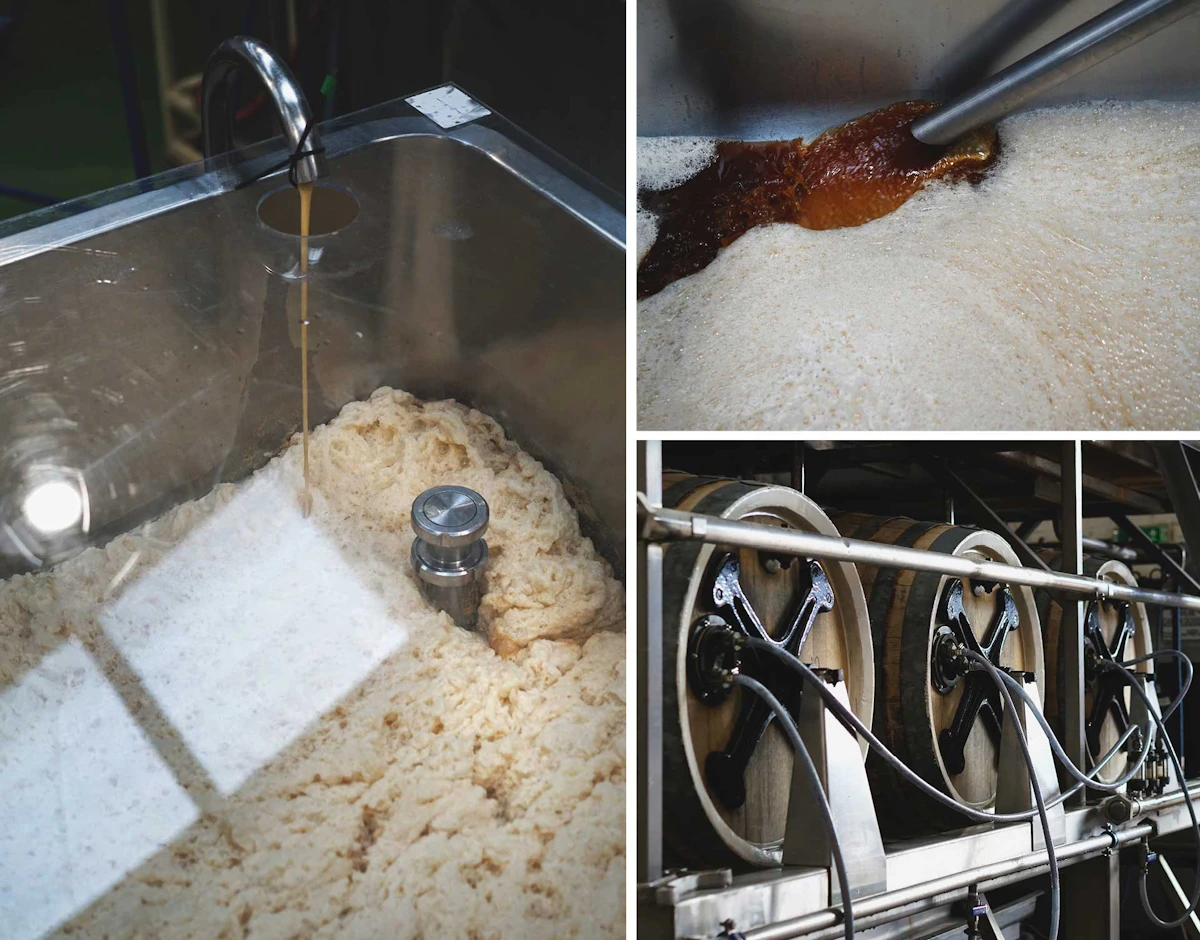
Thornbridge’s Burton Union system stands about 12 feet (3.6 meters) tall. Its steel frame forms a cage around six rotund oak barrels, arranged in two rows of three at its base; faded metal hoops bind together their staves, and the heads of the barrels wear black cast-iron crosses. A network of pipes protrudes from the barrels, leading to a pair of containers reminiscent of small coolships. At the side, a stepladder climbs to a small platform, where six swan-necked pipes stretch up and over into the two troughs. Here, the system collects wort and recirculates it through the barrels during the fermentation process.
The barrels are neutral and add no flavor. The point of the system, originally, was efficiency and consistency. It separated fresh kräusen from the beer while minimizing head space and keeping out spoilage bacteria. It also enabled a degree of temperature stability during fermentation.
This particular Union system was originally commissioned in 1898. At present, it’s the last of its kind still operating in the United Kingdom.
“It makes me very happy,” says Dominic Driscoll, brewing manager at Thornbridge. “Being part of the whole project of bringing the [Burton Union] in and coming up with recipes for it has revitalized my love for making beer in the first place.”
The Union system at Thornbridge was one of a pair that were rescued from being scrapped by its previous owner, Carlsberg. Formerly housed in Burton-upon-Trent at Marston’s Brewing, the Danish giant—which began its merger with Marston’s in 2020—announced in January 2024 that it would be “retiring” the four remaining systems in use at Marston’s. That led to a not-inconsiderable amount of outrage from British beer enthusiasts and commentators. “Here’s a memo to Carlsberg, purveyor of Eurofizz to the masses,” wrote Roger Protz, veteran beer writer. “Don’t dump on our proud ale heritage.”
Step in one Garrett Oliver. The Brooklyn brewmaster has strong connections at Carlsberg, which has been Brooklyn’s European distribution partner for several years. Oliver was able to convince Carlsberg that the Union sets deserved to be rehomed.
After a lot of work—much of it by Marston’s now-retired cooper Mark Newton—one of the two remaining unions found its way to Thornbridge. (That work also included a few modifications, such as an acrylic lid fitted to its upper troughs to keep out potential contaminants.)
The question is, why would a modern brewery like Thornbridge want to invest in the maintenance and upkeep of a piece of equipment that was developed more than a century ago? Sure, the optics are fantastic—who wouldn’t want to own and proudly show off a genuine piece of British brewing heritage? As a piece of brewing technology, however, it’s positively archaic. Because of its nature, this Burton Union system requires 42 hectoliters (or about 36 barrels) of fresh wort every two weeks. Otherwise, the wooden barrels that are inherent to what makes it so special will begin to fail.
“There’s something romantic about brewing a beer and then treating it in the same way as a beer might have been in the 19th century,” says Thornbridge cofounder Simon Webster. “Having that little bit of history that doesn’t exist anywhere else in the world? That’s too good of an opportunity to miss.”
Fermenting in the Union
The Thornbridge team doesn’t transfer fresh wort directly into the Burton Union.
Instead, they brew a big batch in the main brewhouse across the way and begin primary fermentation over there, in stainless. Then, after about 15 to 17 hours, they pump the fermenting beer to the taproom building. There’s no hard piping in place, so they run about 300 feet of hose down the small gravel pathway behind the brewery and taproom. After cleaning the Union, they pump over the 68°F (20°C) wort. Within minutes of cascading from the swan necks, kräusen begins to form in the collecting tray.
“We’re essentially mimicking what we saw at Marston’s,” Driscoll says, “where the wort was sent from the brewhouse to a collection vessel, and yeast was pitched and essentially allowed to get going in the lag phase, [to] use up the oxygen before being dropped into the Union sets. By doing this method, you also leave behind a good degree of unwanted sediment. It is a bit like the old German breweries and their flotation vessels.”
The system presents an interesting challenge, however: How to maintain a consistent fermentation temperature inside each of the six barrels? Because of the Union’s nature, different amounts of yeast are at work in each barrel. Their positioning also affects temperature—some, for example, are nearer to an open shutter, exposed to cooler air in winter.
“We had to modify the cooling a little bit due to the differences in temperature in each barrel,” Driscoll says. “There have been a number of challenges, including working out how to clean it safely. But now it’s singing its song.”
The solution was to use a buffer tank of cold water that flows through copper coils in each barrel, effectively working like compact heat exchangers. They aim to cap fermentation at about 72°F (22°C), and they typically let it run seven days before transferring to holding tanks ahead of packaging.
Drinking a Union Beer
Thornbridge brews to slightly different strengths for cask and bottle, Driscoll says. The batches for cask have a bit lower original gravity, to ensure they finish a little drier, lending them that key cask drinkability.
And let me add with enthusiasm: The Burton Union produces beers that demand to be drunk. On rare occasions, they’ll run a batch of their flagship IPA, Jaipur, through it. While the differences are subtle, they are most definitely noticeable.
Jaipur is notable for its rasping bitterness, notes of pithy orange, and the cracker-crunch of malted barley. From the Union, though, Jaipur takes on a softer character—as though its jagged edges have been gently rounded.
It’s not only Jaipur, though. The union definitely adds a noticeable softness to the beers it’s used to ferment. For Thornbridge, those now include two core beers exclusively produced using the Union: a 4.5 percent ABV pale ale called 1838—named for the year that Burton Unions went into use—and a robust English IPA of 7 percent ABV, simply known as The Union.
To ensure the Union and its barrels are fed every two weeks, Thornbridge alternates: One run will be a core beer, and the next a collaboration with enthusiastic peers. Several notable brewers already have visited Thornbridge to participate—including Doug Odell, who gave a version of his Scottish-style ale, Odell 90 Shilling, the Union treatment. Garrett Oliver, a regular visitor at Thornbridge, worked with Driscoll to develop Strong Dark Mild—a deep and delicious ale of 6.5 percent ABV; the country’s Brewer’s Choice Awards in 2025 named it New Beer of the Year.
The most recent invitee was Mark Slater, head brewer at Theakston in Masham, North Yorkshire. His visit was an opportunity to give the Union treatment to a genuine classic: Masham Ale, a strong, amber-colored English ale typically brewed for the winter months.
Theakston typically ferments in its open Yorkshire squares, with much of the beers’ character driven by a house yeast culture that is several thousand generations old. From the Union, however, the beer took on a different character, eschewing its typical banana-like esters for more malt richness and peppery hops.
It was more proof, if needed, that the Union has a direct impact on the flavor of the beers it’s used to produce.
“Thanks to Thornbridge, this is the only place in the world you can now brew on an original Union system,” Slater says. “It’s iconic. To be able to brew on it was an opportunity that was too good to miss.”
