

Latgale, the easternmost part of Latvia, is mostly gently rolling hills, forests, and lakes, but it also has a good sprinkling of farmland. Latvian farmhouse ale may not have received much attention, but here—right up against the Russian border—the farmers still make a powerfully smoked farmhouse ale using local yeast.
Latgale is somewhat different from the rest of Latvia. It had an earlier stint as part of Russia in the 16th century, and the people here speak a variant of Latvian that the rest of Latvia sometimes has a hard time understanding. Latgale also has a larger Russian population than the rest of Latvia—including a group known as the Old Believers, who broke away from the Russian Orthodox Church to escape religious persecution in Russia centuries ago. Today, the Russians in Latgale mainly make moonshine, while the farmhouse brewing is very clearly Latvian.
The Black Sauna
The area is known for its old traditions, one of which is the melnā pirts, or black sauna. Farmers used to retreat to these black saunas to cleanse themselves with hot baths; in Latvia, this developed into a ritual that could involve several cycles of heating and cooling, “whipping” with birch branches (really a form of massage), and much else. For the Latvians, sauna bathing was about purity, and it had religious overtones.
The Latgalian version is a two-story building in which the ground floor is the bathing sauna, with benches for people to sit. What heats it is the classic Nordic-Baltic sauna oven—just a pile of stones with room underneath for a fire and no chimney. That’s how it got its name: Smoke fills the room while the fire burns, and the walls turn pitch-black.
Like several other pockets around Europe, Latgale is smoked-beer country. The farmers brewed with their own barley, which they dried in the sauna after germinating and steeping. Their saunas included a small hatch in the ceiling, which they would open when drying the malt; that hatch allowed the smoke and heat to waft upward into the drying box (āznīca) on the floor above.
That box is similar to a såinn, or Gotland-style kiln: an empty box with a drying surface for the malt. Today, the surface is usually metal mesh or metal sheeting with holes. Just like in Stjørdal in Norway, the farmers here used alderwood for drying—its characteristic aroma is intense—although the Latgalians seem less insistent than people in Stjørdal that only alder be used.
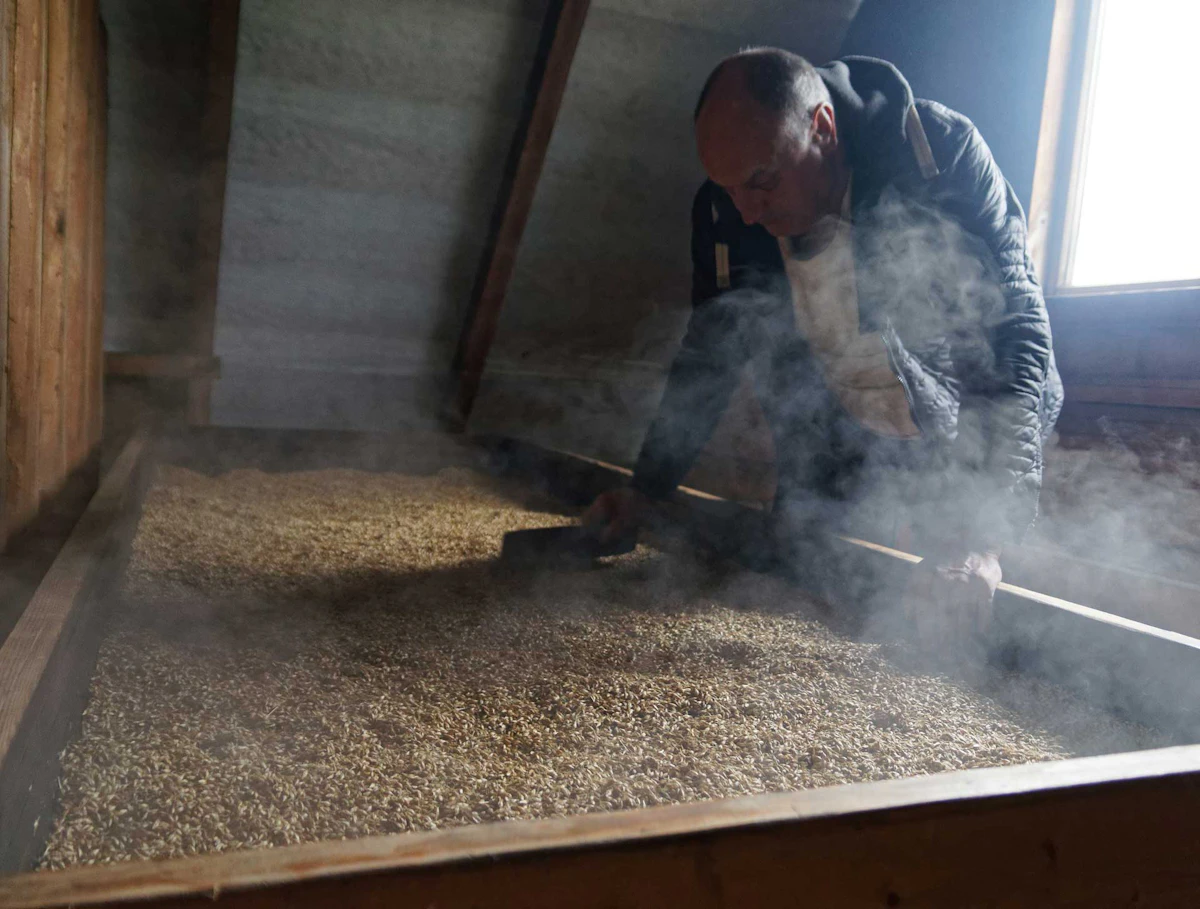
Dainis Rakstiņš kilns malt. Photo: Lars Marius Garshol.
Brewing Latgalian Ale
The brewing follows the classic raw-ale process: an infusion mash followed by lautering and cooling the wort, then pitching the yeast. However, unusually for a Baltic farmhouse tradition, quite a few Latgalian brewers apparently just let the hops soak in the mash instead of boiling a hop tea.
In the southern part of Latgale, it was traditional to brew stone beer—and that tradition is still alive, so the beer there remains slightly different. In other parts of the south, the brewers appear to have abandoned the smoky flavor, instead brewing something closer to the Lithuanian kaimiškas.
In most of the region, the traditional yeast culture appears to be lost. However, at least two brewers in the northern part, around Rēzekne, still have farmhouse yeast. Those cultures, as it turns out, also belong to the family of farmhouse yeast that includes kveik and Lithuanian farmhouse cultures. According to lab analysis, these Latgalian yeasts are mostly nonphenolic—but given how smoky the beer is, that may not matter much, from a flavor standpoint.
As with other farmhouse cultures, the Latgalians would pitch their yeast at around body temperature, and they mostly still do. Like kveik and similar cultures, the Latgalian yeast also ferments quickly. We visited one brewer whose wort-cooling was taking longer than usual, so he ended up pitching the yeast in the late evening, after we’d left. When we came back the next day at noon, the fermentation didn’t have much further to go.
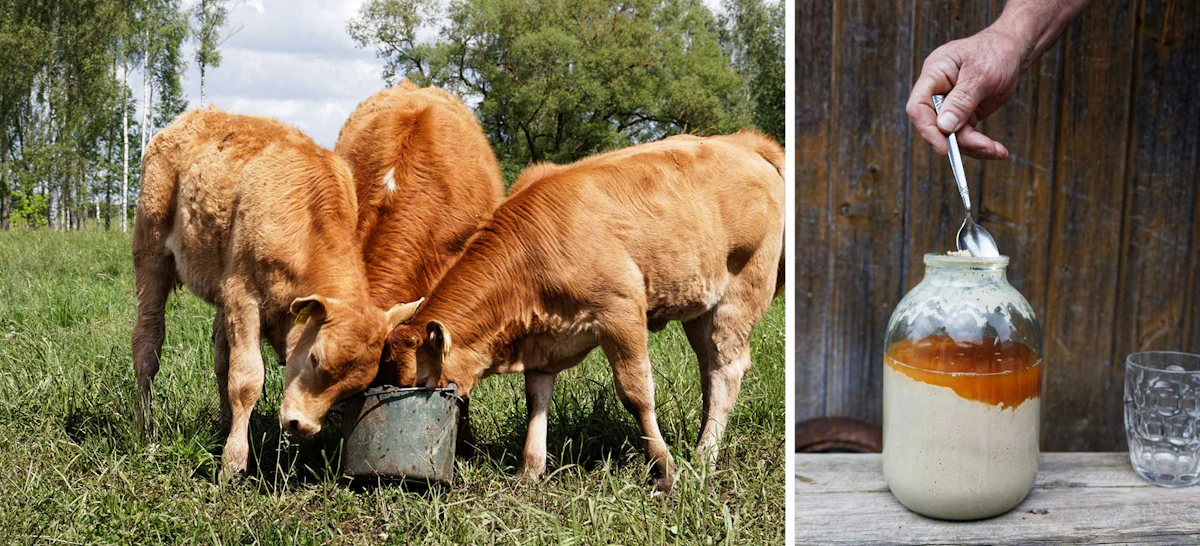
Left: Cows fight over spent grain and hops. Right: Their yeast culture came from a fellow villager two decades ago. Photos: Lars Marius Garshol.
Dark, Smoky Majesty
These Latgalian ales are massive smoke bombs dominated by that strong alder-smoke aroma—though perhaps not as intensely smoky as stjørdalsøl.
The reason for that is probably the greater distance from the fire to the drying surface, so the smoke passing through the malt is cooler and more dispersed. I’ve heard that some brewers use green, undried alderwood to make the smoke aroma stronger, so the intensity probably varies with the brewer’s personal preference.
The beer’s strength appears to be all over the place, with brewers using as little as 200 grams of malt per liter of beer to four times as much. For a five-gallon batch, that’s 3.8 to 15.2 kilos, or 8.4 to 33.5 pounds of malt. Assuming homebrew efficiencies, that could mean a gravity range of 1.042 to 1.166 (10.5 to 37.4°P), fermenting to ABVs that could range from 4 to 15 percent ABV. How much hops they use varies just as widely.
As for how it tastes, I’ve only been able to taste a single version—but, on the plus side, I enjoyed a couple of liters of it over the course of a week.
Dainis Rakstiņš lives in the village of Berzpils. His farm is on top of a hill, which is why it’s called Kolnasāta—“farmstead on a hill.” He uses a yeast culture he got from another villager more than 20 years ago, and he malts his own barley in his sauna. Even the hops grow locally, so Rakstiņš is that rarest of brewers today—a complete farmhouse brewer who doesn’t need to buy anything to make his beer.
And what a beer it is: a dark and majestic smoke bomb with an aroma dominated by alder smoke, but also with notes of fruit and minerals poking through. Once you take a sip, the second shock hits you: Yes, the beer is smoky, but it’s also very bitter. The deep, caramel-forward smoky flavor billows around you as a sharp, lasting bitterness pounds your taste buds… then, toward the end, a delicate blackberry fruitiness shines through as the crowning touch.
Rakstiņš says he’s aware that his beer is not for everyone—but this is how it is, take it or leave it. It’s definitely not a beer for novices.
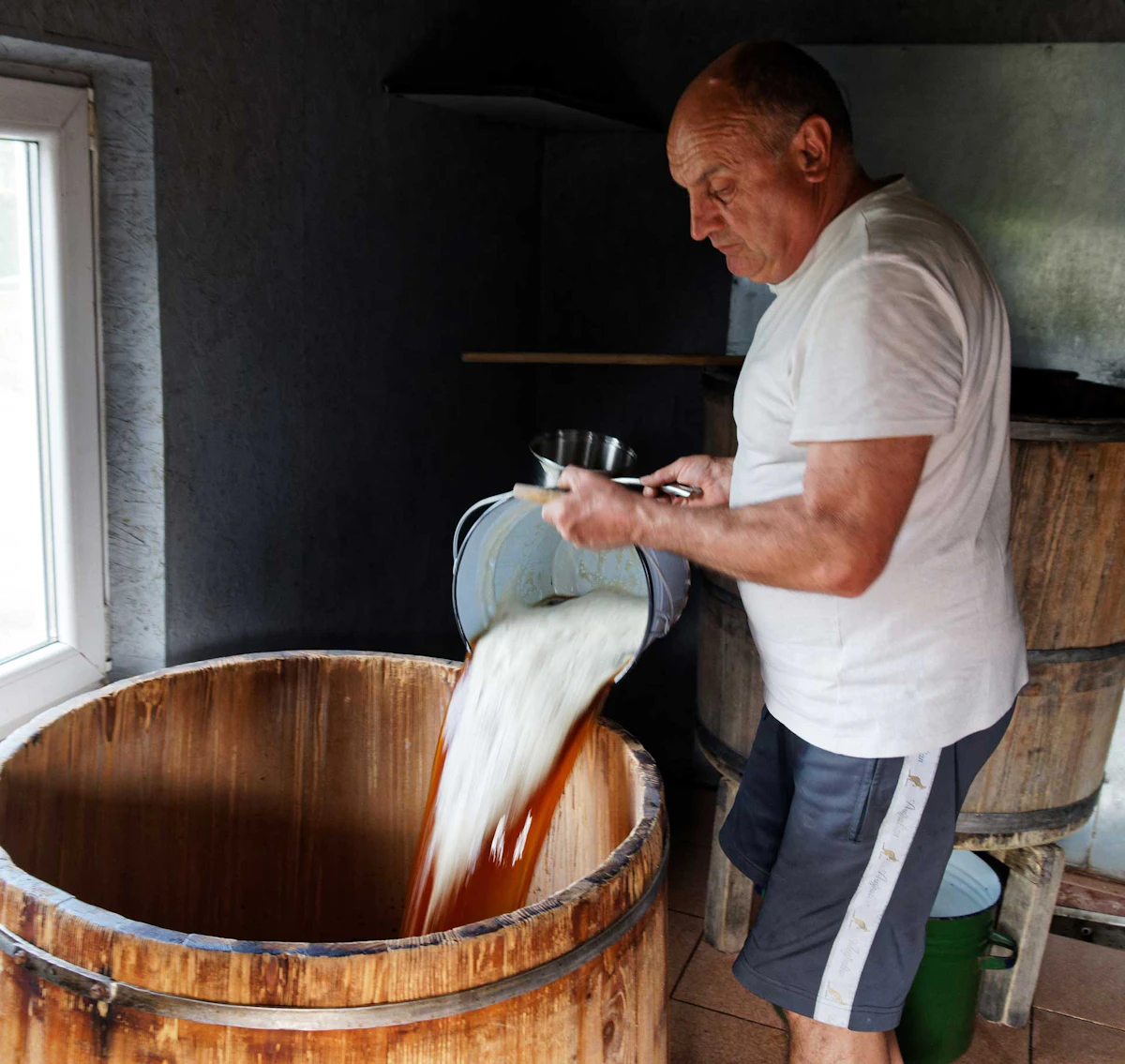
Moving wort from the mash vessel to the open fermentor. Photo: Lars Marius Garshol.
Next Stop: Latgale
It’s certainly possible to drink Latgale’s smoked beer today, but you’ll need to go there.
Together with his wife Ilona, Dainis Rakstiņš runs a small brewery called Mājas Alus Kolnasāta—or House Beer Kolnasāta—and they travel around to local events selling their beer in bottles. You can also buy it directly from the farm. You can even pay a fee to join a brew day there, an experience that I strongly recommend. (You’ll want a translator, though, to understand the brewer’s explanations.)
At the end of the brew day, there’s an extra treat: Dainis and Ilona take the spent grain, still mixed with lots of hops, out to the cows in the field. You wouldn’t think bitter, smoky spent grain would appeal to cows, but you’d be wrong. The cows know the drill—when they see the tractor approaching with the grain, they literally come running. The cows and calves immediately stick their heads in the buckets and start gobbling it up; once buckets start emptying, there’s some light scuffling over the remaining grain.
If a trip to Latgale sounds far-fetched, you could of course build your own black sauna, malt some barley with alderwood, pick some wild hops, and brew a version of this beer yourself. Escarpment Labs has sold the yeast in the past; it’s also available from the British National Collection of Yeast Cultures as NCYC 4542.
So, it’s definitely possible to try Latgalian smoked ale. But you have to really want it.
Can You Read Latvian?
Besides my visit to Latgale, much of the information in this article comes from archive documents that describe the farmhouse brewing through interviews done by the Latvian authorities in the 1930s. However, I haven’t managed to get them all translated. If you read Latvian and want to help by translating documents, please send me an email at larsga@garshol.priv.no. —Lars Marius Garshol
