

Jokes about cask ale aside, nobody wants to drink warm beer. Leaving aside medieval breakfast soups and festive flips sizzled by red-hot pokers, hot beer is not often enjoyed—either by humans or yeast.
Pitching temperature is a make-or-break point in the brewing process simply because most yeast are so sensitive to the environment in which they live, eat, and reproduce. Just ask any homebrewer without an effective chiller about all the ways off-flavors can develop during that transition from hot side to cold. Whether it’s oxidation, unwelcome organisms gaining a foothold, or the more delicate impacts of yeast health and metabolism, controlling the temperature of wort is crucial for quality—and that’s before vigorous fermentation begins in a temperature-controlled vessel.
“For us,” says Mark Fischer, brewery operations director at Firestone Walker, “the brewing process starts with making freezing-cold water.”
In the textbook example of a modern brewery, this crucial chilling process involves what looks like the most unexciting piece of stainless steel in the whole building: the cold-liquor tank, or CLT. Simply used to store cold water, the CLT is more important and impressive than it appears at first glance: It serves not only as a reservoir of water, but also as a reservoir of thermal energy.
It’s a key piece of what should be a highly energy-efficient system—a core node in the brewery’s network of thermal regulation.
Thermodynamics, but with Beer
Brewing, it turns out, is all about heat management. From the mash to the sparge to the boil, precise temperature control is required to consistently brew great beer.
Once the boil and whirlpool are done, the resulting wort is more than the sum of its grains, hops, and water. Coaxed along by attentive brewers, that wort also is a particular product of its hot-side processes—mash temperatures and times, boil length and vigor, various whirlpool choices. We’re investing thermal energy in the liquid—it’s a significant outlay—and we must protect the vulnerable wort. Then, we’ll invest a different type of thermal energy to cool the wort as quickly (and economically) as possible before handing it over to our cold-side yeast force.
Historically, brewers used a variety of methods to nudge along the cooling process. Coolships provided large surface areas for evaporative cooling—energy-efficient, sure, but also relatively slow. Once the wort drops below a certain temperature, it also becomes more susceptible to wild yeast and bacteria; today, we mainly associate these impressively large cooling pans with acidic Old World brews.
The Industrial Age produced other contraptions. In the 19th century, French inventor Jean Louis Baudelot created a cooling device for the brewing industry. In the Baudelot cooler, hot wort flowed downward over a copper plate while cool spring water flowed through copper tubes in contact with the plate’s reverse side. That cut down chilling times significantly, and many breweries adopted Baudelots or similar coolers. It’s sometimes called a falling film surface cooler, and various industries still use modern versions of the device today.
In the modern craft brewery, it’s the heat exchanger (HX) that makes hot wort cool. Be it a shell-and-tube variety or a plate chiller, heat exchangers leverage the same laws of thermodynamics as the Baudelot—namely, the first and second laws. (Those are: Heat lost by one fluid is gained by another, and heat flows from a hot fluid into a cold fluid.) The heat exchanger prevents the hot fluid and the cold fluid from mixing while keeping the temperature differential as large as possible by running the two fluids in opposite directions (hence, counterflow heat exchanger).
There’s as much math as you could want behind all those thermodynamics, but I’ll spare you the details. Suffice to say, there is a constellation of equations for calculating variables such as perfect flow rates and fluid temperatures to achieve almost any desired knockout temperatures for ales or lagers. Simplify this set of equations, and you’ll see the key variable is the temperature differential between the hot wort and the counter-flowing coolant.
And that’s where the cold-liquor tank comes in.
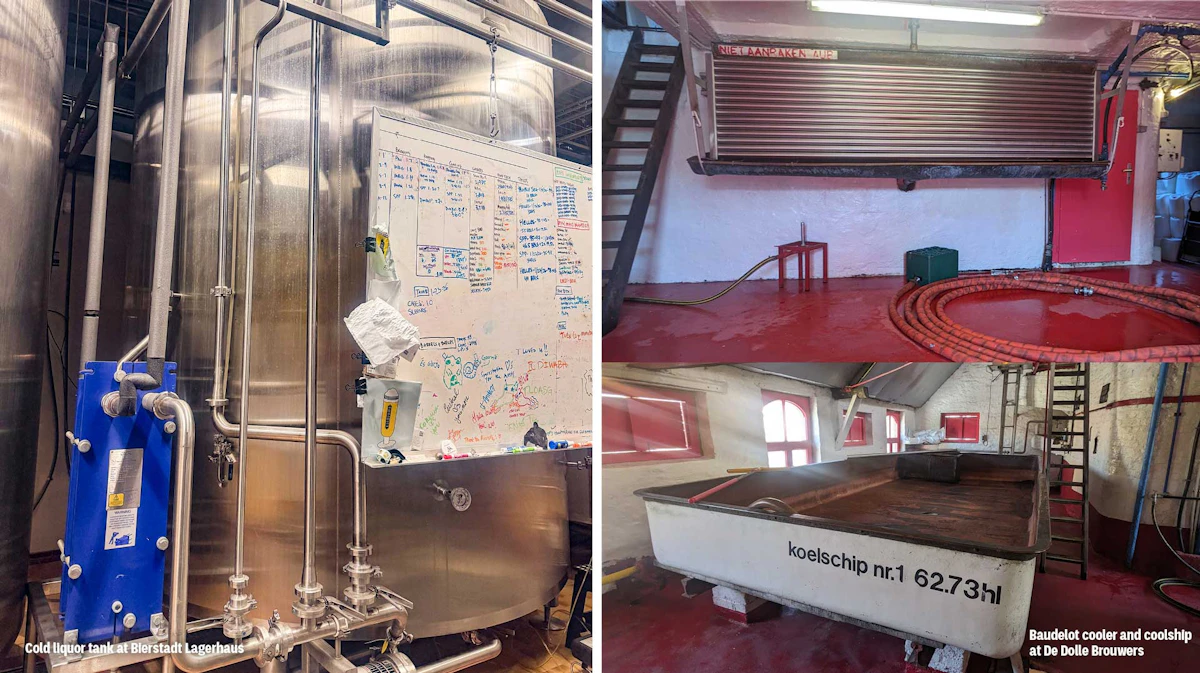
Photos from left: Ashleigh Carter; Joe Stange(2)
Cold as Ice
“I don’t know how we would brew beer without a cold liquor tank,” says Eli Facchinei, cofounder of Tonewood Brewing in New Jersey. “It’s super-efficient.”
Tonewood’s founders built efficiency into the brewery’s DNA. From solar panels to boil-kettle steam recapture to a system that recovers carbon dioxide from fermentations, the Tonewood team minimizes waste and adopts sustainable practices wherever possible. The CLT is just one part of the bigger picture.
Of course, there are alternatives to installing a space-hogging tun of water in the brewery.
“Now that I think about it, when I first started brewing in Telluride, Colorado, we didn’t have a CLT,” Facchinei says. “We were brewing with snowmelt.” In New Jersey summers, however, the municipal water supply can be 60°F (16°C). “You can’t knock out a lager with 60-degree water.”
The obvious alternative coolant for wort-chilling is the same fluid that handles the fermentation vessels and brite tanks in the cellar: glycol. Another quietly crucial piece of infrastructure mostly unseen on brewery tours, the glycol chiller is the practical application of modern refrigeration, unshackling modern breweries from climate and the seasons.
A compressor chills a reservoir of a propylene-glycol solution below the freezing point of water, and pumps send the glycol to jackets that encase the fermentation vessels. That allows tight control of fermentation temperatures, and it can also allow the quick chilling of hot wort. However—more thermodynamics—adding all that heat to the glycol during knockout can over-stress the chiller, causing the temperatures in the other cellar vessels to rise. To avoid that, a brewery might invest in an oversized (and expensive) glycol chiller, or it can disconnect the fermentors from the glycol loop during knockout for however long it takes the chiller to re-cool the reservoir.
“We tried using the tiny glycol heat exchanger that came with our system,” says Kirk Nishikawa, cofounder of Brewyard Beer in Glendale, California. “But it overloaded really quickly, and we didn’t have enough glycol capacity to handle the load. We actually destroyed our glycol chiller prematurely trying to use it as such. That’s when we realized we need a CLT of some sort.”
When icy-cold water from the CLT moves through the heat exchanger, the heat moves from the wort to the water—and, ideally, that now-heated water moves on to another humble vessel: the hot-liquor tank, or HLT. Its on-demand supply of heated water—used for mash-in and sparging—is crucial for speedy turns of the brewhouse.
That CLT-to-HX-to-HLT pipeline means that the brewery can further harness all that energy used to boil the wort, reclaiming that heat for the next batch. That’s particularly important for double batches or for production facilities with a brewhouse working around the clock.
Downsides and Alternatives
While the cold-liquor tank is a standard piece of equipment that becomes more important as production volume increases, it isn’t the best solution for every brewery.
There are downsides to adding a CLT to the facility and the brewing process; many craft brewers get along without one, either with workarounds or alternative systems that work better for their own systems.
The primary drawbacks of a CLT are twofold: up-front costs and the space needed on the brewery floor. Broadly, the latter downside is increasingly painful as the cost of real estate climbs. And while the purchase price for tanks isn’t excessive, it can be tempting for breweries-in-planning to save money by streamlining their systems and forgoing the CLT.
One workable alternative is to repurpose another vessel in the cellar as the CLT during brewing—that’s how Brewyard handled their brew days before they added a CLT. Nishikawa says it worked, but it was a logistical challenge that slowed down production—if they didn’t have an extra empty tank, they couldn’t brew. Any delays in the cellar would reverberate through the production schedule.
At Ambitious Ales in Long Beach, California, the team brews a mix of hazy IPAs and lagers on a CLT-less system.
“We finally got a real brewhouse in February 2024,” says cofounder Garrett Carroll. Before that, the brewery was a scrappy setup cobbled together from dairy tanks; using that ad-hoc system, they built a loyal neighborhood following. They’re currently brewing about 1,500 barrels a year and selling more than 90 of it out of the taproom.
For fermentation, they’re mostly pitching Fermentis SafLager W-34/70 dry yeast, which Carroll says has always handled warm pitching just fine. He says that knockouts take about 35 to 40 minutes on average and that an oversized heat exchanger gets wort temperatures below 80°F (27°C).
“We pitch at whatever temp we can knock out with city water,” Carroll says. “We’re pitching healthy yeast, and we haven’t seen anything weird.” This strategy works even better for breweries with access to cold well water or with a municipal supply that’s similarly chilled. The colder the water supply, the quicker the knockout.
Even among equipment suppliers, there are skeptics of CLTs. Among them is Marc Gottfried, manager of brewery design and sales at Crawford Brewing Equipment, based in Rock Island, Illinois.
“Most brewers don’t need a CLT,” he says, arguing that their ubiquity in breweries is traditional but unnecessary. “The only instance where you must have a CLT is if you are brewing with RO water.” His favored alternative, a two-stage heat exchanger, “saves thousands of dollars and lots of square footage,” he says.
By using a two-stage heat exchanger, you can first use municipal water to cool the wort—even if that water comes into the building at 80°F (27°C)—before a glycol line feeds the exchanger’s second stage. The two-stage units are slightly larger, somewhat more complex, and initially more expensive, but they can save cost and space compared to a big CLT.
The same two-stage principle can work with two single-stage heat exchangers operating in series. The first unit uses the water supply to get the wort mostly cooled—and to fill the HLT—while the second unit can be smaller, hooked into the glycol loop to handle the final drop in temperature without overly stressing the glycol chiller. It adds complexity, but the availability of used equipment could make adding a second HX an attractive alternative.
Be Gentle, and Chill
Still, CLTs have their advocates—even in smaller breweries. Among them is Carl Clements, owner of Bubba’s Barrels in Knoxville, Tennessee, and a builder of smaller-scale brewing systems.
“The CLT is underutilized in a small brewery,” he says—but he notes that it doesn’t have to be a jacketed stainless tank setup connected to the cellar’s glycol loop. “Anything you have is better than nothing.”
For example, you can use a brite tank or a plastic tote hooked up to a small auxiliary glycol chiller, or even “a stainless trash can in your cold room.” After all, small-scale craft brewers are known for their scrappy approach and innovative spirit, and the CLT is not what makes or breaks a beer—it just makes the process more efficient.
“Brewing is super resource-intensive,” says Tonewood’s Facchinei, “and there’s no way around that fact.”
As a brewery grows, there are more opportunities to become more efficient. Sometimes, it can be a big step that leads to a big impact—but it’s often easier and more realistic to tackle myriad small tweaks to process and equipment, with each adjustment moving the needle another little bit.
While CLTs may be unsexy—another stainless tank in a facility that’s full of them is nothing special—there is something elementally appealing about their usefulness. The idea that water is chilled slowly and cheaply so that it can absorb all the heat added to the wort in the kettle, storing that energy for the next brew, where the cycle starts again—that is satisfying to anyone who’s process-minded. It’s not the only way to knock out a batch, but it’s a simple and elegant one.
