

If it weren’t for Questlove, American brewers might never have heard of fonio.
In 2018, the Roots drummer hosted a Manhattan house party at which Brooklyn brewmaster Garrett Oliver found himself chatting with Senegalese-American chef and cookbook author Pierre Thiam. Just the year before, Thiam had cofounded Yolélé Foods with a mission to bring West African ingredients to American tables—beginning with a superfine, beige-colored grain called fonio.
Raising his voice over the ambient soundtrack, Thiam schooled Oliver on fonio’s cultural and culinary importance: West African farmers have grown it as a staple crop for at least 5,000 years, prizing its nutty flavor, versatility in cooking and baking, and ease of cultivation. A remarkably hardy grain, fonio requires no irrigation, fertilizer, pesticides, or fungicides, and it can grow in areas otherwise considered nonarable. Today, it’s still grown by small-scale family farmers—not quite 1,000 of whom supply Yolélé Foods.
Naturally, Oliver had a follow-up question: Could you make beer with it? In the years since, brewers have answered with a resounding yes.
Fonio’s Foothold
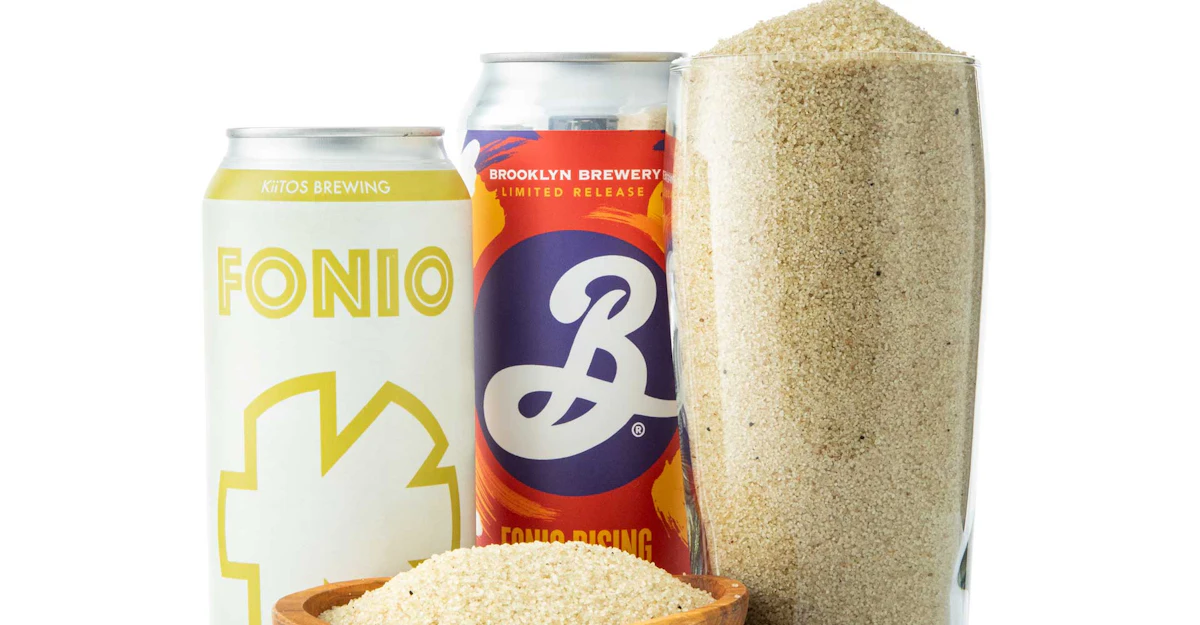
Brooklyn Brewery continues to be fonio’s leading advocate in beer, using it in a year-round pale ale called Fonio Rising as well as periodic one-offs.
Brooklyn also launched a global collaboration series to introduce the grain to other breweries, including Russian River, Guinness Open Gate, Thornbridge, and Carlsberg. Because of those collaborations plus its own beers, Brooklyn Brewery has become (as of early 2026) the largest buyer of fonio in the United States. Its total usage so far tops 10 tons.
However, fonio isn’t a global commodity. Challenges with agricultural and processing yields would make it difficult for larger breweries to reliably use fonio at scale. Yet it’s clearly proven viable at the craft scale: Both RahrBSG and Country Malt carry it, and—at last check—more than 200 beers listed on Untappd have a name that includes “fonio.”
It’s one of those rare brewing ingredients that can generate excitement beyond a narrow subset of technically minded drinkers. The general public can readily grasp fonio’s story, and they can appreciate its flavor. In food, such as pilafs or chips, people typically perceive fonio as nutty. When used in the grist, however, its tasting notes expand to include lychee, white grape, mango, and sauvignon blanc—appealing flavors that can fit with modern hops. Fans describe it as a miniscule grain with enormous possibilities.
However, the grain comes with some technical considerations for brewers. Its small size—almost sand-like, at less than a millimeter in diameter—demands additional attention to water absorption and mash filtering. Fonio available outside Africa is typically dehusked; it also lacks barley malt’s enzyme package and tends to lower a beer’s pH. For all those reasons, brewers generally keep fonio to a minority of the grain bill—anywhere from 15 to 35 percent. (Using a mash press and enzymes, at least two brewers have pushed the envelope to 100 percent—more on that below.)
The grain is remarkably versatile, and brewers are finding roles for it in lagers and IPAs, saisons and stouts. To make the most of it, however, it helps to know more about its unique character and how that plays with other ingredients.
The Flavor Thumbprint
Oliver receives so many questions about fonio that he’s developed an informal FAQ document that he happily shares with curious brewers.
The document outlines Brooklyn’s approach of using fonio at roughly 15 percent of the grist. At that amount—regardless of yeast strain—its signature qualities are already apparent. Those include the aforementioned fruity aroma and flavors as well as what Oliver describes as a “soft, round, silky mouthfeel” and a “clipped, focused” bitterness akin to sake’s amino acid–derived bitterness.
He evangelizes about fonio with the fervor of a true believer.
“The fonio that we’re using, from Yolélé, is very easy to use in brewing,” he says. It’s already been de-hulled, so it requires no milling. It’s also been pre-steamed, so the starch is already gelatinized and ready to convert. Extraction clocks in at an average of 71 percent, not much lower than most malts (often around 76 percent). Brooklyn’s brewers usually add fonio during the mash’s final saccharification rest, finding that they derive maximum aroma and flavor that way. (If your rest is long—say, a full 40 to 60 minutes— Oliver recommends adding fonio for the last 20 to 30 minutes.)
“I’m not really hearing about technical problems,” he says. “People find it very easy to use.”
Others share his faith. Brewers report few, if any, technical problems related to fonio, particularly as a minority component of a grain bill. At less than 30 to 35 percent of the grist, it may not require rice hulls—though some breweries use them as insurance against stuck mashes.
Even at low percentages, there are tangible impacts on aroma, flavor, and texture. When Atlanta’s Creature Comforts and Our Culture brewed their Fonio Lager with the grain at 20 percent of the mash, its tropical-fruity aromas pervaded the entire brewhouse—and they translated just as clearly into the final beer. To improve filtration and help break down beta glucans, the brewers also added rice hulls and the brewing enzyme Laminex to the mash. (As part of Creature Comfort’s Brew for One initiative, proceeds from that beer benefited the Michael James Jackson Foundation, founded by Oliver.)
“You’re only limited by the edge of your imagination when utilizing this grain, and all it takes is your ability to try,” says Isaiah Smith, CEO and cofounder of Our Culture.
Smith and Jossette Footman-Smith—his wife and fellow Our Culture cofounder—had previously homebrewed batches of fonio lager and saison using up to 30 percent of the grain in the grist. Their advice:
- Homebrewers should consider a brew-in-a-bag setup because of the grain’s sticky, fine nature—“like grits times four,” Footman-Smith says.
- They recommend using 50 percent more mash water, to help offset the high absorption rate.
- Rice hulls are “a must,” and enzymes can help if your system has a propensity for stuck mashes.
However, they characterize those as minor considerations with a worthwhile flavor payoff that’s unusual for any grain. “Look at it as an opportunity to paint with a brush that you’ve never had before,” Smith says, “in a space where there is not really another viable innovation lever for flavor and aroma—not at this level.”
Vinnie Cilurzo, owner and brewer at Russian River in Windsor, California, agrees that fonio’s vinous, lychee-like contributions defy what most people—brewers and drinkers alike—expect from malt. A Belgian-style blonde ale brewed with 30 percent fonio has become a semiregular beer at Russian River’s taprooms—particularly during the warmer months, when its lean body and bright fruitiness feel especially appropriate.
Cilurzo says it doesn’t take much fonio in the grist for it to have an impact. “My advice: You don’t have to go all the way to 30 percent,” he says. “Fifteen to 20 percent will also leave a thumbprint on the beer.”
He says the Russian River team is planning to brew pilot batches with up to 50 percent fonio, potentially adding barley hulls in place of rice hulls. “If we’re going to do it, we’re going to make it impactful,” Cilurzo says. “I’m curious to push the limit even more.”
Take It to the Limit
One brewery that’s already pushing fonio to its utmost limits is Salt Lake City’s Kiitos.
In January 2025, Kiitos became the first U.S. brewery to release a beer made with a grist of 100 percent fonio. (Denmark-based Carlsberg brewed a 100 percent fonio beer in collaboration with Brooklyn in July 2024.)
When Kiitos brewing director Patrick Bourque first heard about the grain, he thought it would be a logical ingredient to try—Kiitos has a mash press and had previously brewed a beer from 100 percent millet. Since brewing the all-fonio beer (simply named Fonio), he’s also incorporated the grain into IPAs and sour beers, and he has notions of brewing a strong, barleywine-style beer entirely with fonio.
Kiitos Fonio has a starting gravity of 12°P (1.048) and finishes out to about 5 percent ABV, but not much else about the beer is conventional. Fonio is technically a type of millet; like other millets, it’s gluten-free. Kiitos brews other gluten-free beers, and Bourque says he wants those to taste “like beer.” Not so with Fonio. “I don’t want anyone to try this and expect a beer,” he says.
The finished product is crystal-clear with a fruity dryness that evokes sparkling white wine more than anything else. Because of the huge fruit aromas and flavors, Bourque says fellow brewers can’t believe there are no hops and no thiolized yeast involved.
While brewers don’t necessarily have to forgo hops altogether, the grain’s character does provide an opportunity to reduce them—perhaps offsetting fonio’s cost of about $2 per pound. Even in beers that use fonio at small percentages, brewers say they find they can reduce hop usage substantially.
The Our Culture–Creature Comforts Fonio Lager got 44 pounds of hops for 60 barrels of beer—just a small bittering addition and the rest in the whirlpool. (That scales down to about 1.9 ounces/54 grams for a five-gallon/19-liter batch.)
“I’m able to derive this flavor profile of a Hallertau Blanc or something like that, and I use an ingredient that costs $2 a pound to get there,” says Our Culture’s Smith. “So, that’s the way you think about the economics. Your cost of ingredients may go up at the item level, but the overall batch cost is lower.”
Brewing an all-fonio beer without a mash press would be challenging. However, Cilurzo at Russian River sees potential for higher levels of fonio—including beers that are gluten-free or gluten-reduced, offering unique textures and flavors that can appeal to those who often prefer wines or cocktails to beer.
“When I had the 100 percent fonio beer from Kiitos, I thought, ‘This could be an alternative to a seltzer while still staying true to yourself [as a brewer], if seltzers aren’t your thing,’” Cilurzo says. He also muses on the potential flavor combinations that might be found by adding fruit to an all-fonio beer. “It struck me as a way for a brewery that does have a mash filter to make something really unique.”
To get the seltzer-like profile of its all-fonio beer, Kiitos adds a combination of amyloglucosidase and pullulanase enzymes to cleave the more complex dextrins and help dry out the beer. Even so, the beer goes through what Bourque calls a “glucose stall,” when fermentation slows over the course of its few final days, ultimately finishing slightly higher than a more conventional beer would. Nutrient additions don’t seem to affect that tendency, and it’s never led to refermentation in the package.
Bourque also notes that acidity can be a concern in all-fonio beers. Without buffering— Kiitos uses calcium carbonate—the beer’s pH can threaten to drop below 3. There’s another notable attribute that both Bourque and Cilurzo mention: Fonio appears to have very low to no free amino nitrogen—a real boon to shelf stability.
The Fonio Call to Action
Kiitos uses the grain in other beers, including an IPA with a grist of 50/50 pilsner malt and fonio, hopped with Citra and Vera. Bourque’s growing experience with the grain has made him another resource for fonio-curious brewers.
“Mostly when people reach out, they’re curious about the flavor profile,” he says. “The sauvignon blanc thing nails it on the head. For us, that’s pure fonio. As far as what it brings to an IPA … I don’t know where the hops end and where the fonio begins, but there is a tropical passion fruit–guava thing that’s very complementary.”
There’s still a lot that’s unknown about why fonio presents like it does in beer. How can this nutty cereal express as wine-like and tropical once it’s brewed? Cilurzo hypothesizes that some sort of biotransformation could be at work, but no one is certain yet. Research on the grain’s brewing properties is still scant, though brewers of all sizes are eager to try it. As fonio becomes more widely used, particularly by larger breweries, no doubt those studies will follow.
Still, the best way to grasp this tiny grain’s huge potential is to simply taste it. Our Culture, Brooklyn, and Russian River have all done some version of fonio beer-and-food pairings to drive home how divergent its flavors are in those varied applications. A fonio beer alongside fonio fritters, croquettes, chips, grits, or even soup presents guests with a memorable sensory lightbulb moment they’re unlikely to have encountered before.
Rarely does a totally new, impactful brewing ingredient come along—particularly one that’s simple for the general public to grasp. Fonio’s fans among brewers make the case that the grain is sustainable, economically empowering, exciting to drinkers, and—most importantly—delicious.
“The call to action here is that there’s not a lot of research on this grain,” says Smith at Our Culture. “There’s not a lot of funding for research on grain. So, let’s adopt it and change that. It’s never going to 100 percent replace barley, so I don’t think we should be looking at this as an opposition to the current infrastructure so much as an evolution of opportunity and of innovation.”
