

Ask a craft brewer about their sustainability commitments, and you’ll hear a lot about local sourcing, grain-to-glass efficiency, and spent-grain composting. What you hear less about is what happens to the ring of plastic holding together four cans of their flagship IPA after the beer is gone.
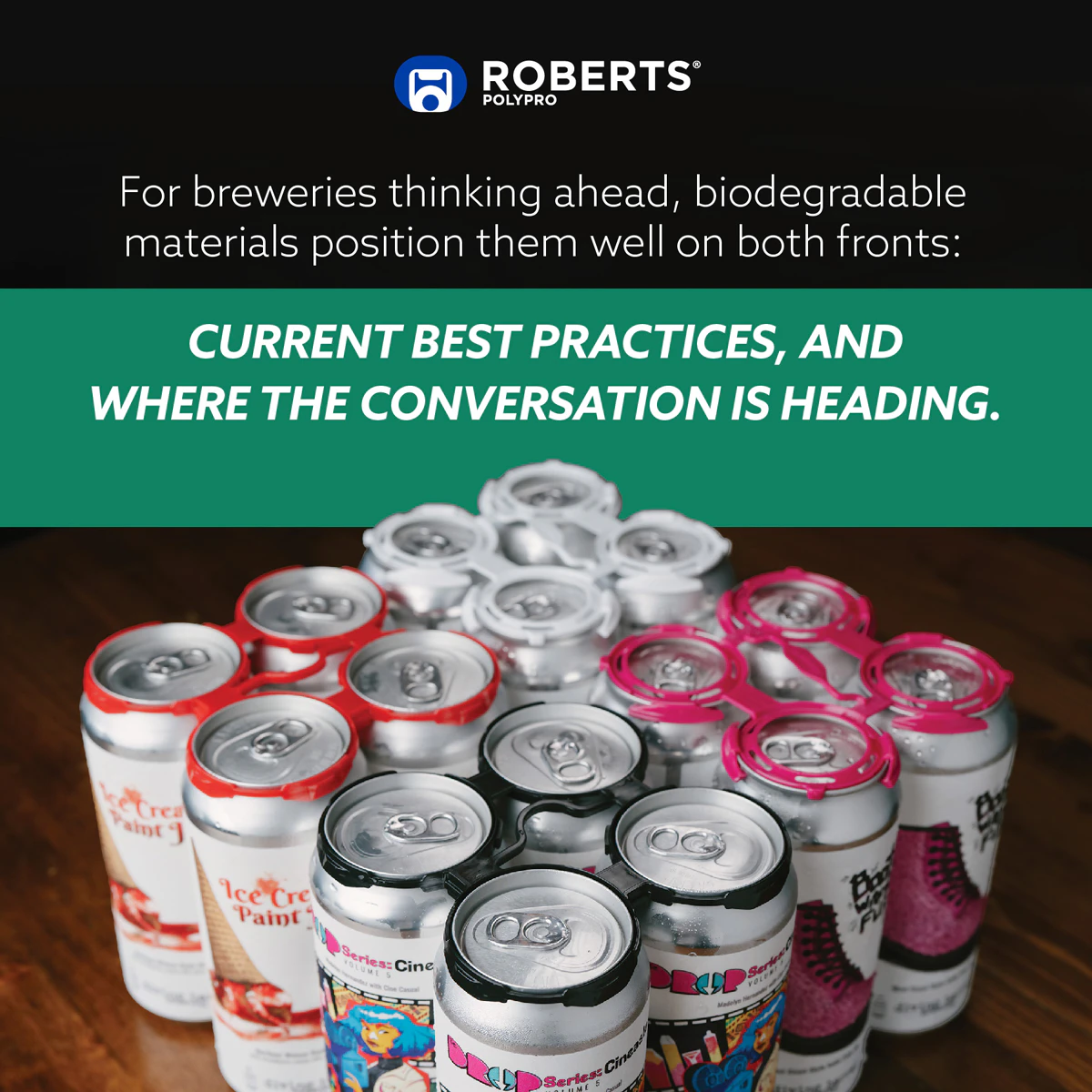
That’s starting to change. As environmental scrutiny on packaging intensifies and consumer expectations rise, a growing number of beverage brands are adding a new class of solution to their sustainability toolkit: biodegradable handles. These go a step beyond recyclable or reduced-plastic options by being designed to break down completely after disposal.
It’s a shift that’s been years in the making, and the companies leading it say the biggest misconception in the market is that going bio means making tradeoffs on performance. The data are beginning to tell a different story.
Recycling Gets You Far. Biodegradable Gets You Farther.
The recycling habit that consumers and brands have built over the past few decades is genuinely valuable. Reduce, reuse, recycle: That hierarchy still makes sense, and recycling programs have diverted enormous amounts of material from landfills.
But for beverage packaging specifically, recycling works best as one layer of a broader sustainability strategy, not the whole answer.
Plastic multipack carriers are recyclable in many municipalities, and plenty of consumers make the effort. That said, recycling infrastructure for can multipacks is inconsistent across regions, meaning not every carrier that goes in the bin actually gets processed: some end up in the landfill.
Even plastics that are successfully recycled can take a very long time to fully degrade after their useful life is over, which leaves open the question of what happens at the end of that cycle.
Microplastics have emerged as one of the defining environmental issues of the decade. These fragments, often invisible to the naked eye, are increasingly present in natural systems. For an industry whose products are often enjoyed outdoors—at rivers, lakes, and shorelines—minimizing any contribution to that issue is both an environmental good and a brand responsibility.
Regulatory attention to packaging is also growing. Several states and countries have moved to update standards around plastic multipack carriers, and industry observers expect that trend to continue.
What Biodegradable Actually Means
Biodegradable is a term that gets thrown around loosely in packaging marketing, so it’s worth being specific about what it means when applied to multipack carriers. True biodegradable packaging is engineered to break down through microbial activity in real-world conditions, including landfill environments, without leaving behind persistent fragments.
This is fundamentally different from materials marketed as “compostable” (which often require industrial composting facilities to degrade properly) or simply “made with recycled content” (which says nothing about what happens after disposal). Roberts PolyPro has built our biodegradable product line around this distinction.
Our complete line of biodegradable handles is certified to break down in landfill conditions, with independent third-party testing showing that our LDPE and HDPE handles fully biodegrade within 28 and 56 weeks, respectively. The testing protocol was designed to eliminate both false positives and false negatives, meaning the results reflect actual degradation, not a technicality.
That kind of verified, real-world performance is increasingly what buyers, sustainability officers, and retail partners want to see when evaluating packaging claims.
Performance on the Line: The Other Half of the Equation
For production managers and packaging engineers, the environmental backstory matters, but it can’t come at the expense of line performance. Multipack handles must work reliably at production speeds, hold up through refrigerated distribution, and arrive on the shelf looking like they belong there.
This is where biodegradable multipack carriers have historically faced skepticism. Early iterations in the category had real limitations around tensile strength and heat stability, which made them impractical at scale.
That’s largely no longer the case. Modern biodegradable handles engineered for multipack applications are designed to match conventional plastic on the performance metrics that matter, including:
- Grip strength
- Resistance to tearing
- Compatibility with standard multipacking equipment
- Durability across temperature variations in the cold chain
Savings in Materials and Costs
Roberts PolyPro’s biodegradable handles, for example, use up to 50 percent less plastic than competing plastic handles, while maintaining the strength and rigidity needed for multipacks. By reducing the material used while maintaining quality, beverage companies gain a cost advantage as well, with potential savings up to 25 percent for HDPE handle formats.
For craft breweries already operating on tight margins, saving on packaging that aligns with the sustainable positioning their clients expect can make real bottom-line differences that further their brand in the market.
The ESG Angle: Sustainable Packaging as Brand Architecture
Younger beer consumers, particularly the millennial and Gen Z cohorts driving growth in craft, are increasingly making purchase decisions that reflect environmental values. A craft brewery that can speak credibly about what happens to its packaging after the beer is consumed is telling a different story than one that can’t.
For larger regional breweries and those with distribution agreements that carry Environmental, Social, and Governance (ESG) reporting requirements, biodegradable packaging also provides a tangible, documentable metric. It’s easy to say you’re committed to sustainability. It’s more credible to point to third-party verified materials with measured biodegradation timelines.
The circular economy framework assumes materials will eventually re-enter natural systems cleanly. Recycling advances that goal meaningfully, and biodegradable packaging takes it a step further by ensuring packaging that never makes it into a recycling stream will still break down without leaving a lasting footprint.
What to Look for When Evaluating Bio Carriers
Not all biodegradable claims are created equal. Breweries considering a switch to bio multipack carriers should ask the right questions of any supplier:
- Is biodegradability verified by an independent third party? Look for testing that follows recognized standards and rules out false positives.
- Under what conditions does the material biodegrade? Landfill-condition biodegradation is most relevant to real-world outcomes because most packaging will end up in landfills regardless of consumer intent.
- What is the timeline for degradation? A material that breaks down in 28 to 56 weeks behaves very differently environmentally than one with a 10-year degradation window.
- Is the product compatible with your current multipacking equipment? Switching to bio should not require a major capital equipment overhaul.
- Does the material produce minimal residual microplastics as it breaks down? This is the crux of the environmental benefit and should be part of the testing documentation.
A Practical Next Step
The path to biodegradable multipack carriers doesn’t have to start with a full line conversion. For most breweries, the practical entry point is a direct comparison: test a run of biodegradable handles on a single SKU, measure performance against your current carrier, and get eyes on the cost differential.
Roberts PolyPro has been manufacturing multipack handles for decades. We offer biodegradable options across our full product line and work directly with breweries to match handle specifications to production equipment and package formats, making the evaluation process low friction.
Recycling will always be part of the packaging conversation, and rightly so. Biodegradable materials build on that foundation, covering the gaps that recycling can’t always reach. For breweries that want their sustainability story to hold up under scrutiny, packaging that breaks down completely after use is a powerful next chapter.
Ready to see the difference for your production line? Contact Roberts PolyPro today to test our biodegradable handles on your next run, using your own equipment or ours, or to order your free samples.