

“If you want to make a pilsner, you need a decoction,” says Bogdan Tochka. “Decoction is very important to get the Czech-style taste. With decoction, you have a full body, but without caramel colors and taste. Not all people can taste this, but it is important that we perform a decoction.”
Tochka is cofounder of Mova Brewing in Dnipro, Ukraine, and he is uncompromising about the company’s Czech-style pilsner. That dogged approach is clearly working: Mova Pilsner won the gold medal in the Bohemian-Style Pale Lager category at the 2025 European Beer Star competition, beating out Czech, German, American, and other top lager brewers from around the world.
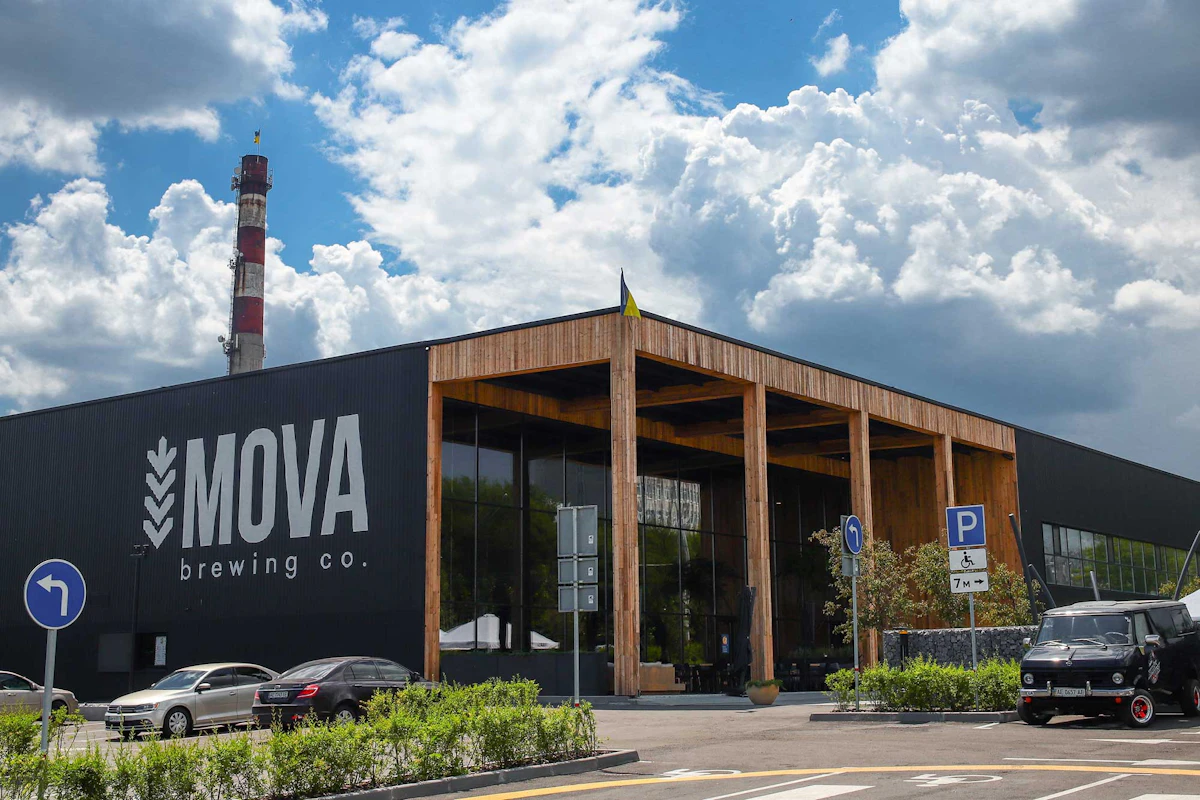
The win is an illustration of how brewers in war-torn Ukraine are working as hard as ever. Dnipro is roughly 60 miles from the front lines. Previously a contract-brewed brand, Mova opened its own modern brewery in Dnipro in 2021. Russia invaded Ukraine the following year, and Russian drone attacks and missile strikes on the city have been regular occurrences ever since.
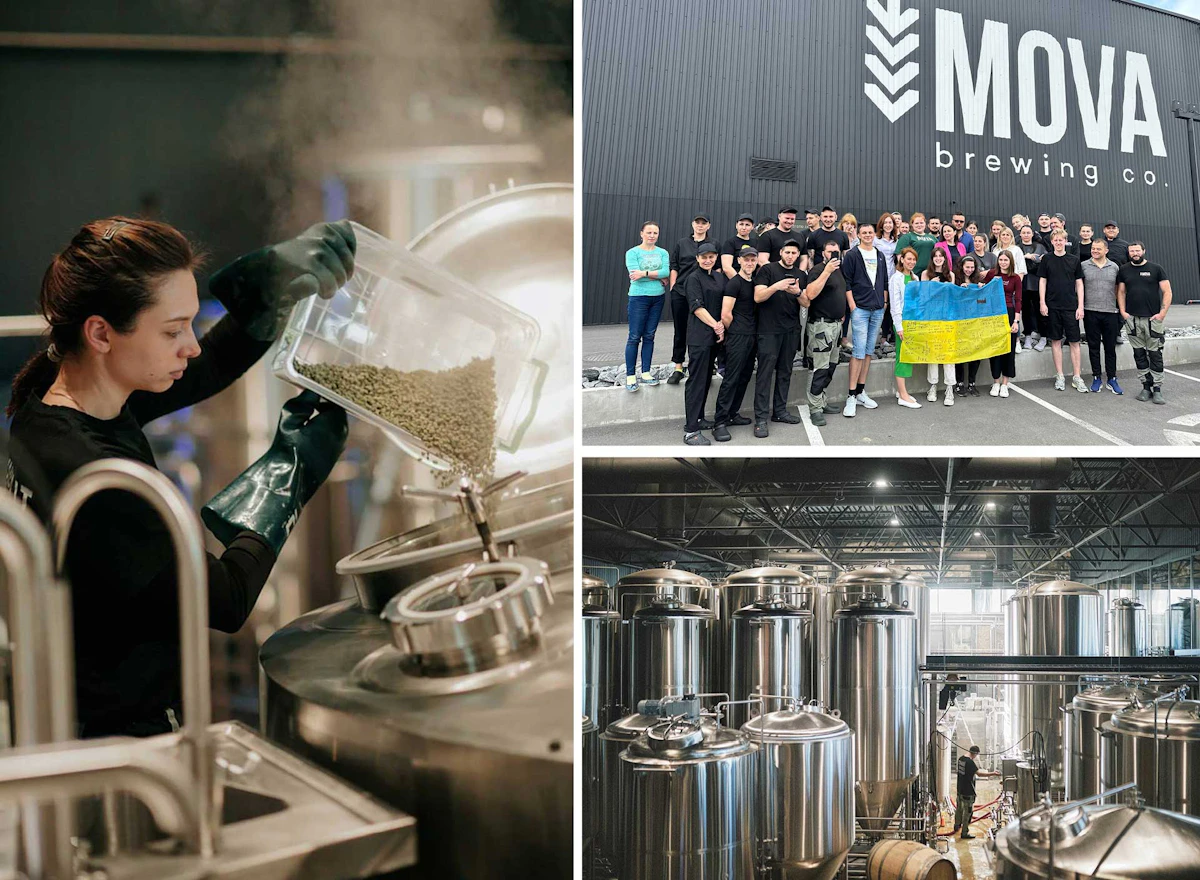
Mova, meanwhile, continues to brew while embracing a mission to foster connections within its community. Among other activities: The brewery hosts an annual two-week festival of music, food, and beer; it supports brewing courses at the local university; it published a book on brewing history in the region; and it supports a local brewing museum. Through various collaborations, Mova also has helped raised funds to support Ukrainian troops on the front lines.
Mova brewmaster Daria Bandura studied in Odesa, earning her bachelor’s and master’s degrees in fermentation engineering. While the medal is no doubt a source of pride, Bandura says the brewery doesn’t enter competitions for the marketing boost.
“We don’t build our company around the awards,” she says. Instead, the brewery uses competitions to get professional feedback on its beers. “This helps us understand how to make our beer even tastier.”
Mova Pilsner’s win at the European Beer Star, incidentally, marked the first time the brewery had submitted the beer to an international competition.
Czech Inspiration
Mova started in 2017 when Tochka and two friends wanted to open a brewery—Tochka says he had the time but not the money, while his partners had the money but not the time. So, he traveled around Ukraine and brewed on different equipment, figuring out what he wanted in Mova’s own system.
“After three years of contract brewing, we built our brewery,” he says. Mova’s lineup of beers is modern and diverse, including amber ale, witbier, oatmeal and vanilla stouts, and IPA. The Pilsner, however, is traditional through and through, and the four-vessel brewhouse has no problem handling Mova Pilsner’s single decoction.
Czech-style pale lager is what Tochka wanted to brew from the start. “Czech pilsner is more complex and full-bodied,” he says. The team toured Czechia to visit breweries and develop their own process and recipe.
“We visited not only the big historic breweries, but also little village breweries,” Tochka says. “When the Czech people are brewing beer, they are not putting too much of an emphasis on it. It is just easy thinking because the father brews beer, the grandpa brews beer. In the Czech Republic, this is normal.”
One thing they learned is that oxygen isn’t the same kind of enemy to Czech pale lager that it is for other beers. “We usually fight against oxygen,” Tochka says, “but in Czech pilsner, a little bit of oxygen is nice.”
Originally, Mova used an open fermentor that was dedicated solely to the Pilsner. When the kräusen would start to slow down, the team would transfer the beer to a conical tank. However, the Pilsner that won European Beer Star gold fermented in conicals rather than open tanks—the brewery has recently moved away from open fermentation to more easily meet strong demand for the beer.
“Our open fermentors can only make 120 hectoliters per month, but the people need 200 to 300 hectoliters per month,” he says. The role of oxygen was more pronounced in the open-fermented lager. “It made the beer a little darker and gave it some caramel notes,” Tochka says. When the brewery moved away from open fermentation, they slightly increased the amount of Munich malt in the beer to compensate for that loss of richness.
Exacting Standards
While Mova Pilsner gets some Ukrainian-grown Magnum hops for bittering, the flavor additions are strictly Czech Saaz.
“Magnum is responsible for a soft, delicate bitterness,” Bandura says. The Ukrainian hops come from the Zhytomyr Oblast, west of Kyiv.
Ukrainian hops are becoming more accessible, Tochka says, despite the country’s largest breweries buying up most of the supply; he estimates that craft beer is only about 2 percent of the market.
Still, Tochka says he doesn’t envision a time when they might replace Saaz with a Ukrainian variety. “If you make pilsner without Saaz, it’s not pilsner,” he says. “I can see in the future a great beer with all Ukrainian hops, but it is not pilsner, it’s Ukrainian beer.”
To select their Saaz, the brewery works with its Czech supplier to get samples of hop lots sent to Dnipro to evaluate. “We buy a five-kilogram pack from the supplier, and we boil water with a cup of hops,” Tochka says. “If the end result is nice, we will buy a larger quantity.”
The beer’s grist is currently 88 percent pilsner malt and 12 percent Munich. “With one-step decoction and a little bit of Munich, it adds complexity,” Tochka says. “With two or three decoctions, you can use only pilsner malts.”
Mova sources both those malts from within Ukraine—Tochka says it’s important to support the country’s economy. Supply disruptions have become common during the war, so Tochka says they use more than one Ukrainian supplier to ensure they’ll have enough malt.
They ferment the Pilsner with Fermentis SafLager S-189, initially at 55°F (13°C) for about a week. Once the gravity has dropped to 5.3–5.7°P (1.021–1.022), they raise the temperature for a diacetyl rest. The team then lagers the beer for three weeks.
The Hovering War
Mova has redundant sources of power, necessary because of occasional power outages as Russia continues to target Ukraine’s infrastructure.
“When the Russians attacked our electrical system, we had blackouts,” Tochka says. “We bought a solid-fuel steam generator, so when we don’t have electricity, we use that and a diesel generator to continue.”
The war’s looming presence is something that people in Dnipro feel daily. Some people have left, Tochka says, while others who lived closer to the front lines have moved into the city.
“Our brains are a bit crazy but have adapted to the constant air raids,” he says. Last year, a Russian missile destroyed a neighboring business.
“Every person feels it. Everyone understands that this could be our last day. We understand that we cannot stop.”
