
New Growth Equation: Meeting Demand with the Lean Brewery Mindset
Growth in 2025 doesn’t look like it used to. In this webinar, we’ll explore what it takes—from SKU discipline to data visibility—to expand with confidence in today’s market.
Joined by Toppling Goliath Brewing Co., Encompass Technologies, and Bump Williams Consulting, the conversation will take a look at data and what it takes to adapt production strategies, pursue diversified portfolios and leverage technology to unlock growth.
Topics covered:
- Copacking in today’s market conditions
- How to know when you’re ready to expand
- Role of data in planning launches or retiring SKUs
- Operational considerations
- Category expansion stories
- Pitfalls to avoid when stretching your portfolio
Participants:
- Amy Taylor – Toppling Goliath Brewing Co., Quality & Process Engineer
- Brian “BK” Krueger – Bump Williams Consulting, VP Business Development & Portfolio Strategy
- Nate Tarantino – Encompass Technologies, Product Director
To learn more or speak to an expert, click here.
The Lean Brewer’s Data: Unlocking Copacking for Category Expansion
The lean and agile brewery relies on data to make growth-based decisions. Given today’s market trends and consumer preferences, that operational data could reveal that the smart path of growth is investing in copacking and venturing into popular beverage categories.

Before a beverage hits the shelf or makes it into someone’s weekend cooler, big decisions are made. Agile brewers don’t just decide how much hops should go into the liquid, but they consider whether they need to invest in more equipment or borrow someone else’s to brew their products. They assess how they can meet consumers’ changing demands with the assets they already own. In sum, they ask themselves what needs to change and how they can do it in a cost-effective way.
The foundation of a lean brewery—its ability to streamline operations, maximize ROI of their assets, and achieve sustainable growth—is built upon its centralized and actionable data. This data can guide breweries to thoughtfully evaluate copacking—becoming a facility that produces and packages beverages for other companies—as a strategic way to expand their product line.
Key Data Indicators for Copacking
Several key data indicators can help your brewery decide whether copacking is the right strategic move. They include production capacity and utilization, production schedule, equipment and workforce costs, equipment idle time, COGS breakdown, category sales trends (on-premise and off-premise), and distributor sales for each product category.
Analyzing this comprehensive information lets your team reassess whether copacking could be right for you and which categories you should invest in, prioritizing products of high growth over underperforming ones. Specifically, when the data highlights under-used tanks, ample idle time, or existing capacity for new products, they point to a prime opportunity to consider producing through copacking. Copacking lets the lean brewery leverage those assets and capture profit growth by investing in booming segments.
Copacking for High-Growth Categories
While entering new and unfamiliar markets may be daunting and risky, copacking serves as a strategic lever to reduce that fear and diversify your brewery’s revenue streams. And there’s no better time to begin copacking in popular consumer drinks that distributors and retailers are looking for producers to stock—Delta-9 THC drinks, nonalcoholic beverages, ready-to-drink cocktails, and functional beverages.
Delta-9 THC Drinks
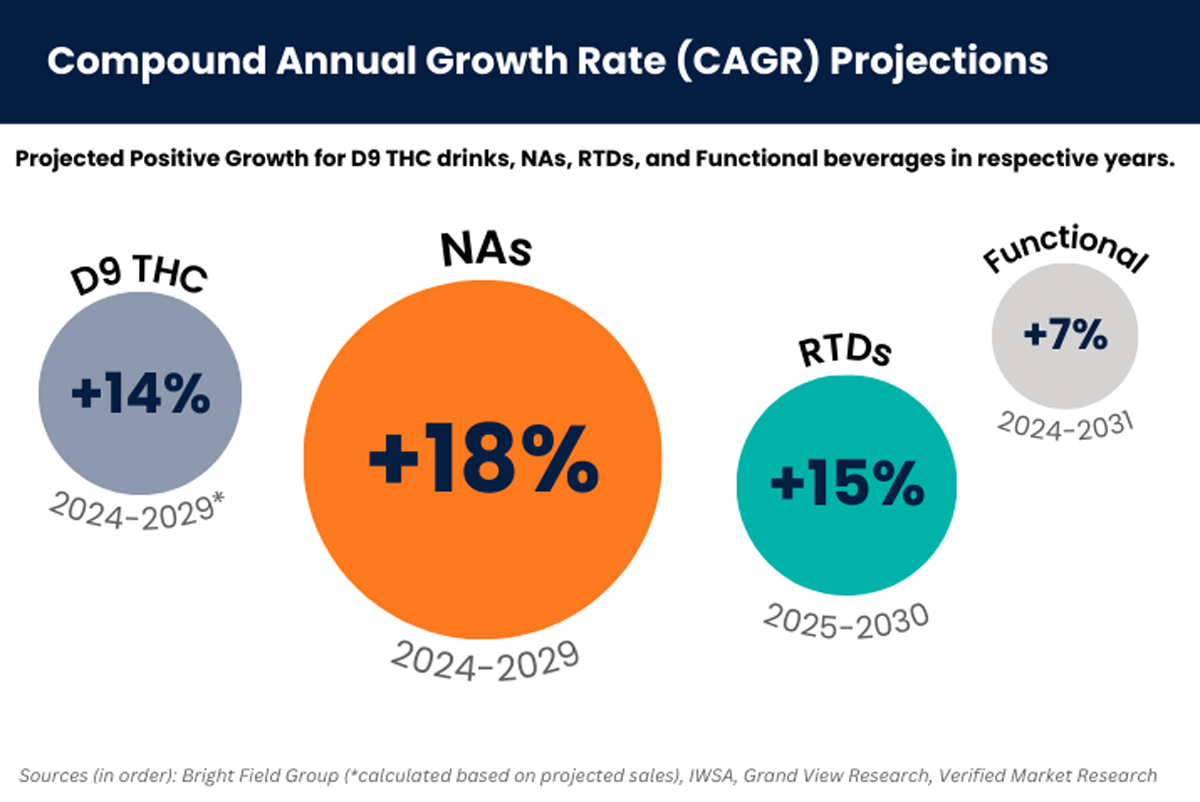
Delta-9 (D9) drinks are infused with the major psychoactive compound, Delta-9, which is the most abundant form of tetrahydrocannabinol (THC). They are promoted as a way to experience the effects of THC in a controlled and enjoyable way. Consumers increasingly want that experience without the next-day sluggishness. Since the 2018 Farm Bill transformed hemp policy in the United States, the D9 THC beverage market has experienced exponential growth with the category reaching around $382 million in sales in 2024 and expecting to grow to nearly $750 million by 2029 in the United States, according to Brightfield Group.
Nonalcoholic Beverages
Given the changing customer desire to be more health-conscious, nonalcoholic beverages (NAs) are seeing significant expansion as well. In fact, Innova Market Insights found that low and no-alcohol product launches in the United States grew by 11 percent in the past five years. There’s no signs of slowing down either as an IWSR report reveals that the U.S. NA market’s compound annual growth rate is forecast to grow by 18 percent from 2024 to 2028. NA beer is the primary volume driver, with NA spirits and NA RTDs following closely behind.
Ready-to-Drink Cocktails
Driven by a rising demand for convenience and portability, customers are turning to ready-to-drink cocktails (RTDs) for effortless enjoyment—social hangouts with friends, outdoor activities, and solo at-home consumption. The popularity of RTDs is ultimately reflected in Grand View Research’s report, which states that the U.S. RTD market size was valued at $903.4 million in 2024. More importantly, it’s projected to grow at a 15.3 percent compound annual growth rate from 2025 to 2030.
Functional Beverages
A functional beverage provides health and wellness benefits from such functional ingredients as caffeine, probiotics, and bioactive proteins. With customers’ rising focus on personal fitness and lifestyle, functional drinks with targeted health benefits are also making waves in the market. According to Verified Market Research, data show that the popularity of functional drinks will push its market to grow at a 6.9 percent compound annual growth rate from 2024 to 2031.
Conduct a Tech Check for Copacking
Copacking offers your brewery a strategic opportunity to unlock growth by entering and capitalizing on these thriving segments. But the use of your data extends far beyond simply deciding whether copacking is the right move. With centralized data and established copacking operations, you can track the performance of your newly created products against market-wide benchmarks. You can also identify consumer-demand trends through distributor insights or retail data. Last but not least, you can leverage data to closely monitor gross margin and profit.
Becoming a lean brewery isn’t just about cutting costs; it’s about using data to choose the smartest path forward. Given market trends and consumer preferences, the data can reveal that the road of growth is investing in copacking and venturing into popular beverage categories.
So it’s important to consider the following:
- Do you have ample, real-time, and insightful data that can guide your decision to copack or not?
- If you decide to copack, are your existing tech and data tools sufficient to handle those operations?
If you’re limited with your existing tech/data stack and are looking to revamp it to unlock greater growth, check out Encompass’s Production Cloud features and demo.
The Lean Brewery and Its Data-Driven Edge
In today’s changing consumer and economic market, breweries need to optimize the performance of their assets and processes. The key to becoming a lean brewery is to use real-time data to streamline operations, cut costs, and grow smart. If your spreadsheets and system can’t keep up with the shelf, it’s time to rethink how your brewery runs—do more with less.

Walk down the alcohol-beverage aisle of your grocery, convenience, or package store today and yet again, you’re reminded of your new beverage reality—such a tremendous number of beer options: Pink Grapefruit Ale, Salted Caramel Triple Fudge Stout, Yuzu Lemon & Ginger NA, When the Vibes Were Poppin’ IPA, and other names that double as indie-band EPs or breakup texts. It’s a wild shelf out there—the variety of craft beers is exploding endlessly thanks to modern consumers’ curiosity, affinity for health-conscious options, and lack of brand loyalty. To add fuel to the fire, production costs are rising across the board—from hops and malt to steel equipment and shrink wrap—tightening margins even more. The pressure is here, and it is real.
Given this changing consumer and economic landscape, as a brewer, you are forced to consider how to be agile and adopt a leaner production to save time, cut costs, streamline operations, and grow smart. In other words, the key to success in today’s dynamic and competitive market is to become the “lean brewery”—optimizing the performance of your investments, assets, processes, etc. And becoming a “lean brewery” can happen only when you have centralized data and a deep understanding of it.
How Data Enables Smart Growth
Tech has become too advanced for breweries to still rely on disparate production systems, multiple spreadsheets, and outdated data. Production Cloud is an all-in-one platform that serves as a single source of truth, providing real-time numbers and analytics throughout the production process. Accurate and unified information lets you uncover operational gaps, identify revenue opportunities, and drive sustainable growth for your brewery.
With the right insights, you can:
- Confidently diversify your portfolio through multi-segment production
- Align SKU rationalization with performance-driven planning
- Optimize asset allocation
- Explore copacking as a strategic revenue stream
Diversifying Your Product Portfolio through Multi-Segment Production
Gone are the days when loyal consumers stick with a single brand and when breweries can rely on a single flagship to drive growth. With the explosion of options on the shelf, today’s drinkers are explorers—sampling across styles, formats, and brands. Curiosity is replacing loyalty, and brand affinity is earned sip by sip, not assumed.
Diversifying product portfolios is a must—think core beers and nonalcoholic beverages (NAs), RTDs, and seltzers. From Q1 2024 to Q1 2025, Beer Business Daily reported those last three categories actually grew almost 25 percent in volume and 16 percent in share, reaching 9 percent share of overall packaged on-premise offerings. And from January 2024 to January 2025, health-conscious options such as NAs saw 33 percent growth in sales, according to BrewBound.
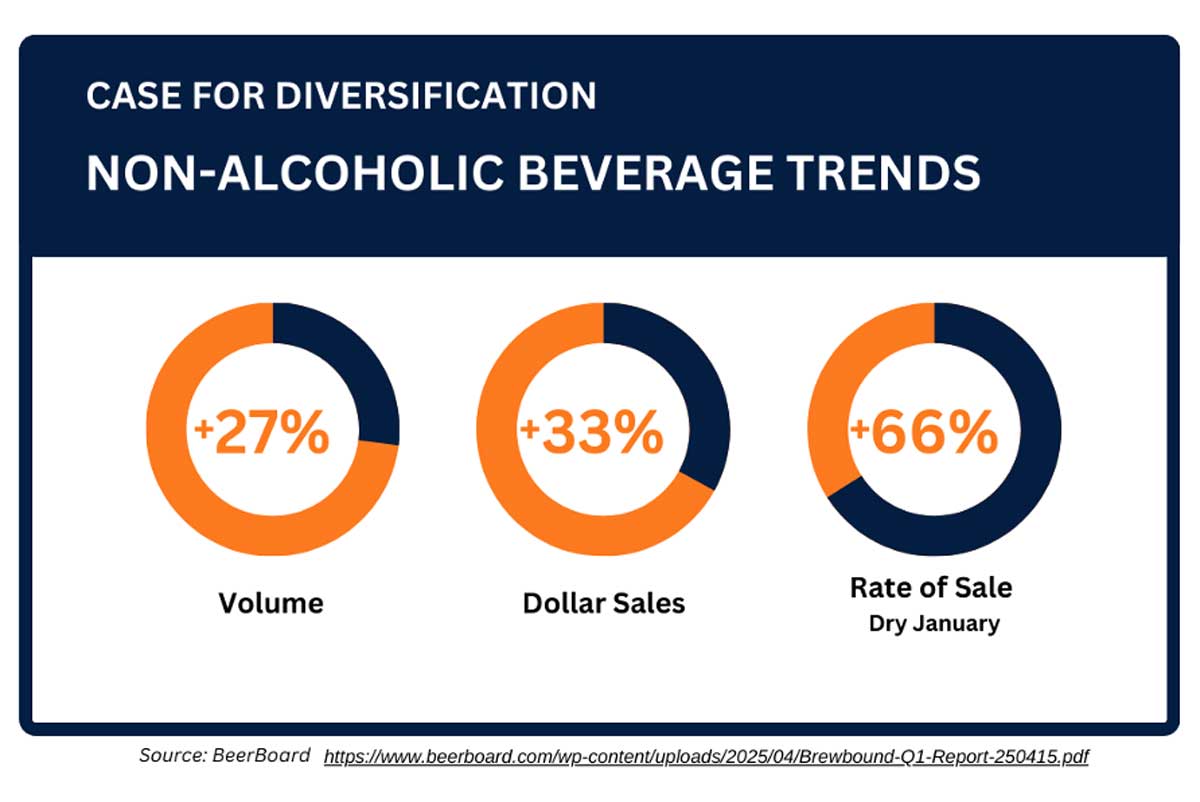
With real-time data, you can see which categories are growing in popularity. You can then prioritize production of higher performing existing SKUs and/or craft new recipes.
But that’s not all. Good data that connect the maker to the market also provide a level of visibility into your distributor sales activity, giving you a clearer picture of the retail market. With those details, you can assess and fill the gaps in your distributors’ portfolio and make tailored product recommendations. The result is a stronger relationship and trust with your distributors, unlocking more strategic growth opportunities.
Aligning SKU Rationalization with Performance-Driven Planning
Real-time analytics on inventory and sales allow for smarter decision-making on which SKUs are selling best according to what channel. This empowers production teams to assess which products and channels to pour more attention and resources into. At the same time, data also let you see which products are contributing to margin drag and should be dropped, so you can reallocate those resources elsewhere to optimize performance and revenue.
Optimizing Asset Allocation
Brewing equipment is already costly enough with its upfront price and its ongoing maintenance costs. By leveraging data on brewing schedules and tank/equipment usage, you can pinpoint efficiencies that directly translate to revenue. For instance, the numbers may reveal which tanks are being underutilized, letting you assess the opportunity cost of idle assets. You can then repurpose this equipment to expand into high-growth categories such as NAs, RTDs, spirits, etc. Alternatively, you can leverage it as an additional revenue stream by becoming a copacker or contract brewer for other breweries.
Exploring Copacking
According to Grand View Research, the copacking market is projected to grow at a compound annual growth rate of 12.1 percent from 2021 to 2028. That growth signals a significant shift: breweries are increasingly embracing copacking. Having data on your workforce, equipment production capabilities, and raw-ingredient COGS is crucial when you’re deciding whether to scale up internally or partner with a copacker. This information helps you assess whether it’s more cost-effective to invest in new equipment and team members to launch your own brand or to outsource small-batch, experimental SKUs to a copacker without overextending on space and capital.
Alternatively, if your production data show underutilized space or idle equipment, you can offer copacking services for interested breweries looking to quicken their speed-to-shelf process in new beverage categories.
Re-evaluate Your Current System and Dataset
Innovating to meet shifting consumer preferences and the challenges of today’s tight economy has never been more critical. Yet, it’s not just about cutting costs where you can. The path to becoming a lean brewery starts with having centralized data that can be analyzed.
In turn, it’s important to consider these questions:
- Does your system provide end-to-end production support?
- Does your platform offer real-time data for strategic decision-making?
- Does your tech stack better connect the “maker” to the “market”?
So, the next time you walk down that alcohol-beverage aisle, know that the brewers winning today aren’t just creative; they’re lean and data-driven producers who’ve learned to do more with less. If you’re ready to join the winners’ circle, contact us today.