

Every year in September, brewers from around the world make a pilgrimage to the Pacific Northwest to select their preferred lots of their favorite hop varieties. Selection can be challenging, even with varieties that are well established in the marketplace and that brewers have brewed with successfully for years.
And if the evaluation and selection of established hop varieties is tricky, what about unknown varieties (new genotypes)? How are they evaluated? Are there particular attributes the evaluators are looking for? How do they determine the potential of each? Could insights gathered by experimental hop evaluators prove useful to brewers?
And when a new variety is made available to brewers, how do they learn about the new hop? What gives them the confidence that the new variety can help them energize customers through their beer? With the plethora of hop varieties and hop products being presented to breweries, how can they possibly evaluate them all and be confident a hidden gem hasn’t eluded them?
In this Deep Dive series, we give you a peek behind the curtain at our early evaluation processes for new genotypes and the factors leading to “go/no go” decisions. Three brewers will share their experiences navigating the weird and wonderful world of hops to help you gain perspective that can lead to new ideas for considering hops with which you’re unfamiliar.
Where Do All These Hops Come From?
We evaluate hops from 100–160 new genotypes every year. These genotypes come from the breeding and research arm of our program that has taken place at Oregon State University since 2009, where genetic crosses are made and resulting seeds grown out to be tested against disease, pests, drought resistance, and more. A lot of thought and persistence go into the early stages of generating new genetic material that might withstand the rigors of a changing natural world and present desirable new brewing characteristics.
Each new seed produced by pollinated female plants is genetically unique. Males and females used for breeding crosses in this program vary widely. Historically, hop breeding focused on a very small group of dependable brewing hops such as Brewer’s Gold, Hallertau Mittelfrüh, and Fuggle. Consequently, the resulting population wasn’t genetically diverse. Dr. Shaun Townsend heads up this phase of our program at OSU and has made genetic diversity a priority, bringing new material into the breeding mix by collecting seed from wild hops and by exchanging with other breeders some breeding stock that hasn’t previously made its way into commercial populations. This diversity broadens genetic traits in offspring from both an agronomy and a brewing-character standpoint, which through natural selection and screening will likely lead to desirable results in both areas. Each fall in an average year, Dr. Townsend collects 5,000–10,000 seeds to be grown out for evaluation, and two to four years later, hops from roughly 100–160 plants come to us where we begin screening for brewing and market potential—which is the focus of this Deep Dive.
What Are We Looking For?
Do we know what we’re looking for when screening these new hops? Honestly, we don’t know exactly what the brewing profile of a hidden gem will be. We’re beer nerds and former brewers who are borderline cultish in our belief that the hop cone is a miracle of nature, but it took us a few years to realize that we just don’t know what miracle nature is going to throw our way. So our screening criteria is very broad at the beginning, then we drill down deeper as we go. Some of our broad initial criteria are:
- Amazing new sets of hop flavors and aromatics for IPA/DIPA that might help our industry diversify and reach even more consumers;
- Hops with the unique “architecture” that supports classic lager beer—low-alpha, no resins to interfere with malt and fermentation flavors, pleasant nonaggressive aroma, and a classy hop finish that is catchy and dry but doesn’t take over the beer;
- Moderate alpha hops for hop-driven beer to provide more versatility for late hot-side use.
- Brewing characteristics matching existing popular hops that struggle from an agronomy standpoint and are becoming less dependable.
Naturally, familiarity with existing hop varieties and how these hops express in successful beers is critical because we’re looking for new varieties that expand possibilities for amazing beer. That awesome new hop doesn’t exist yet, but we figure we’ll know it when we see it.
How Are We Looking for “It”?
You may wonder whether we use chemical analysis to help find the hidden gems. We do run gas chromatography (GC) chemistry on many new genotypes, but this is for future data analysis. Hop chemistry is extremely complex—so complex that there are still hundreds of compounds that have been detected but not identified. To make matters even more complicated, different compounds have different detection thresholds to different people, and some compounds are detected as one flavor at a particular concentration and an entirely different flavor at another concentration. Consider that there are some 400 chemical compounds found in hops, and you’ll see that the number of potential combinations/ratios is astronomical. Fascinating knowledge about individual oil components is being unveiled in labs every year, and our cumulative knowledge is impressive, but to find out what the brewing character of a new genotype is, it simply has to be put into beer and evaluated by people.
What’s the Rub?
To find the hops that have commercial potential, we start with a “dry-rub” evaluation. At this stage, we’re not looking for that next “home run” hop; rather we’re culling the ones that clearly have no market potential. We’re wary of the dry rub, though, where unknown genotypes are concerned because it can be misleading. Some hops are curious and a bit off-putting on the rub but then come to life and are impressive in beer. We also see plenty of hops that are far less expressive on the rub than they are in beer, so we don’t pass over a hop for lack of intensity on the rub. We merely remove the genotypes that clearly have no market potential, whether because of a complete lack of character or such off-putting aromatics that nobody would dare put that hop in their beer. The dry rub helps us reduce the new genotypes by roughly half.
Beer Tells All.
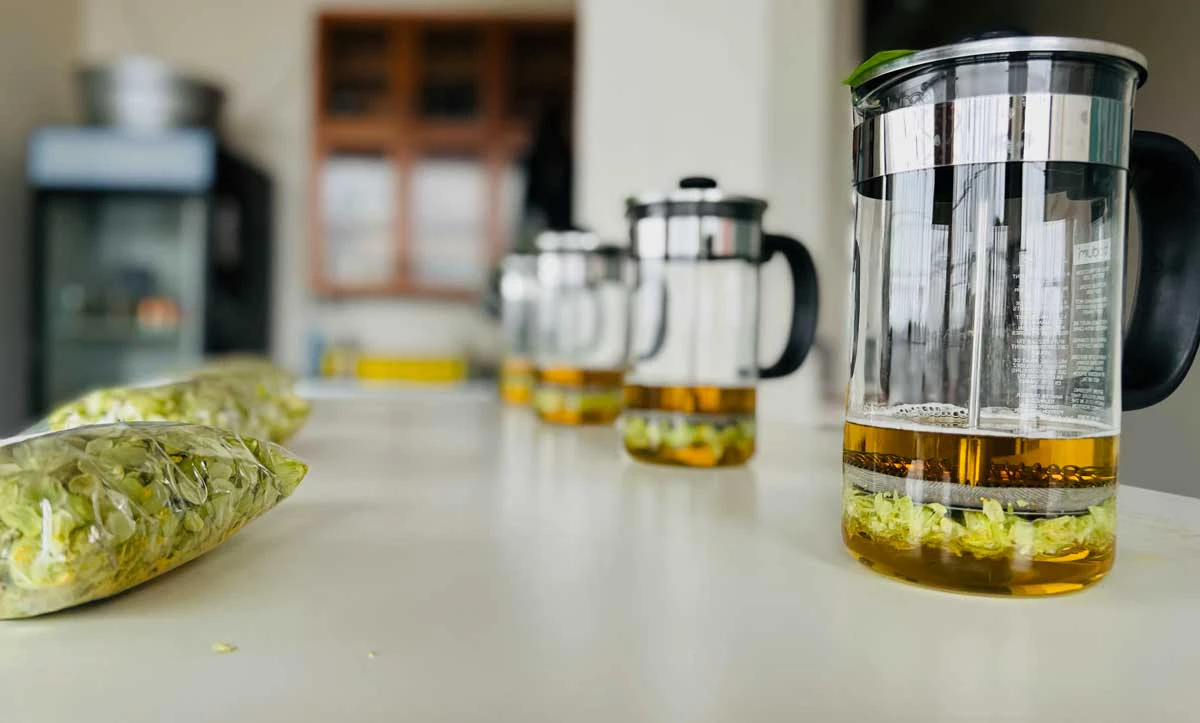
After the dry rub, we’re ready to really evaluate the remaining genotypes by putting them in beer. We use a small-scale dry-hopping technique that has provided good results for more than 12 years. We use a Kölsch that is well balanced with hop bitterness but shows little to no hop aroma/flavor and is “clean.” We pre-rub the hop material to expose what’s inside, place the material in a French press, then gently pour cold beer (straight out of the fridge) over the hops. We use the filter/plunger to push the hops into the beer, and the French presses (we do eight at a time) are left out at room temperature. At the 15-, 30-, and 45-minute marks, we gently lift the plungers, then press them back down into the beer to reposition the hops in solution, careful to avoid forcing too much of the carbonation out of the beer. After the third repositioning, we return the presses to the fridge for another 15–20 minutes. Then the dry-hopped beer is ready for evaluation.
The differentiation between genotypes and the expression of hop aroma and flavor is uncanny. We do overdose (it’s the equivalent of about 6 pounds/2.7 kilos per barrel), but this allows for the accelerated dry hop using finished beer, providing flexibility for experimentation. While dry hopping doesn’t tell us everything about a new hop, it gives us plenty of information to know whether the hop might turn out to be a useful “arrow in the quiver” for brewers and worth a closer look by advancing the genotype for brewing trials. It even gives us an indication of the hop’s versatility, and not just where hop-driven beers are concerned. For example, when Lórien came along in 2016, this dry hopping technique displayed classy aromatics and flavors that can certainly be excellent contributions to IPAs, but what stood out to us was how crisp and clean the beer remained. We were about to introduce Strata to the world, and the thought of following up with a “lager hop” was exciting.
Did You Find Anything?
We have, indeed, found genotypes that we wanted to pursue, although not all were obvious at this stage. Here are some examples using hops that have gone through our program.
Strata
Strata showed up in our first batch of new genotypes to evaluate in 2012. This one was easy to notice, praise the hop gods! Strata stood out even on the dry rub, and in the French-press dry-hop trial, the beer showed such depth of enjoyable aroma and flavor that we wondered how on earth it could be improved upon. This was a rare occurrence, though—like one in 100,000.
Lórien
Lórien was less obvious on arrival in 2016, but because we believed in the future of lager, we were looking for that lager hop “architecture,” and Lórien proved to be a standout. From a hop supplier’s view, the lager market is very different from the IPA market in that the IPA market isn’t encumbered by tradition and almost anything goes, whereas in the lager world, tradition creates limitations, so a new lager hop takes more time to work its way into the mix. A number of brewers have grabbed hold of Lórien’s magic over the past four years, and momentum is building. It’s important to us that we support evolving segments of the market that broaden interest in craft beer.
Luminosa
Luminosa found our French presses in 2018 and jumped out at us with an exceptionally bright and fresh character that would light up any IPA (hence the name). There were already plenty of citrusy/tropical hop varieties available, but many were in the overripe-fruit zone. The bright, fresh flavors from Luminosa were unique enough to have a “hook” that we were pretty sure brewers would latch onto. In addition, Luminosa didn’t have as much piney/resiny character as most citrusy/tropical hops, opening up more options to use these catchy fruit flavors.
Audacia
Audacia reached us in 2019 and is the most recent variety we decided to make commercially available. It is a great example of a hop that expresses quite differently on the dry rub than it does in beer. “Classy” and “beautiful” come up as descriptors for Audacia on the rub, but in beer, this hop is very expressive with berry flavors and lilac/lavender aromatics that can put a new twist into IPAs. The moderate alpha of 6–8 percent we feel is a plus and adds to this hop’s versatility. But, unlike Strata and Luminosa, Audacia doesn’t announce its presence loudly on the rub, so it can be pigeonholed as a lager hop. For this one, we had to don our hop-evangelist hats and spread the word that a new IPA hop was born.
Market Ready?
To help us validate hops for commercial potential, we take the step of pilot-brewing trials. Our customers with pilot systems from 1–5 barrels help us with single-hop brews that can be sold in their tasting rooms to gauge consumer response. When the planets are aligned, this can even lead to commercial beers that help introduce a new hop! Odell Brewing in Fort Collins, Colorado, brewed a Strata trial beer for us that convinced them to put Strata into their Wolf Picker IPA seasonal in 2017. This Wolf Picker IPA was basically a striking single-hop Strata beer. It led to a new year-round beer from Odell, Mountain Standard IPA. Special thanks to Odell for providing recipes for both beers.
For the thousands of breweries that aren’t involved in early trials of a hop, it’s great to learn about the hop through a successful seasonal beer from a respected brewery. The planets don’t always align so perfectly though, so breweries find themselves faced with a staggering number of new hop varieties and products. And not all breweries have small pilot systems to test new ingredients with minimal risk. Later in this Deep Dive series, we’ll have brewers from Odell, Other Half, and Sunriver share some of their experiences navigating the array of hop options that confronts brewers.
What’s the Point?
We continue these efforts of creating and evaluating new hop genotypes because we believe that hops will continue to be one of the key qualities that attract people to craft beer. In fact, now that we are said to be in a “mature market,” unique hop varieties that help breweries differentiate their beer and resonate with a broader spectrum of consumer palates are more important than ever. Hop products that are a subset of popular hop varieties can be useful tools, but they are different versions of the same variety. To diversify and reach more people, unique hop varieties are nature’s gift.
So, what insights from our early evaluation processes do we have that might be helpful to brewers? After screening thousands of new genotypes and introducing a handful of them to brewers, we can narrow it down to a few findings.
Chemistry can’t identify which hop will make amazing beer. We do run full chemical analysis on new hops, but human sensory of how various hops perform in beer is required to build confidence in and begin to understand a hop with which you are unfamiliar.
The dry rub is limited. It’s great once you’re familiar with a variety and know what you’re looking for, but for new varieties, the dry rub might let an amazing hop slip by.
Avoid pigeonholing hops based on the chemistry and/or dry rub. Some “lager hops” are amazing IPA hops! In addition to pursuing our unique varieties, we work with existing varieties that excel in our growing region. Oregon is not only a fantastic growing region for leading “IPA hops” but is also uniquely able to produce low-alpha, low-oil hops that contribute catchy flavor twists to IPAs. Crystal and Sterling are fantastic examples of this, but they are often overlooked for IPA use.
Total oil is not an indicator of a hop’s “punchiness.” It’s the composition of the oil that matters (which oil compounds and in what concentrations). We’ve seen hops with 3.5–4.5 ml/100 g of hop material that barely show up in beer and many with 1.5 ml/100 g that come through loud and clear. At the very least, if you really want to look at total oil, first remove the myrcene. Myrcene is by far the largest component of total oil in hops, and even a hop with very low myrcene levels has more than enough myrcene to maximize this oil in beer. Removing myrcene will get you closer to the so called “survivables” portion of total oil.
Never before has craft beer tasted so good and been available fresh in so many locations. Some say we’re in a mature market. But maybe we’re just catching our breath before spreading the miracle of beer and its natural ingredients for more people to enjoy with others. Either way, remember this: Life is short…Let’s make it flavorful!