

It’s everywhere—hidden in houses behind humble white flags hanging from bamboo poles or found at the entrances of vast Inca sites with concentric circles manicured for history buffs and tourists.
Sometimes they serve it in tiny, hand-size bowls made from the hardened skin of local fruit; at others, they hand it to you in massive mugs that echo Bavarian beer-hall culture.
Once you’re in the Andes—from the northern tip of the South American continent all the way down to the sacred valley of Peru and Bolivia beyond—it hits you: One of the world’s most fascinating, time-tested brewing cultures still thrives to this day.
And it’s almost completely misunderstood by most of the Western world.
Of Prayers and Confusion
For Westerners, attempting to grasp the chicha universe can be confusing.
Not only does the word “chicha” enjoy many meanings in various contexts, but the beverage itself has many variations that depend on regionality, season, and local legislation. For example: While the classic recipe’s grain bill is entirely based on malted maize, the meaning of the word “chicha” depends on where you are in Latin America. Rice, cassava, and quinoa may also be part of the brew, as can pineapples, bananas, and wild strawberries.
From a technical standpoint, brewing recipes abound. So do misconceptions.
No, most of these brewers don’t chew their corn. No, most of these brewers don’t spit to provide the enzymes to convert starches into fermentable sugars. Homemakers and professional chicha brewers alike either grow their corn themselves or buy it from a nearby farmer. They either malt the corn themselves or buy it from a seasoned local maltster. They either ferment their wort with their own house slurry, lathered in the fermenting pots or coating the brewing implements, or they let Pachamama—Mother Nature—do her thing.
Yes, in the sweltering jungles east of the Andes, indigenous tribes still chew and spit. Yes, these people still serve their chicha at rites and social gatherings. Back in the Andes, however, from the lowlands to the highlands, Quechuan people see chicha as the backbone of a healthy pub culture, in which political discussions, daily banter, and relaxing after a hard day’s work are the norm.
The earthen ground in the more rural chicherías may be pocked with small craters made by liquid, voluntarily dropped as an offering—say, a prayer for a good harvest—but that is all. The rest is anecdotal.
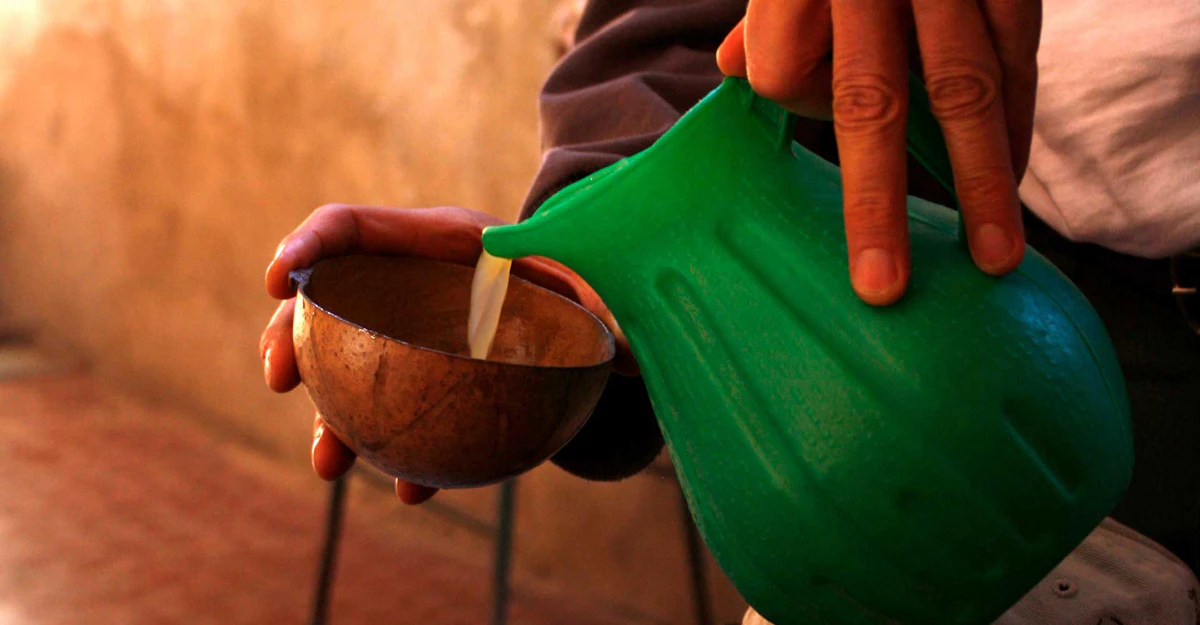
Photo: Martin Thibault
From Field to Froth, in a Fruit-Shell
To malt the corn, the chicherero leaves the kernels in water to accumulate moisture, then takes them out to germinate. The duration of each step depends on the family recipe—the recipe itself linked to the corn variety, altitude, and equipment used. (Famously, Peru has more than 50 distinct varieties of corn.) The result is then sun-dried and ground.
If that malting process sounds pretty standard, that’s because it is.
Brewing can then commence. The brewer steeps the malted corn flour in tepid water, often heating it up to a boil. Boiling lasts a few minutes, or a few hours, before the wort is filtered, cooled down, and sent to fermentors—often already lined with the microflora necessary to transform the wort into chicha. Some brewers add panela sugar to help get the desired result. After a couple of days, the beverage has reached an alcohol volume close to 3 percent ABV, ready to be served to the public.
These processes likely sound familiar. The chicha made by the Quechuan populations of the Andes is a malted-grain beer with a yellow complexion not unlike hazy IPA—sometimes crowned with a frothy head of foam, sometimes looking more like an unblended lambic—but almost always with soft, cask ale–like carbonation.
Occasionally, they serve it in a large glass tumbler; at other times, in a dried fruit’s husk.
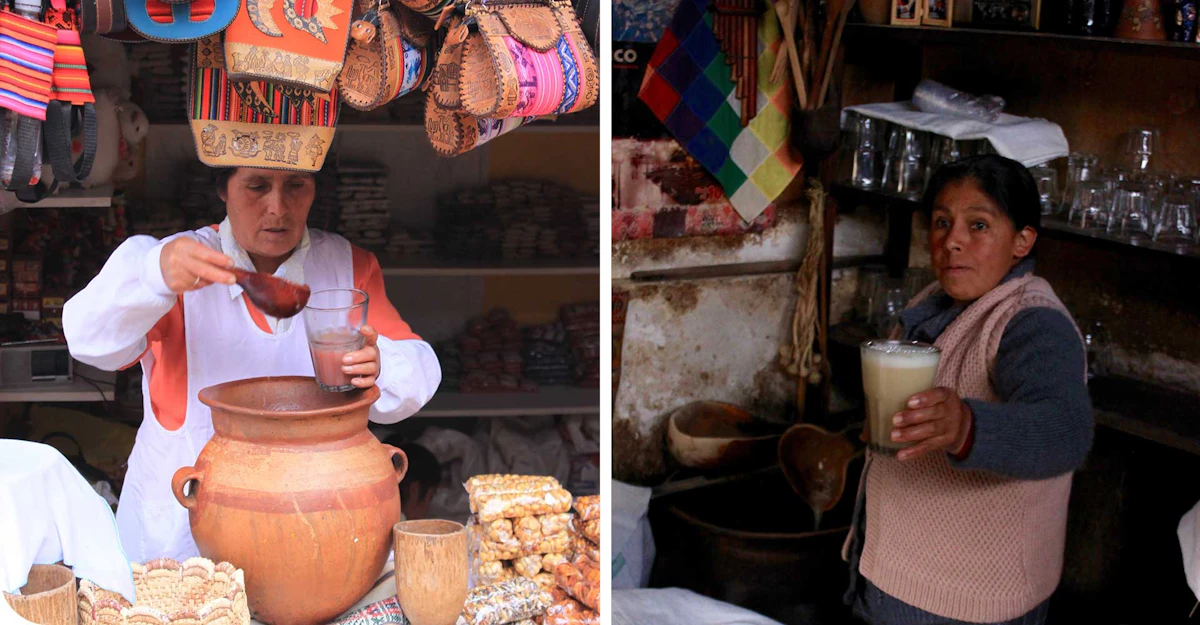
Photos: Martin Thibault
The Sources of Sourness
From colonization and armed conflicts driving people from ancestral lands to state authorities convincing the population that foreign drinks are more sanitary, South American chicha culture has endured many setbacks over the past few centuries. Both globalization and local legislation have soured outlanders to the idea of drinking the age-old beer.
The craft-beer scene, however, has already started to build bridges between urban cosmopolitanism and local traditions. Cervecería Barbarian, a microbrewery in Lima, Peru, brews Chicha Tu Mare—a dry, tart beer not unlike a Berliner weisse in character, but made with corn and quinoa. Sereno Moreno—an inviting, brightly-lit pub in Quito, Ecuador—serves various flavors of their house chicha complete with tasting glasses and growlers to go. Chichería Demente in Bogotá, Colombia, is an atmospheric, upscale restaurant proud to brew its own hazy chicha, served alongside traditional cuisine imbued with contemporary flair. And the list goes on, from Cuzco to Otavalo.
These chichas represent a wide range of ingredients and approaches to fermentation, with serious potential to inspire modern brewers elsewhere.
Consider: Researchers have studied the breadth and complexity of the chicha fermentation, proving scientific worth even beyond its obvious cultural and historical significance. In one study, they sequenced 27 samples from 14 chicherías in seven Peruvian provinces, finding wide variation in microbial composition—though more than half featured Lactobacillus. In another study, researchers found that the chichas of Ecuador contained 26 species of yeast; Saccharomyces cerevisiae and Torulaspora delbrueckii were most prominent.
Experts as well as brewers are learning more about the origins of chicha’s signature tartness—surely a feature that could pique the interest of brewers worldwide, much as they adopted the use of Norwegian kveik.
A Condor’s-Eye View over the Andes
Loss of habitat may have threatened chicha, but—like the Andean condor—its sacredness and symbolic power remain relevant to this day. To highlight its regional expressions, here’s a quick flight over its producing countries.
Peru For now, the Peruvian Andes are the showpiece of chicha-brewing culture … in Western eyes. Tourism money in the Sacred Valley—from the UNESCO-protected Cusco town center to the world-renowned mountain holy site of Machu Picchu—has spawned overt advertising.
Instead of a plain flag hanging out front, colorful menus, large drinking halls, and road signs with actual words such as chichería or its Quechuan equivalent, aqha wasi, invite visitors to confidently sit with a caporal—a huge tumbler glass—of the foamy, sour brew. Frutillada,a pale pink strawberry-infused version of the ubiquitous yellow chicha de jora, is very popular here as well.
Northern Peru, around the Piura area, is slightly different, more akin to the Bolivian approach. Served in a dried gourd, the chicha is less foamy, dominated by its funky yeast and bacteria signature.
Bolivia The Cochabamba valley, southeast of the university town of Cochabamba, may appear quiet and rural, but community life bustles within the chicherías.
Furthermore, this area away from the touristic hotspots of Uyuni, La Paz, and Titicaca is home to the largest density of Bolivian chicha brewers. Often women, they use eucalyptus wood to fire up their cauldrons. Producing billowing masses of eye-stinging smoke, the malted-corn mash can last many hours before they transfer the wort and heat it to a boil.
The ensuing cooling and fermentation—in containers lined with the house slurry—can take anywhere from a couple days to a week depending on the season, the temperature, or the social events on the calendar. Each family produces chicha with its own recipe, and only a few open their doors to locals. The sign to look for in these parts is a white flag hanging outside a house’s main door or front window—Quechuans understand this clearly, but it may be enigmatic to travelers. Its message, though, is simple: This house is a chichería, chicha has recently been brewed here, and it’s now ready to be served. Do come in.
The chicha produced here is served in a small bowl, often made from the hardened shell of the orange-sized fruit of the calabash tree. It is nearly flat, and it tastes tart, fruity, and mildly funky.
Ecuador
While other Andean countries tend to focus on specific geographic locations and one main ingredient—malted corn, or jora—Ecuador offers a plethora of chicha styles along its highlands.
The classic chicha de jora is a common option, but the town of Otavalo also has chicha de yamor, famously made from seven different types of corn: yellow, white, dark, chulpi, canguil, morocho, and jora. Chicha de morocho and chicha de yuca—made from cassava and palm seeds—can also be found in the mountains. Several traditional restaurants offer chicha along the main roads away from Quito, as well as in surrounding towns and villages.
Colombia
The story of chicha in Colombia clearly speaks of the trouble brewed by colonization.
Not only did the Colombian government ban the brewing and selling of chicha as recently as the 20th century for what they claimed were sanitary reasons, but archbishops, royals, and city officials were all among those who’d banned it before. Law 34, ratified in 1948, was specifically written and enforced to allow German-style beer to take over the market, revoking the locals’ rights to sell chicha in their own country.
Despite that legal context, Bogotá is a vibrant center of chicha brewing today, with festivals and bistros offering many versions of the beer. Corn malt is still the main ingredient, but variations include rice, yuca, and those flavored with pineapple. The fall festival held in Bogotá’s La Candelaria is easily the best opportunity to sample diverse flavors without doing much research.
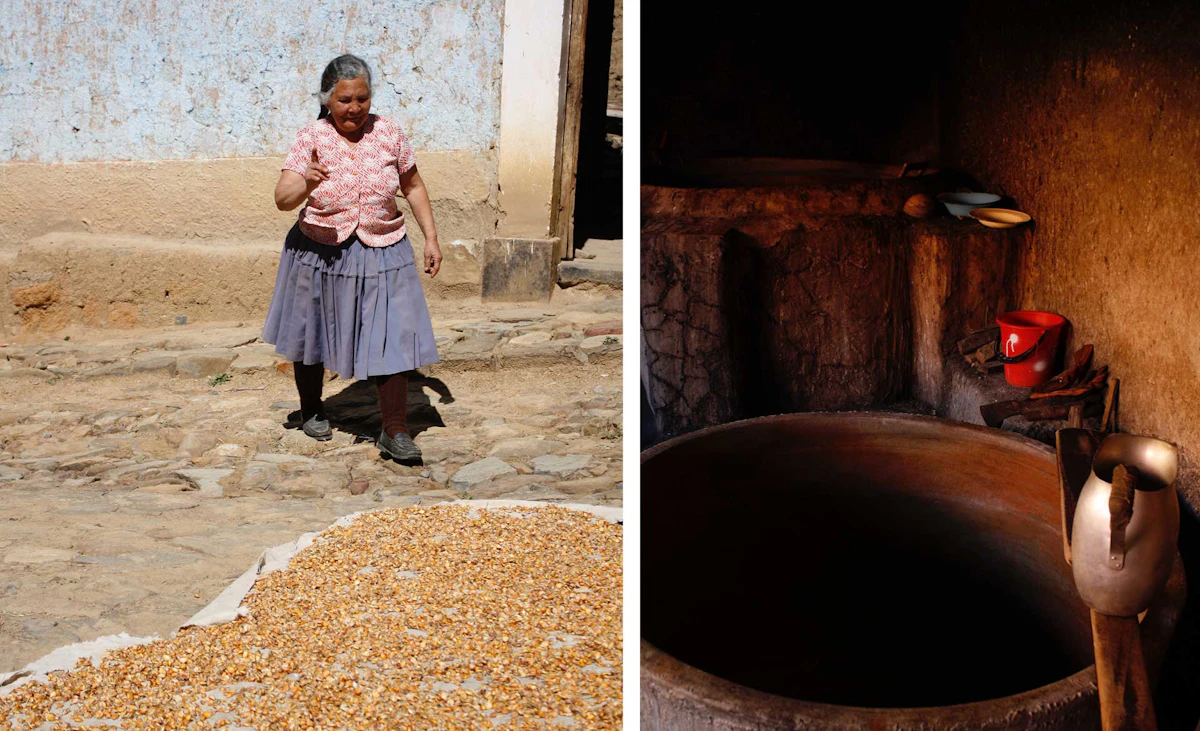
Left:A chichera dries malted corn. Right: Serving apparatus in a chichería. Photos: Martin Thibault.
Beyond the Rituals
Yes, chicha was a ceremonial beverage of the Inca Empire, linked to supernatural invocation, imperial rituals involving virgin women, and even socializing. And yes, its history is ripe with such juicy kernels, and evoking them is important.
Yet as compelling as these historical elements are, chicha today is a thriving modern beverage—albeit one with ancient roots. It’s a vehicle for gathering people, a locus for community life and family tradition.
Chicha is alive, it’s diverse, and it’s a fascinating gateway to better understanding various cultures—well worth seeking out, beneath the unassuming flutter of a simple white flag.
Chicha Culture’s Cultures
Want to chew further into the complexities of chicha fermentation? These two studies are a good place to start:
“Peruvian Chicha: A Focus on the Microbial Populations of This Ancient Maize-Based Fermented Beverage,” by Daniela Bassi et al, in Microorganisms, January 2020.
[“Saccharomyces Cerevisiae Populations and Other Yeasts Associated with Indigenous Beers (Chicha) of Ecuador,”](https://www.scielo.br/j/bjm/a/bkKvZPcQFSdnMBH64wFPM8C/) by Fernanda Barbosa Piló et al, in the Brazilian Journal of Microbiology, October–December 2018.
