

Keptinis was virtually unknown outside Lithuania until about a decade ago—and even today, sadly, it’s seldom brewed anywhere else. I’d love to say that it’s been unfairly overlooked but, frankly, there’s another reason why so few people brew it: It’s not easy to do.
Keptinis hails from Lithuania, and its name is short for keptinis alus, meaning “baked beer.” Northern Lithuania, a rich agricultural region, has become well known for its farmhouse ales, and keptinis comes from the eastern part of that region. The keptinis area starts about 19 miles (30 kilometers) east of Panevežys and runs right to the Belarusian border.
As the name implies, when brewing keptinis, you bake it—the mash, that is—in an oven. Why? Because, historically, metal cauldrons for brewing were far too expensive for most farmhouse brewers. That made it difficult to heat the mash; one solution was to brew with hot stones.
An oven, essentially, is a more technologically advanced solution to the same problem.
Oven Beers
Wherever farmhouse brewers used an oven, there were a couple of different ways they did it, leading to two different kinds of oven-based beer.
One way is to put a cold mash in the oven and heat it there, producing flavors that are only subtly different from ordinary mashing. The other way is to first do an infusion mash, then bake that mash in the oven. Lithuanians have called both types of oven beer keptinis, but the two are very different in flavor—and the one baked post-mash is by far the most important of the two.
The ovens used for these beers are called duonkepis—literally, “bread-baker”—in Lithuanian. They’re huge brick monsters, usually about 6 feet tall by 5 feet wide by 13 feet long (1.8 x 1.5 x 4 meters). The opening is a bit like that of a pizza oven, where a fire can be lit, both to heat the oven and to heat the opening for cooking (or brewing).
Every Lithuanian farmer’s house was literally built around one of these ovens, and it was the heart of the house. While these ovens are important to Lithuanian culture, they’re not uniquely Lithuanian—you can find similar ovens throughout Eastern Europe, where it’s also possible to find other baked-beer traditions.
Keptinis in Lithuania
In 2017, I was lucky enough to watch the brewing of keptinis—baked post-mash and all—by father and son Vytautas and Ignas Jančys in Vikonys, in northern Lithuania.
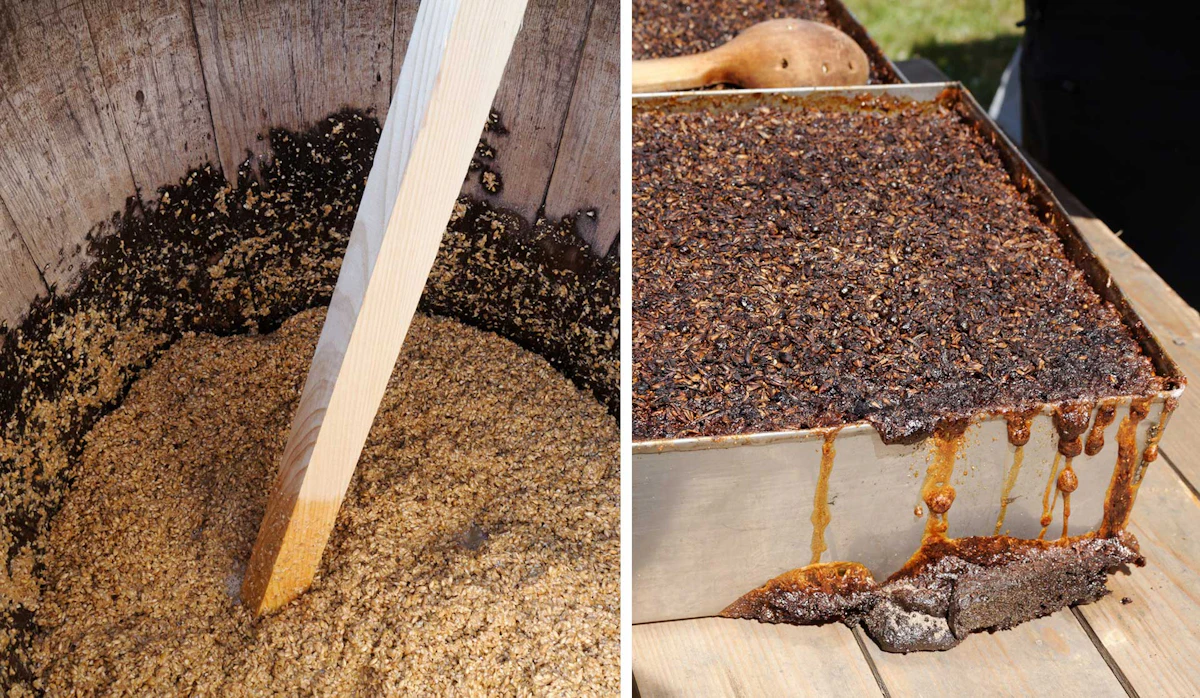
They started by mashing in a wooden vessel, adding hot water in the usual way. They then scooped the mash out of the vessel into metal trays (more like boxes) about 8 inches wide by 16 inches long by 4 inches high (20 x 40 x 10 centimeters). Before putting these box-like trays into the large brick oven, the Jančyses carefully added water to some of them, to ensure that each had the right amount of moisture. They also put out the fire, so the heat that remained in the bricks baked the mash.
I asked how hot the oven was but, because it was wood-heated, they didn’t know for sure. I’d brought a thermometer, but—after seeing Vytautas don a plexiglass face mask and huge gloves to put the boxes in the oven, I didn’t dare stick the thermometer in there. It’s safe to conclude that the oven was very hot—my guess is about 570°F (300°C) at the start.
The mash boxes baked in the oven for three hours. When they came out, the top layer of the mash had turned a deep brown. Wort had boiled out of the boxes and congealed into globs of baked sugar. The top was hard, from the sugars sticking together, and it tasted like caramel and honey.
It was only when we tasted the beer from the previous batch, however, that I really understood keptinis. They were mashing with 100 percent pale malt, but the beer they poured was black, verging on brown at the edges. The flavor was unforgettable—huge, earthy caramel of enormous depth. It was like nothing I’ve ever tasted.
Photos: Lars Marius Garshol
More on the Process
Seeing the baking happen helped me figure out why this beer is so different from other dark beers.
Beers such as porter or schwarzbier get their color, obviously, from malts kilned at high temperatures—what gets roasted, then, is starch and husk because the malt hasn’t yet been mashed. Not so with this keptinis, whose pale malts are first mashed—and what gets roasted is the sugar. That’s why it tastes so different from any other dark beer I’ve tried.
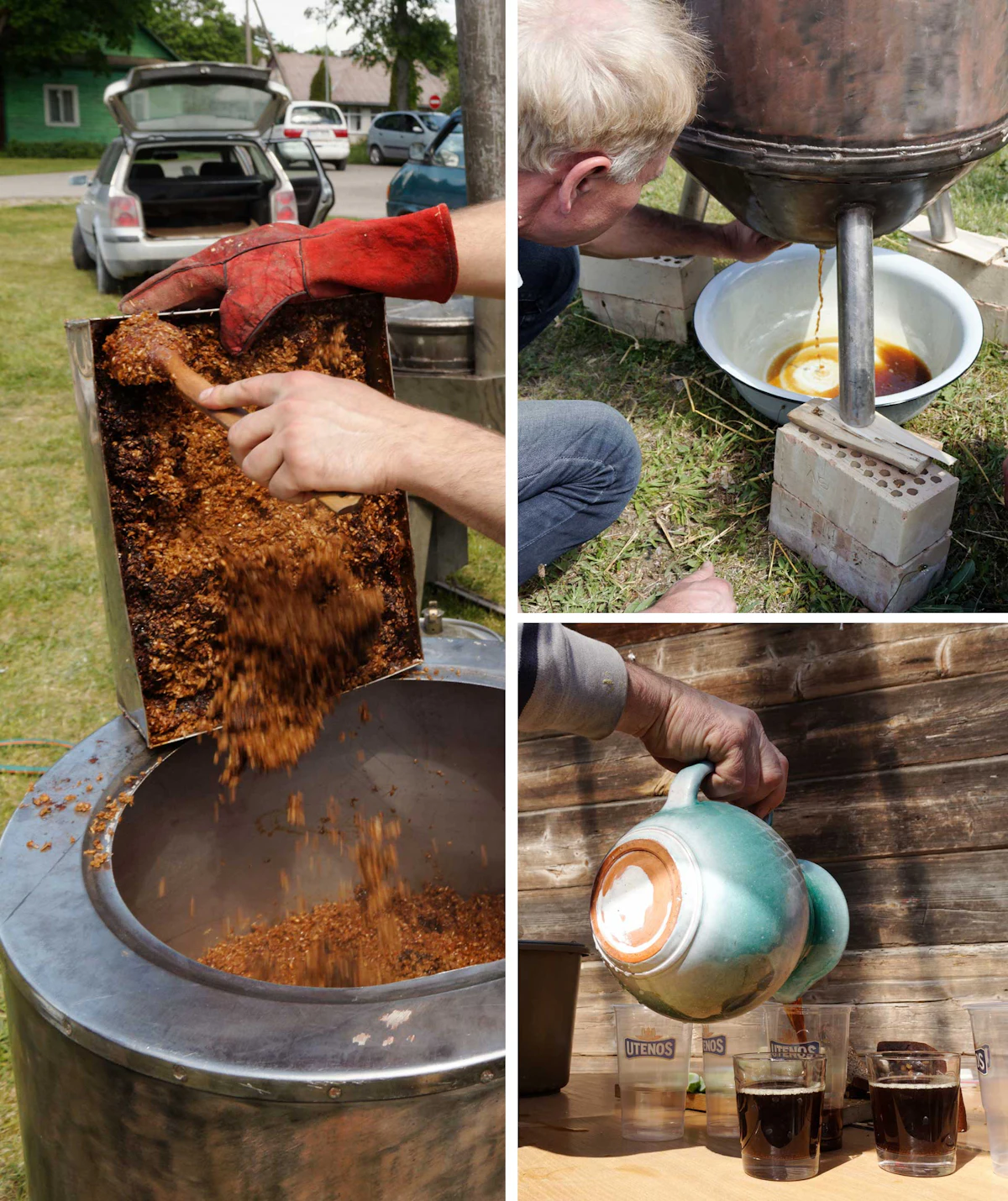
After baking the mash, the Jančyses removed the trays, used a big wooden spatula to break up the crust, then dumped the contents into their lauter tun—to which they had already added straw to act as a filter. They added some hot water, and the wort lautered out a porter-black color—despite the fact that it had been pale malt. They then cooled the wort and pitched their yeast—boiling wort appears to have been virtually unknown in Baltic farmhouse brewing.
They did, however, boil hops in some water on the side, making a hop tea to add to the wort in the fermentor. The keptinis recipes I’ve seen use a lot of European hops; I estimate they take the beer to about 50 IBUs. From experience, that seems to be necessary to counter the perceived sweetness of the caramel flavors. For the same reason, you may want a relatively low mash temperature of about 149°F (65°C)—the same mash temperature I observed when visiting the Jančys family.
They fermented their keptinis with commercial brewing yeast, but some other keptinis brewers use baker’s yeast. And at least one keptinis brewer I know has his own family yeast culture.
It may sound odd that a beer style that developed in the absence of metal cauldrons would make use of metal boxes or trays, but it makes sense. From ethnographic videos and older descriptions, it’s clear that the keptinis brewers originally shaped the mash into bread-like loaves, often held together with straw, and baked them without any containers at all. So, the metal trays are just a modern convenience.
Photos: Lars Marius Garshol
Keptinis in the Kitchen
Fascinated by this beer, I tried to reproduce it at home. That turned out to be harder than I expected.
For my first attempt, I baked the mash for three hours at about 360°F (180°C), which turned the surface nicely brown—but only the surface. The rest was as pale as when I started. The finished beer tasted like ... vossaøl. That is, caramelly, but the wrong kind of caramel—like that of the long-boiled Norwegian farmhouse ale. In my case, the water in the boxes kept the temperature at 212°F (100°C) or lower, so I got no true caramelization. Only the edges heated to about 320–356°F (160–180°C)—where true caramelization happens, not just Maillard reactions.
I tried again at 480°F (250°C), which baked the surface of the malts pitch black—but, again, only the top. A meat thermometer showed that I still wasn’t getting it above 212°F (100°C) in the center of the trays because of the water. The taste of the beer was strange, too—more toast and mineral than caramel—but interesting. Not a bad beer at all. And there’s a lesson there: It takes a lot to completely ruin a keptinis, and you get an interesting beer almost no matter how you bake it.
For my third attempt, I turned on the oven fan, to blow out as much moisture as possible, and I set the oven to 375°F (190°C). This time I watched the browning of the surface, stopping after a bit more than two hours, when the color looked right. I still didn’t get the center above 212°F (100°C), but I managed to get a flavor closer to the original, even if it lacked the same depth and intensity.
René Rehorska, an Austrian researcher, reports that he tried baking the mash for two hours at 570°F (300°C) in a combination steamer set to dry heat, but he still only got the center of the mash up to 216°F (102°C). It’s possible that you can’t get the center temperature up to caramelization temperatures above 320°F (160°C) in your home kitchen—and maybe you shouldn’t even try. The Jančys family only browned theirs at the edges, too, but that provided enough flavor.
An electric kitchen oven probably isn’t ideal for keptinis because it may not be good at pushing the heat into the mash trays. Pizzas are best baked in stone ovens because the surface transfers heat into the pizza much more quickly. To help with that, you can buy pizza stones, quarry tiles, or pizza steel for your home oven, and using those for keptinis may be a good idea. Using the fan also helps. So does putting the mash in a shallow, wide container, which offers more surface-to-volume ratio, increasing the baked surface. However, a stone or brick oven is very likely the best alternative.
Other Practicalities
The biggest obstacles to brewing keptinis, however, might be finding an oven and containers that are big enough for your mash—then, once you’ve brewed it, doing the cleanup. Keptinis can be labor-intensive.
I did speak to one small Lithuanian brewery that produced a keptinis. To bake the mash, they collaborated with the local bakery, which had big ovens with racks for bread pans—so they could bake a lot of trays in one go. Even so, they managed to bake only about half the mash.
If you want to taste a keptinis, there are commercial options, but not many. The easiest place to buy it by far is Lithuania, where several different breweries have made it. Unfortunately, I have yet to taste a commercially available keptinis with the same depth of flavor as what the Jančys family brewed.
If you make it to Vilnius and want to find keptinis, head for the Alaus Namai pub. In a basement that feels like a student bar, you can reliably get the keptinis from Ramunas Čižas on draft—and it’s a true farmhouse ale, fermented with his family yeast. It doesn’t quite taste like that dark monster from the Jančys family, but it’s still an experience worthy of any true beer lover’s bucket list.
The best option, however, is probably to find a friend with a pizza oven and ask if you can borrow it. For science.
