

When I arrived in the tiny village of Shenako, the first thing I did was drink a glass of warm beer. My shirt was soaked, and my backpack felt like it weighed 100 pounds. Nothing ever tasted so satisfying.
I was in Tusheti, a remote highland region in Georgia’s Caucasus Mountains. In most of Georgia, wine is the ritual drink. In Tusheti, it’s beer. Known as aludi, it’s brewed from local barley, flavored with wild hops, and fermented with yeast passed down from the previous batch. Every village—and often every household—has its own way of making it.
That was what I had come looking for, and what I’d just hiked four miles through a high-altitude pine forest to find.
As I climbed the last hill into Shenako, one of Tusheti’s few inhabited villages, I spotted locals outside my guesthouse holding beer glasses. Before I’d even set down my bag, I was asking whether I could try some. At that moment, I began an incidental lesson in how an ancient brewing tradition survives in one of the most inaccessible corners of the Caucasus.
Braving the Highland Climb
To drink aludi where it’s brewed, you must first survive Abano Pass. At nearly 10,000 feet (3 km), it’s the highest drivable mountain pass in the Caucasus—a crumbling, dirt-and-gravel ribbon carved into cliffs that snow, rain, and landslides tear apart each year.
Beyond the pass lies a scattering of villages in high pastures and valleys, all surrounded by pine forests patrolled by wolves, bears, and wildcats. Here, though, it’s the giant sheepdogs that pose the greater threat. With ears cropped to keep wolves from tearing them off in fights, they’re fiercely protective of their flocks. Anyone hiking the area in search of aludi is more likely to be stopped by one of them than a wild predator.
Winters are just as menacing. By October, snow closes Abano Pass, cutting off the region until June. Most Tush families now live year-round in the Alvani Valley below, returning to ancestral villages only in summer. Few remain through the long winter.
That seasonal austerity and ruggedness have kept Tusheti isolated for centuries, preserving traditions found nowhere else.
Making Beer in the Cradle of Grain
Georgia’s winemaking heritage is believed to be 8,000 years old, but its beermaking may be nearly as ancient.
The Greek military leader Xenophon wrote of drinking barley beer in what is now Armenia in the 5th century BCE. Some houses, like the one where I stayed in Shenako, still have centuries-old copper brewpots and agricultural tools inside them.
“Some say the Tush might be Mesopotamians who relocated to the mountains, found safety, and became shepherds,” says Shota Lagazidze—a towering Tush brewer, winemaker, and baker—over drinks in Tbilisi. “They may have brought beer-making here.”
What’s certain is that Georgia is a cradle of grain diversity. It’s the only country where 15 of the world’s 20-plus known wheat species grow. Five are endemic.
In recent years, many Georgians have set out to revive native crops and traditions suppressed under Soviet rule. In Tbilisi, Lagazidze bakes with endemic grains he cultivates himself, including tsiteli doli, a copper-hued wheat that thrives in harsh climates. Each summer, he returns to his home village, Dartlo, to brew aludi the traditional way: with barley malted under the mountain sun and with hops gathered from surrounding forests.
While every village has its own recipe, the process remains largely the same for sacred rituals. They soak the barley for two or three days—usually in rivers or streams—then leave it to germinate in the sun before grinding it with a millstone. They compress and wrap the foraged hops, or svia, leaving them for several days to release their flavors before drying. Being wild hops, they’re likely very low in alpha acids, and there’s no fixed amount—one brewer tells me that a family might use four to five kilos of hops for 300 liters of beer (or roughly nine to 12 ounces for a five-gallon batch).
For the mash, or darko, Tush brewers typically use five parts water to one part malted barley—that is, five liters of water per kilo of malt—though they’re more likely to eyeball it than measure it precisely. The mash goes into a copper kettle set over an open flame. To keep the pot from overflowing, the brewers ladle out some of the liquid, cool it, and pour it back while stirring the mixture. They typically add the hops near the end of the boil, a process with no set schedule.
“We don’t make beer by time,” Lagazidze says. “We put a stick in the pot. When the liquid has reduced by four fingers”—he holds up four fingers on his bear paw of a hand—“it’s ready.”
At that point, they filter some of the liquid into a barrel and add some dried yeast from a previous batch. Once it begins to ferment, they add this starter back to the cooled wort, covering the barrel with a cloth. Three days later, the aludi is ready to drink.
I sampled four different kinds of aludi in Tusheti. Both the flavor and fizziness differed not only from batch to batch, but also from glass to glass. It’s apparently typical to serve aludi while it’s still in the midst of primary fermentation.
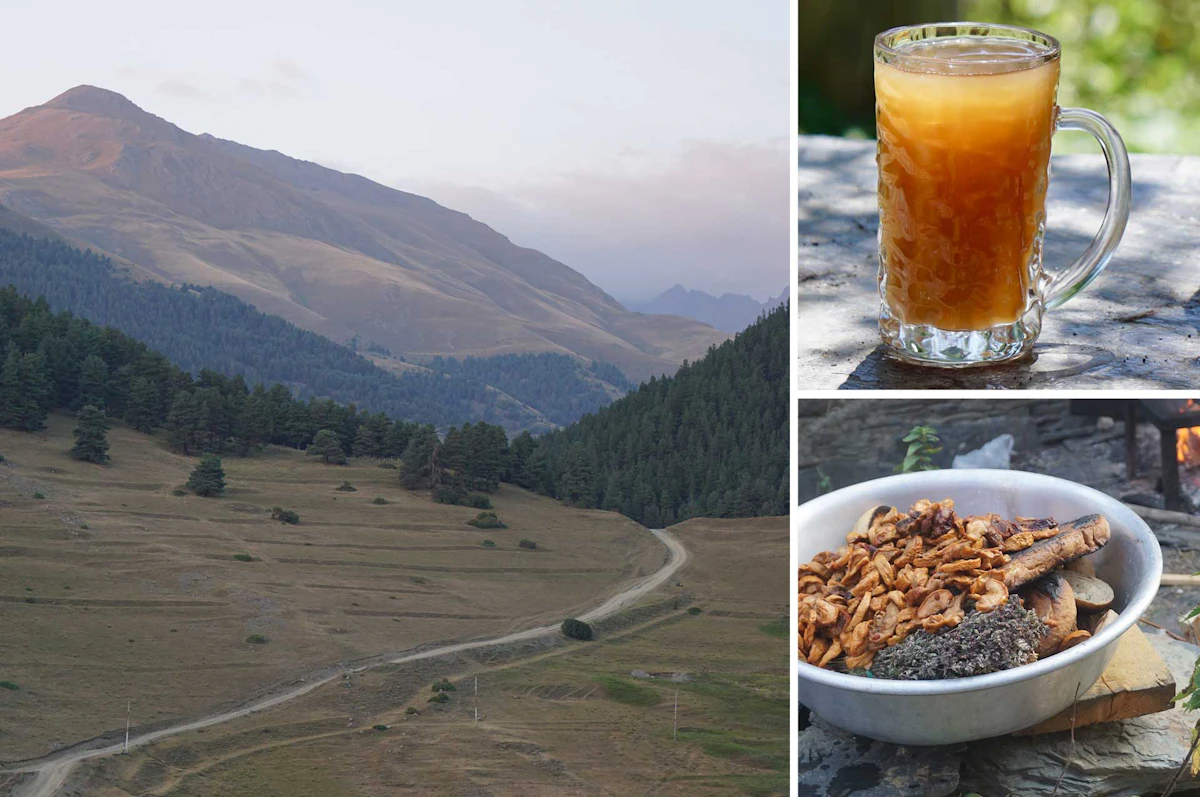
Clockwise from left: The rugged mountains of Shenako facing Dagestan; glass of aludi at Qeto’s guesthouse in Dartlo; toasted bread, dried apples and plums, and a wild herb bundle macerate overnight.
Tusheti’s Sacred Brewing Traditions
Brewing aludi isn’t just about making beer. It’s a tradition that’s bound up in Tusheti’s blend of pagan ritual, Orthodox faith, and survival tactics.
When I meet Lagazidze in Tbilisi, he speaks of aludi with the reverence of a believer and the tolerance of a schoolteacher. He explains that villages have separate temples for men and women—and, historically, brewing aludi was a sacred act reserved for men. In the past, brewers even secluded themselves in the forest for weeks before making it.
“In a place like Tusheti, you need strict rules and clear roles just to survive,” he says, and he ventures a guess: “Maybe that’s why only men were allowed to make aludi.”
But the rules are not as rigid as they seem.
The aludi I drank in Shenako was sweet, fruity, and lightly herbal, almost like a cloudy apple beer. Even at room temperature, it’s delicious. When I ask who brewed it, all eyes turn to the family matriarch, Darejani Oshoridze, a jovial 70-something native of Shenako with neat, tied-back gray hair, a warm smile, and a saintly patience.
“Women have always made aludi at home. I learned from my grandmother,” she says through a translator—her granddaughter, who may be next in line to learn the family trade.
Unlike ritual aludi, the household versions are often made by women and can follow entirely different recipes. Oshoridze describes a process that resembles the making of farmhouse kvass. She begins by toasting bread over an open flame. When it’s cooled, she puts the toasted bread into a brew bag with dried plums, apples, and juice, along with a secret bouquet of foraged herbs—wild thyme, mugwort, and others that only she knows.
The next day, she boils the bag in a pot of water for two hours, topping up the liquid as it evaporates. After about an hour, she adds hops. Once cooled, she filters aludi into plastic jugs. Most of it stays at home, shared with family, friends, and guests. The rest goes to her granddaughter, Daji, who sells it at the Above the Clouds café on Abano Pass.
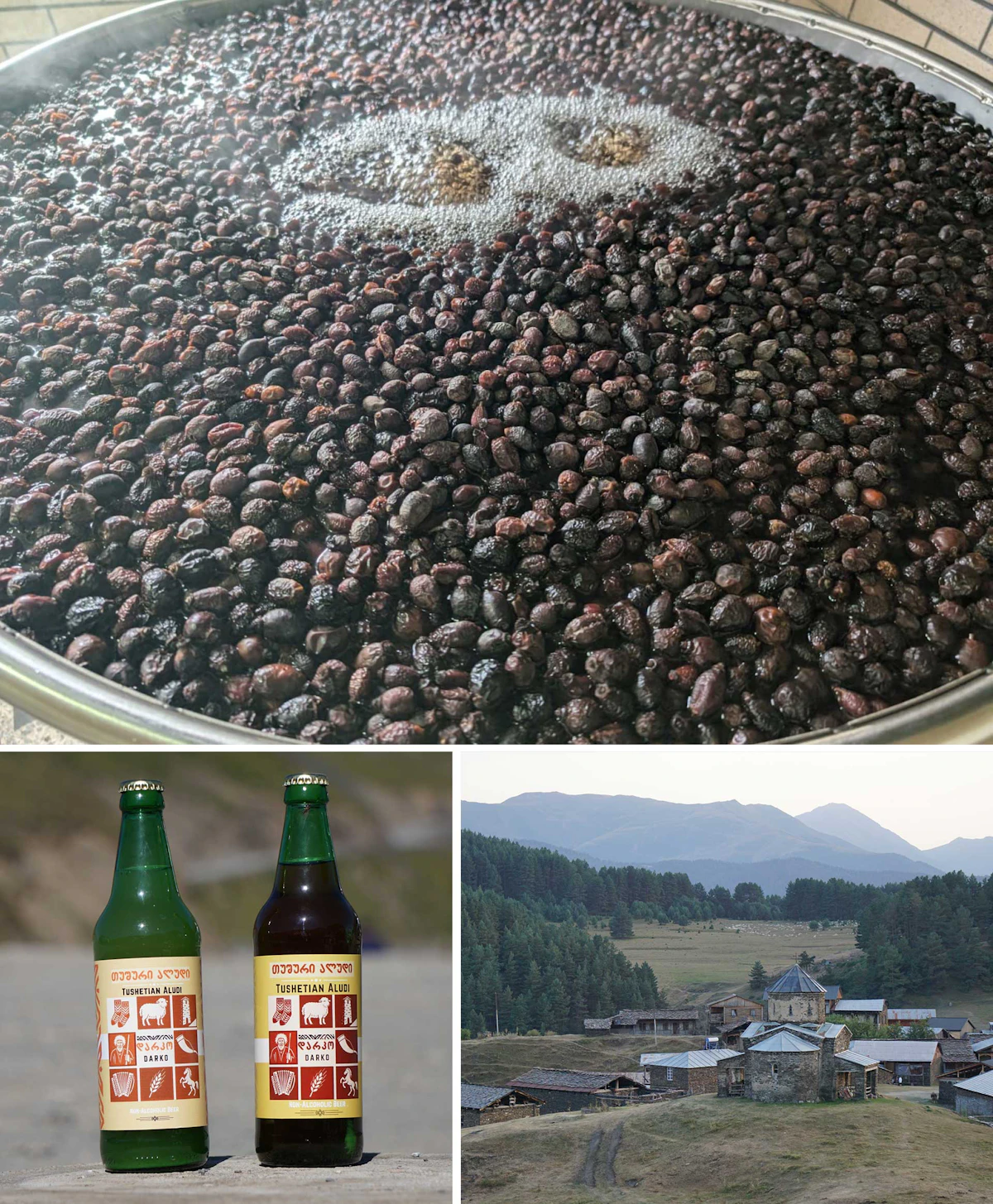
Clockwise from top: Black hawthorn gives Darko’s aludi a natural sweetness; the village of Shenako with the church in the foreground; bottles of Darko aludi at the Albano Pass.
Maintaining the Traditions
I had stopped at that cafe on my way into Tusheti, and there I noticed a beer brand I’d seen before: Darko, the local word for mash. On the back of the label, I found the email contact for the brewer, Mariam Tavberidze, a Tush woman living in the Alvani Valley.
When I reach out to her, I ask how long women have been making aludi. “Since ancient times, during Tush festivals, beer has been brewed in large quantities only by men,” Tavberidze says. “In the family setting, of course, women could brew.”
Tavberidze says she learned from her grandmother, who always made aludi for family celebrations—in Tusheti, they brew beer for everything from births and deaths to religious festivals. However, the tradition of making aludi at home is at risk, as more young Tush leave the highlands for the city.
“It’s very rare to find women continuing this tradition at home,” Tavberidze says. “Usually, it’s only grandmothers who still brew.”
Tavberidze says she hopes to buck that trend. After studying the brewing traditions with different families in Tusheti, she began making and packaging Darko earlier this year at Kisturi, a small brewery that makes traditional, Chechen-style nonalcoholic beer in the Pankisi Valley.
Before summer, she released 2,000 bottles of two types of beer. Each is made largely according to tradition and includes wild produce. One is sweeter and darker, laced with hand-picked black hawthorn and rosehip. The other is golden and dry, made with wild hops but without sugar.
I drank the latter during my hike up to Shenako. It tasted like a shandy and was perfect on a hot day.
“My main goal is to preserve and share the authentic Tush beer tradition,” Tavberidze says. Releasing Darko “was a major step in continuing our heritage.”
They don’t brew aludi for hikers (let alone beer writers), but it’s easy to understand why Georgians such as Tavberidze, Lagazidze, and Oshoridze feel such responsibility for their heritage. This reverently treated traditional beer represents their culture and their history—and it represents a way of life that could vanish, if no one preserves it.
