

The Danish farmer was tired of the burial mound that was always in the way when he plowed his fields, so he was digging to remove it when his shovel suddenly hit something hard. Scraping away the soil, he realized he’d found an oakwood coffin.
Rather than open it himself, the farmer immediately alerted the Danish National Museum, which dispatched an archaeologist to travel across Denmark to Egtved, in the chill of February 1921.
Inside the coffin, the archaeologist found the remains of a young blond girl, buried in a tunic and a short string skirt, with a large brass disc resting on her stomach. Next to her was a small bucket made of birch bark; it contained the dried-up remains of some drink. Analysis indicated that she’d been buried in the summer of 1370 BCE. For reference, that’s about a millennium after the pyramids and half a millennium before the founding of Rome.
News of the find caused a sensation in 1920s Denmark: Suddenly, it was possible to visualize a Bronze Age Dane—and a rather daringly clothed young girl, at that. The outfit made some think of a dancer, and the drink in the bucket made her even more interesting.
The drink proved to be made of wheat, honey, cranberries, and lingonberries, and it had been flavored with bog myrtle, or Myrica gale—in other words, it was a sort of mixed wheat-and-berry beer with honey.
Glimpses of the Grogs
There was a lot of speculation about this “beer” in the decades to follow, but it was difficult to conclude anything from just a single find.
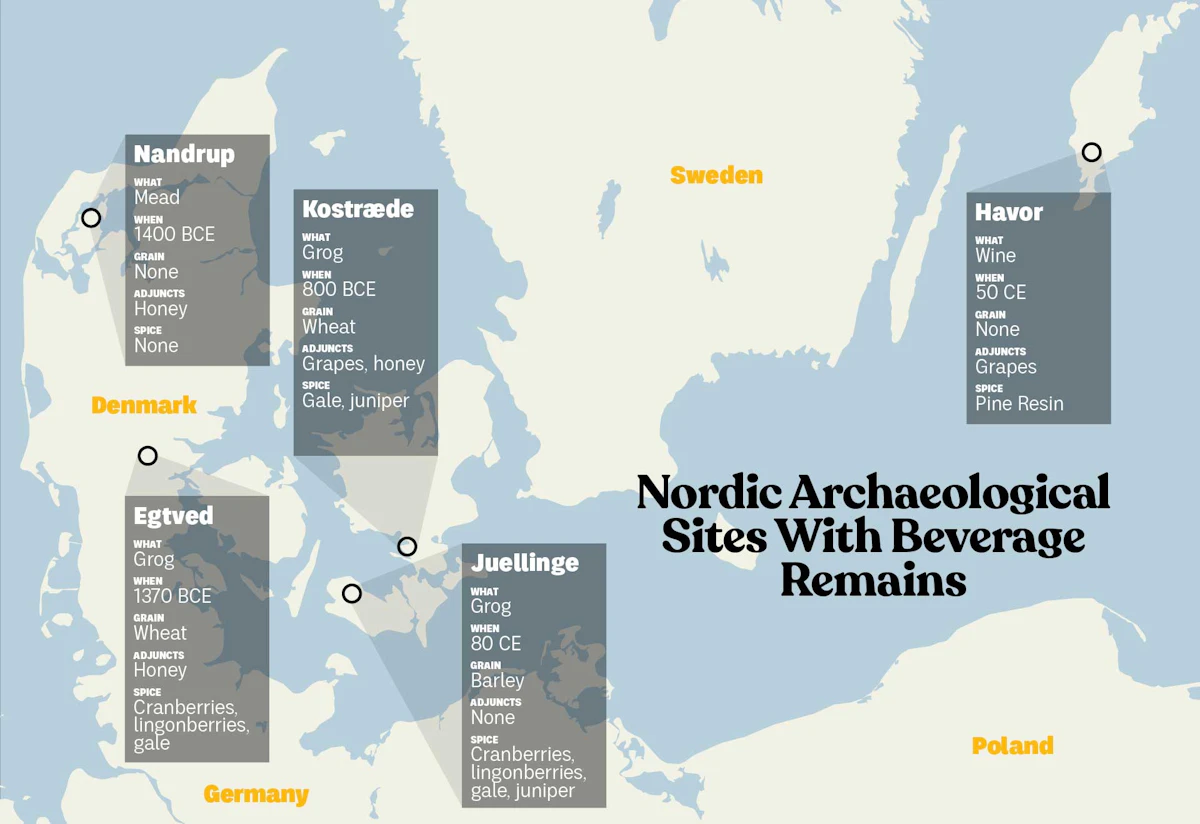
That changed in 2013, when Patrick McGovern and colleagues at the University of Pennsylvania published a new analysis of four archaeological drink finds from Denmark and Sweden. Their finds, and the similarity with the Egtved Girl’s drink, led them to coin the name “Nordic grog” to describe these ancient beverages.
For the most part, archaeologists use microscopes to analyze food or drink finds, trying to determine the species of the ingredients by looking at the shapes of, say, pollen grains or other small plant remains. McGovern, however, was using a new method: chemical analysis of the substances that were in the drink. With this new method, McGovern led a groundbreaking series of analyses on ancient drink finds from around the world. The discoveries won him a nickname: “the Indiana Jones of ancient beverages.” (Sadly, McGovern died unexpectedly on August 23, 2025.)
Analyzing the four finds, McGovern was able to show that one was a mead, one was a wine, and two were mixed or hybrid beverages.
The wine was found on the island of Gotland; dated 50 CE, it showed that wine already was being exported from the Mediterranean by then.
One of the mixed drinks, from Juellinge and dating to 80 CE, was very similar to the Egtved Girl’s. However, it was made from barley instead of wheat and contained no honey, but it also included cranberries, lingonberries, and gale—plus juniper. The other mixed drink, from Kostræde around 800 BCE, contained honey, wine grapes, gale, and (again) juniper.
It’s not easy to say what all this actually means because there are so few beverage finds from that long ago. In fact, I only know of 10 finds from Denmark dating to before 500 CE, and several are incomplete or uncertain, so there isn’t a whole lot of information to work with.
Making Some Inferences
Some people have taken the concept of Nordic grog—being a mixed beverage—to mean that beer, wine, and mead didn’t become separate drinks until later in history.
However, that doesn’t seem right: There are two mead finds from 1400 BCE, a pure wine from 50 CE, and a pure beer from 50 CE (Skudstrup). So, clearly, “pure” drinks also existed. In fact, there are more pure finds than grogs.
Two of the grogs were found in graves, and the graves are clearly those of high-status people. Ordinary farmers couldn’t have afforded letting Egtved Girl’s metal jewelry go into her grave, nor could they have raised the huge burial mound over her. The Juellinge grave contained very expensive glassware and a bronze wine-drinking set, imported from the Roman Empire. The last grog, in Kostræde, came from a buried hoard of expensive objects, including gold earrings.
One thing that stands out clearly in the archaeology of prehistoric Europe is that princes and chieftains were putting enormous resources into alcoholic drinkware—and into the drink itself. Drinking was an arena for showing off—that notorious pastime of the rich—and that’s likely how Mediterranean wine made it all the way to Gotland: simply because it was expensive and exotic. Some of the metal drinkware from this time is big enough that you could comfortably bathe in it, and this from a time when all metals were precious.
You can glimpse some of this through the Old English epic Beowulf, which takes place in Denmark. In the epic, the monster Grendel ravages the “mead hall” of the local ruler, Hrothgar. Hrothgar’s warriors seem to spend most of their evenings in that hall, drinking. When Beowulf, the hero, arrives from over the sea, he introduces himself over horns of ale and mead, and the talk is all of past deeds and exploits—showing off in words, essentially.
So, maybe the grogs were made by people who wanted to make something more sophisticated and expensive than a plain old beer? After all, every farmer had grain enough for brewing because they made their living by growing grain for food. Honey, on the other hand, was expensive. (It still is, but it was much more expensive back then.) Wine was very costly indeed. Even berries weren’t easy to come by because they ripened at the same time as the grain harvest, which meant farmers had no time to pick them.
The spices used in these drinks are no less unusual. There is no sign of hops in beer in Scandinavia before the seventh century, so these beers would have tasted very different from what we know. Gale is the most famous of these ancient spices, not least because it was found in the 1929 analysis of Egtved Girl’s drink, and it was found in both the other grogs as well. In fact, we can trace the use of gale in beer through all succeeding periods and even surviving in farmhouse ale into the 20th century, especially in Estonia and Sweden, but also in Denmark. (For more about brewing with Myrica gale, see Special Ingredient: Bog Myrtle.)
McGovern found chemical traces of juniper in both the grogs he analyzed, and that’s remarkable because no other analyses of ancient drinks have found juniper. However, that’s also easy to explain. Juniper pollen is unstable and doesn’t survive very long, so the other analyses—done with microscopes—likely wouldn’t have found any juniper pollen, even if there had been juniper in the beer.
The surprising fact is that out of all the ancient beers analyzed with McGovern’s method, two out of two contained juniper. Of course, using juniper in farmhouse ale is still very common today.
Toward a Recipe
There isn’t enough information from the archaeological find to put together a definitive Nordic grog recipe—not least because the three we know of clearly are different from each other.
However, it’s possible to make some guesses. Malt, honey, cranberries, lingonberries, gale, and juniper seem the most common ingredients, though not necessarily all in the same beer.
What malt, though? We know almost nothing about malting in this era, but two finds from Sweden and Germany were both of smoked malt. On the other hand, sun-dried malt would not leave archaeological traces, and it would give the other ingredients more room to shine. As for the proportions, nobody has any idea about those—although if Nordic grog really was a status drink, you’d expect it to be strong. (Whatever “strong” meant in 1370 BCE.)
Then there’s the question of brewing process. Big cauldrons did exist in the Bronze Age, but whether they were used for brewing or for serving beer isn’t clear. Most people definitely could not afford them, so stone beer must have been far more common. (See Fire & Brew-Stone.) If this was a high-status beer, then maybe it could have been an early example of a cauldron-based beer.
Putting together all the pieces: We could imagine a beer made from sun-dried wheat, with honey, cranberries, and lingonberries. Put all of that into the lauter tun, then pour on hot water. Lauter through juniper branches with gale, then cool the wort to body temperature and pitch some farmhouse yeast culture with all the strains still in it.
If you want to experience Nordic grog for yourself, you can of course travel to Denmark. They’ve rebuilt the Egtved Girl’s burial mound, and there’s a nice little museum next to it. The Danish National Museum and Moesgård Museum have jaw-dropping exhibits from this period, including the Juellinge woman, Roman drinking sets, silver cauldrons, and many more things to help you dream of Bronze Age drinking.
Bryggeriet Skands in Brøndby, Denmark, makes Egtvedpigens Bryg (the Egtved Girl’s Brew), a wheat beer with honey, gale, and berries. However, it’s a boiled, carbonated beer fermented with a single yeast strain, and it includes hops. It’s more like a slightly odd German hefeweizen than Egtved Girl’s drink, unfortunately.
So, unsurprisingly, you’re probably best off brewing this one yourself. Watch out, though, lest serving it summon Grendel, come to ravage your own mead hall.
