

Nagardo® is a naturally derived microbial stabilizer made from a purified mixture of glycolipids produced by the edible mushroom Dacryopinax spathularia (sweet osmanthus ear). It disrupts microbial cell membranes, providing broad protection against spoilage yeast and bacteria.
Because it is water‑soluble, shelf‑stable, and direct‑addition friendly, Nagardo can be incorporated into beverage production without special dosing equipment or complex safety procedures.
Want to learn more about Nagardo? See “Introducing Nagardo: A Revolutionary New, Natural Microbial Control Agent.”
Nagardo in Nonalcoholic Beer
Nonalcoholic (NA) beer is uniquely vulnerable to microbial spoilage for several reasons. With little to no ethanol present, NA beer lacks one of the most fundamental natural hurdles against microbial growth. These beers also tend to carry more residual nutrients, giving spoilage organisms more to feed on. Modern NA production also often includes late additions such as dry hops, fruit purées, botanicals, or flavorings that can introduce microorganisms and/or substrates, further increasing spoilage and refermentation risks.
Where Nagardo Fits
Nagardo® is an excellent alternative to tunnel pasteurization and preservatives. Many breweries don’t have the space, budget, or throughput to justify a tunnel pasteurizer, and alternative preservatives such as sorbate or benzoate can create noticeable sensory impacts in beer. Velcorin® is a strong microbial control option in many beverages, but its chemistry is not compatible with typical beer pH.
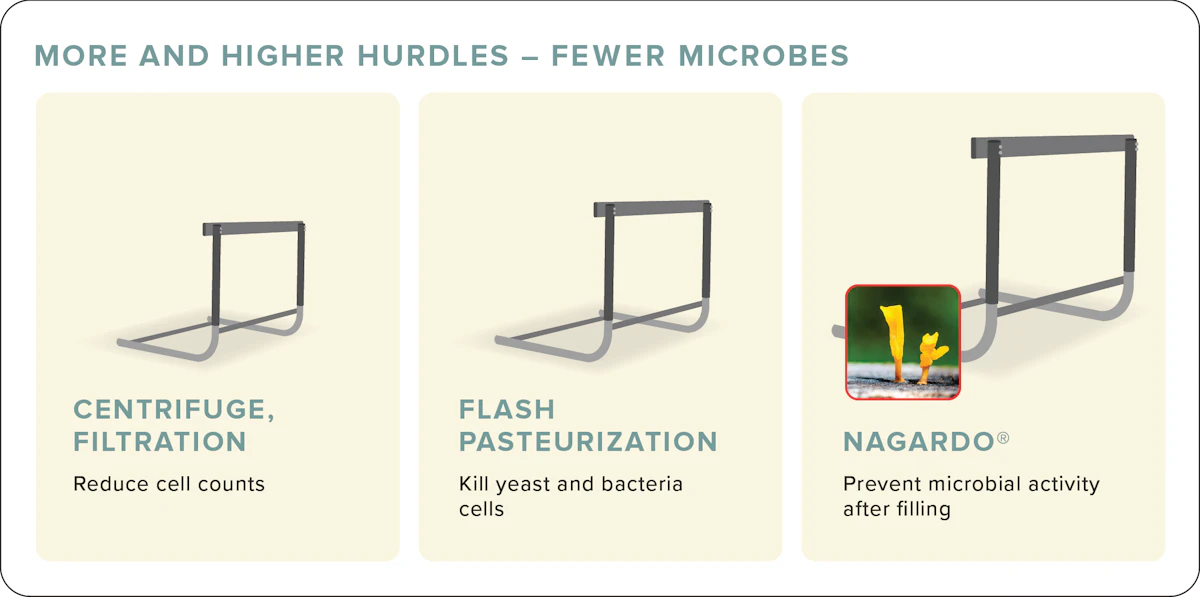
Nagardo, on the other hand, is effective across beer’s typical pH range. When combined with standard process controls such as centrifugation, filtration, and/or flash pasteurization, Nagardo helps build a reliable multi-hurdle strategy for NA beer.
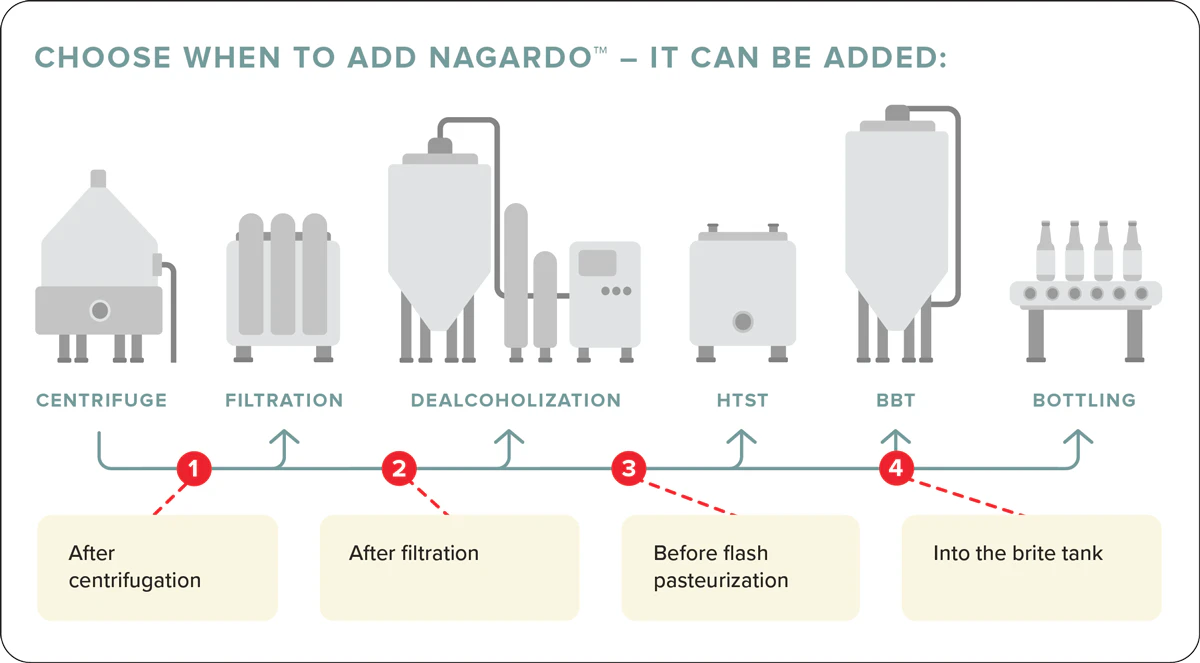
Note: Nagardo can be used in NA beer upon formula approval by the TTB.
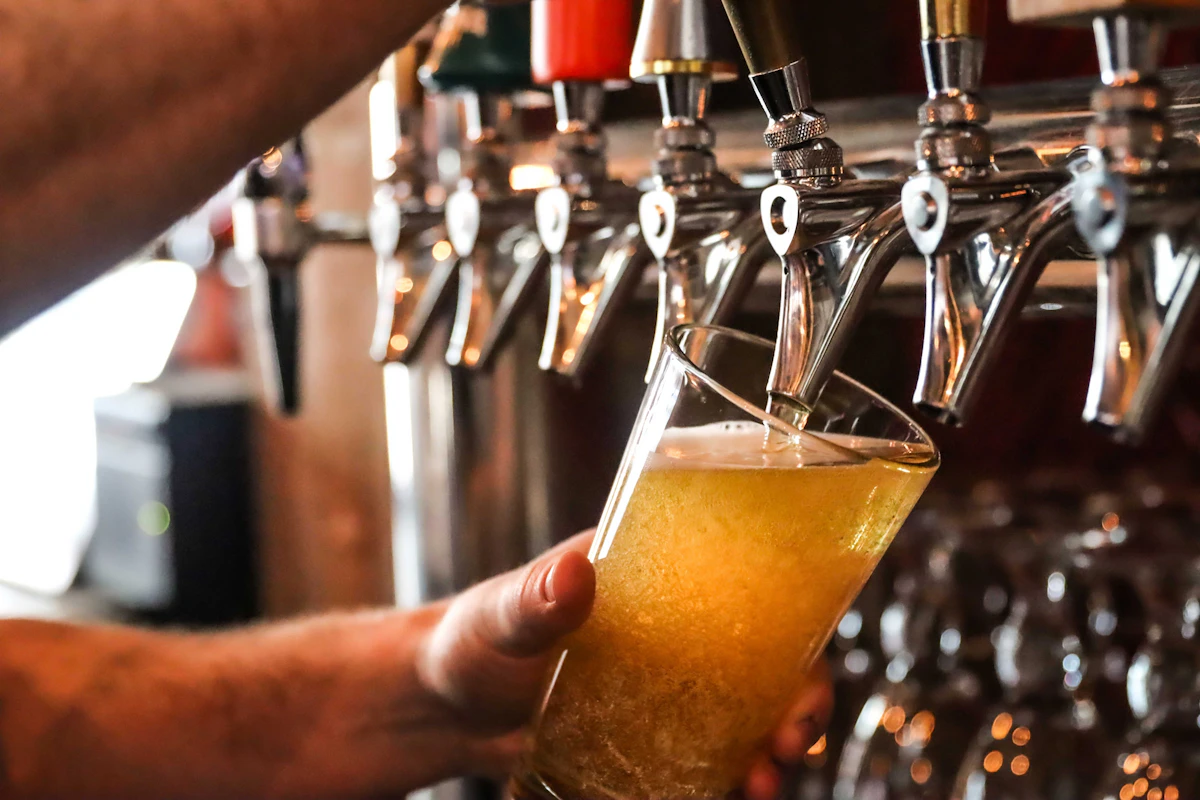
Nagardo Enables NA Beer on Draft!
NA beer on draft has historically presented stability challenges. Traditional kegging depends on alcohol content and strict cold-chain storage to limit microbial growth. Because NA beer lacks alcohol’s inhibitory effect and often contains more nutrients for microbes, kegged NA beer has long been viewed as a high‑risk format.
Nagardo changes that. When dosed into the brite beer tank (BBT) and mixed evenly with CO2 injection, Nagardo remains present through packaging and helps maintain microbial stability, including in kegs. Because Nagardo doesn’t require any process changes or specialized equipment, breweries can stabilize NA beer in a way that finally makes kegs a viable and scalable format.
Nagardo in Ready-to-Drink Beverages
Ready‑to‑drink (RTD) beverages are fully mixed alcoholic drinks packaged for immediate consumption and include products such as canned cocktails, spritzers, vodka sodas, and coolers. The category has grown quickly in recent years and spans a wide range of formulas. The base alcohol varies (typically spirit, malt, or wine), and there are almost infinite possibilities for fruit, flavor, or concentrate additions. Therefore, these beverages vary widely in pH, sugar content, microbial load, and microbial risk and can be complicated to stabilize.
Why Is Stabilization So Complicated in RTDs?
Many producers making RTDs are existing breweries and distilleries, and RTDs can present new stabilization challenges compared to beer, spirits, and other traditional beverages.
Many RTDs have such additions as flavoring, concentrates, juices, fruits, wine, and ciders. Some of these products are prone to oxidative damage, which can manifest as browning, loss of aroma, and development of bruised apple/honey character. Some of these additions can also cause “colloidal instability,” which can result in filtration challenges, hazes, and precipitates.
Refermentation
Many RTDs contain residual sugar in the additions mentioned above. Even if these products are aseptic, their residual sugar can be consumed by spoilage yeast and bacteria picked up before or during packaging and result in refermentation on the shelf.
While residual sugar is the primary reason for refermentation, many organic acids present in fruits (and even ethanol itself!) can be metabolized by certain spoilage organisms. Therefore, it’s common to see additional antimicrobial measures employed in RTDs for extra insurance on the shelf.
Co-packing
Many RTDs are packaged at co-packing facilities. This can mean that the producer is removed from the stabilization and packaging process, which is the final critical control point for the product. Finding a knowledgeable co-packer with the right capabilities to stabilize your specific product is critical, especially if you personally don’t have the expertise.
Where Nagardo Fits
Nagardo® is well‑suited for RTD production for several key reasons:
- Broad pH efficacy: Nagardo is effective across pH 2.5–7, making it adaptable to the wide range of RTD formulations on the market.
- Compatible with malt‑based RTDs: Velcorin®, a great option for stabilizing many RTDs, is not compatible with malt-based RTDs. Nagardo presents an excellent alternative in these beverages.
- Broad spectrum: RTDs often contain diverse substrates (sugars, organic acids, etc.) and can support a variety of microorganisms. Nagardo is effective against both yeast and bacteria, providing comprehensive microbial control.
Note: As with NA beer, Nagardo can be used in RTDs upon formula approval by the TTB.
Nagardo in Wine & Cider
In wine and cider, one of Nagardo’s most promising applications is as a reliable antimicrobial alternative to SO2. It can be used throughout the process to control yeast and bacteria when SO2 is undesirable and/or ineffective.
- When chemistry limits SO2 efficacy—Post-fermentation, pH limits the proportion of SO2 in its antimicrobial (molecular) form.
- For low-input wines—SO2 use must be minimized or eliminated.
- For canned wines—SO2 can react with aluminum cans to generate sulfur off-odors (H2S).
Can Nagardo Replace SO2?
Nagardo® can’t completely replace SO2 because it still provides antioxidant protection that Nagardo does not. The key is the dosage: The SO2 levels needed for antioxidant protection are far below the levels often required for antimicrobial protection. Nagardo enables producers to reduce overall SO2 usage to only the levels needed for antioxidant protection without sacrificing microbial control.
Use Alongside Velcorin
Wine and cider producers have the opportunity to combine Velcorin® and Nagardo®, using each where it excels: Velcorin (DMDC) as microbial protection during packaging and Nagardo earlier in production, in transportation, or in storage.
DMDC can technically be added at earlier stages, but it’s not typically used this way. The TTB caps total DMDC use at 200 ppm over the life of a wine, and because DMDC hydrolyzes quickly, it doesn’t provide lasting protection. For that reason, it is recommended to use the full 200 ppm at packaging—where the treatment is most effective—rather than dividing smaller doses across earlier stages.
By pairing Nagardo earlier in the process with Velcorin on the packaging line, producers can cover both ongoing microbial control and final package stability. This complementary approach builds a multi-hurdle system that minimizes microbial risk.
Note: For use in wine and cider, producers can evaluate Nagardo under TTB experimental use (27 CFR § 24.249) at this time.
Operational Simplicity
A recurring advantage across all beverage categories is Nagardo®’s operational simplicity:
- No specialized dosing equipment is required.
- No dedicated safety protocols are needed.
- It is water‑soluble.
- It can be added directly.
- It is compatible with existing antimicrobial treatments and practices.
This “easy on‑ramp” makes Nagardo ideal for small and mid‑sized beverage producers who may not have the infrastructure for more complex stabilizing technologies.
Contact us to learn more.