

Hop water isn’t a novelty anymore. It’s a high-margin, low-lift segment that’s growing faster than most other segments in the adult-beverage category. For breweries with the equipment and know-how to handle hops, it’s a natural product extension that meets changing consumer preferences without cannibalizing existing SKUs. No alcohol. No calories. No sugar. And with the right tools, no production headaches.
If you’re already using advanced hop products or exploring terpene brewing solutions, you are 90 percent of the way to producing hop water.
Here’s the other 10 percent.
The Foundation: Clean, Controlled, and Customizable
The following base recipe comes straight from our in-house development program. It’s designed for precision, minimal input cost, and maximum flexibility. This version is scaled for 5 gallons (19 liters), perfect for pilot batches or benchtop testing. Multiply everything by three and you’re at standard keg volume.
Basic Hop Water Recipe
5 gal (19 l) water
5–7 ml Abstrax Quantum or Omni (depending on desired intensity)
1.8 g salt (Diamond Crystal preferred)
Citric acid for pH sweet spot between 3.9 and 4.2 (shelf-stable at 4.6 or lower)
That’s your chassis. We’ve found that it is one of the most solid chassis to bolt bodywork onto and can serve as a foundation for artisanal innovation.
Flavor builds on top of this chassis. You can treat it like a hop base, a fruit base, or both. There is a 10 ml flavor ceiling per 5 gallons (19 liters), which gives you room to layer complexity without risking over-saturation. For example:
- 5 ml Strata + 2 ml Pineapple Skyfarm = tropical snap, IPA-adjacent
- Flip those proportions and you’ve got a more fruit-forward soda
Why Hop Water Works Right Now
It’s cheap to make. Compared to nonalcoholic (NA) beer or kombucha, hop water costs less in ingredients, labor, and time. No fermentation. No yeast. No tied-up tanks.
It’s fast. Dosing and carbonation can be done in a matter of hours. With water-soluble hop products, you can prototype new flavors by adding drops directly to carbonated water at the bench.
It’s scalable. Abstrax’s terpene and hop-oil products provide shelf-stable, batch-consistent flavors without the extraction loss, haze, or instability of traditional dry hopping.
It sells. According to NielsenIQ and Brewers Association data, the U.S. hop-water market grew from $2.3M to $5.5M between 2020 and 2022. It continued growing another 20 percent year over year into late 2024.
It serves new customers. Millennials and Gen Zers are actively reducing alcohol consumption. Sober-curious drinkers, wellness-minded buyers, and even diehard IPA fans are all reaching for hop water.
Layering Flavor: A Modular Approach
Hop water doesn’t have to be a single-hop showcase, although varietal trials are useful tools for education and tasting flights. The bigger play is in fusion: combining hops and terpenes to create distinct, mood-forward beverages.
This table shows a few of our proven hops and flavor pairings.
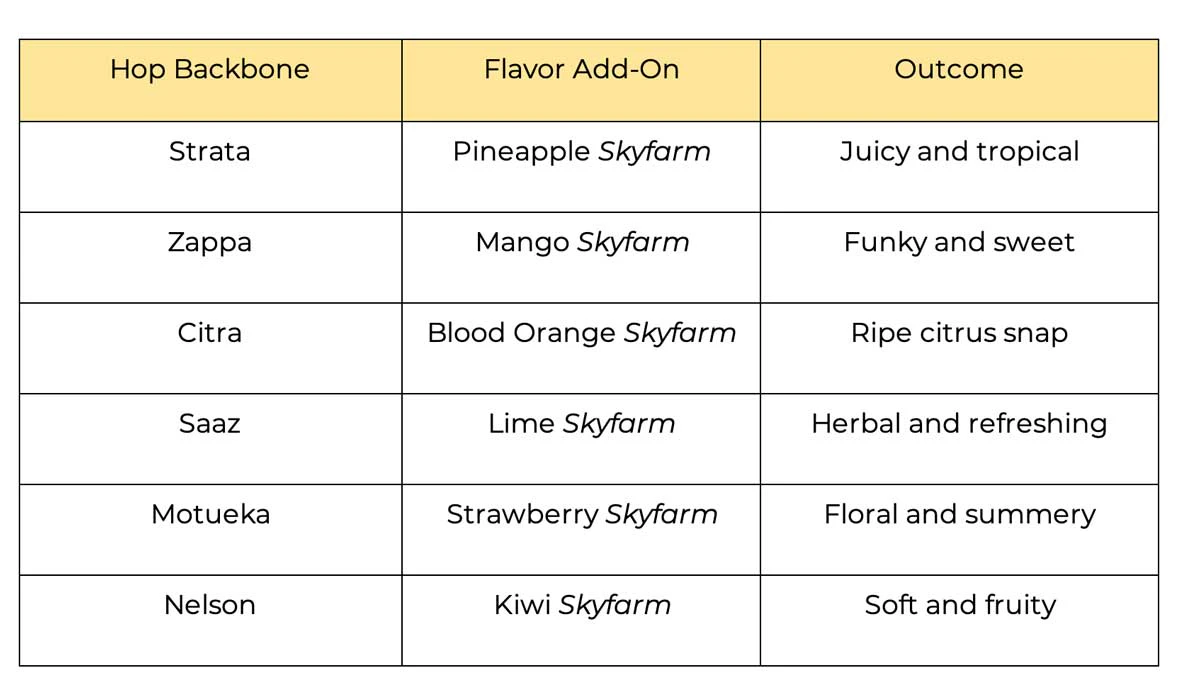
These blends can be built and tested within a day, packaged within a week, and on shelves without interfering with your core beverage production. No fermentation time means you can pivot quickly to seasonal flavors, regional collabs, or trending profiles without worrying about time of year or other supply-chain issues.
Behind the Scenes: Why the Inputs Matter
Quantum Brite and Omni aren’t just hop oils. They’re the product of advanced analysis and precision extraction, built to deliver maximum flavor and aroma without the drawbacks of traditional inputs.
- Quantum is essential oil pulled directly from the hop cone. It captures varietal-specific aromatics without bittering acids or light-sensitive compounds that create flavor defects over time.
- Omni replicates those same expressions using a fine-tuned blend of botanically derived compounds to scale with consistency.
Neither Quantum nor Omni contains alpha acids, polyphenols, plant material, or any compounds that react with light to produce off-flavors. That means no haze, no astringency, and no fermentation risk. These products give brewers exact control over flavor profiles with a 100 percent utilization rate.
This is especially valuable in hop water, where there’s nowhere to hide off-flavors. Precision is critical, and with benchtop testing possible via direct dosing into carbonated water, you can iterate and finalize recipes in hours.
Commercial Realities
Costs: Lower than NA beer, lower than kombucha, and far lower than traditional fruited sodas or functional beverages.
Speed to Market: Days instead of weeks. Pilot batches can go straight to taproom release or small-scale distro.
Margin: Strong. Many brands price four-packs at $8–12. With COGS this low, the per-barrel return is attractive even at modest volumes.
Brand Benefit: You can experiment, diversify, and stay relevant in a changing marketplace without straying from core values or stretching infrastructure.
Final Word
Hop water isn’t just a fad or a benchtop experiment. This new category is built for the future of brewing. It gives you a direct path to meet the needs of new drinkers, broaden your offerings, and use the tools you already know how to wield. It works with your existing process and expands your ability to craft signature experiences with precision.
Whether you’re starting with a single varietal or layering terpenes to create something more dynamic and memorable, the platform is yours to explore. Every component can be fine-tuned. Every flavor can reflect your unique signature.
If you can brew beer, you can brew hop water. The real question is whether you want to let someone else beat you to it.
Want to get started? Learn more or request a sample kit at abstraxhops.com.