
Orval Brewery.
From The Oxford Companion to Beer
Abbaye Notre Dame D’Orval, one of Belgium’s six Trappist beer producers, is located in southern Belgium in the province of Luxembourg. The abbey gets its name from a legend in which the widowed countess Mathilda of Tuscany accidentally dropped her wedding ring into a spring on the site of the future abbey and assumed it was lost. She prayed to God for the return of her ring, promising to build a great abbey if she should see the ring again. Within moments a trout swam to the surface with the ring in its mouth. She is said to have exclaimed “This place truly is a ‘val d’or,’” meaning “golden valley,” and established a church on the site known as Orval. The trout with the ring in its mouth remains the symbol of the abbey. Orval has a long and storied past, with the first evidence of monks arriving in 1070 to begin construction of a church. The church was completed in 1124, and in 1132 joined the Cistercian order. Two events almost destroyed the community. First, a major fire in 1252 caused enough damage to consider closure. After much rebuilding over time, the abbey was burned and looted during the French revolution in 1793 and lay in ruins. In 1887 the Harenne family acquired the ruins of the abbey and its estate, and rebuilding work began in the 1920s. A brewhouse was installed in 1931, Orval regained its rank of “abbey” in 1935, and in 1948 its magnificent new church was finally consecrated and headed by a Trappist abbot. The Harenne family remains involved in the day-to-day affairs of the brewery, which remains inside the walls of the striking Art Deco abbey buildings.
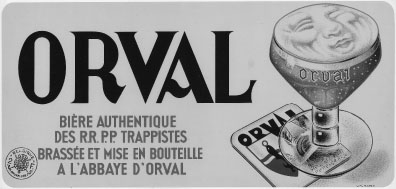
Decal, c. 1930. The Belgian Trappist brewery at Orval produces two beers, only one of which, simply called Orval, is available for public consumption. pike microbrewery museum, seattle, wa
True to the Trappist ideals, the Orval abbey produces both beer and cheese. Although a brewery was probably always present in the abbey, it wasn’t until the 1930s that Orval distinguished itself as a brewery. Orval makes only two beers, and only one of these makes it into the outside world. This beer, simply named “Orval,” is an outlier among Trappist beers, a honey-colored pale ale of distinctive character. The beer is a relatively light 6.9% ABV, but with a unique taste profile due mainly to the yeast strains used, the dry-hopping with fresh Hallertau, Styrian Goldings, and French Strisselspalt hops. Most unusually, the beer is partially carbonated, then bottled with a small dose of priming sugar and a blend of yeast including the “wild” yeast strain Brettanomyces.
This definition is from The Oxford Companion to Beer, edited by Garrett Oliver. © Oxford University Press 2012.