

To Thee! Pils™ is a sister to North Star Pils™, which has been produced at Rahr’s Shakopee, Minnesota, facility since 2019 and is used in numerous award-winning beers. To Thee is made at Rahr’s Alix, Alberta, malthouse from Canadian barley and malted to a slightly different spec. It’s available in Canada and the western United States, with other locations by special order.
How did this new malt come to be? Grab a beer and retrace the journey with us.
How It Started
The story of To Thee starts not at a malthouse but at a brewery. pFriem Family Brewers in Hood River, Oregon, opened its doors in 2012 with, as brewmaster and cofounder Josh Pfriem puts it, “a big focus on Belgian-inspired beers, but also German-inspired lagers.”
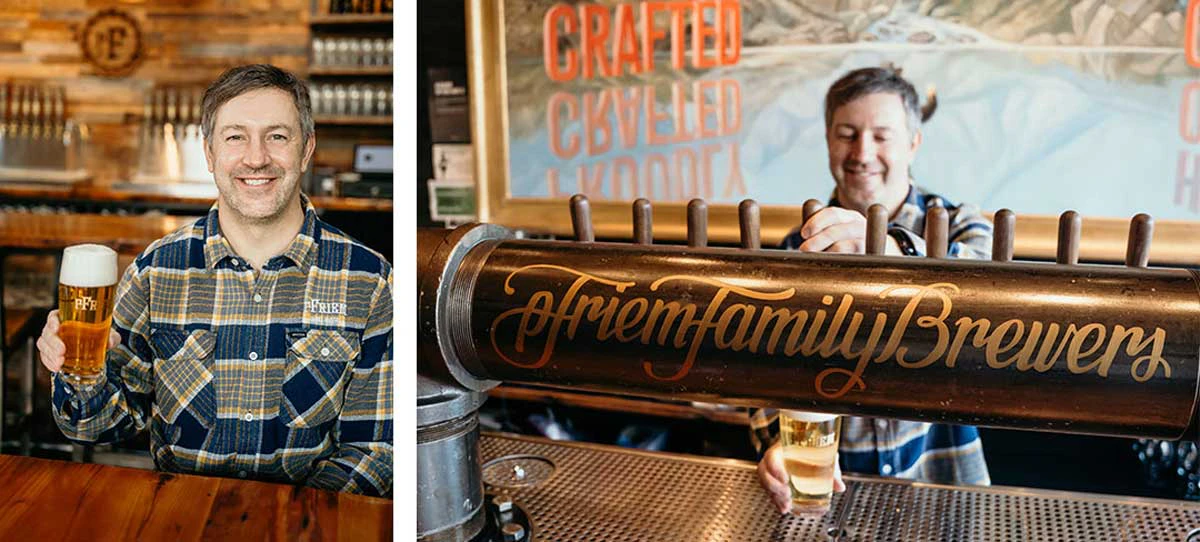
“Over my career, I’ve had the opportunity to play with a lot of different types of malt,” he says. “We had done a lot of trials and talked to some of the best brewers in the United States, from our perspective, and they were all using Rahr pale, or a good chunk of them were. We got silos for Rahr and Gambrinus, and those malts have kind of been our bread and butter for the majority of our history. And at the time, Rahr and Gambrinus were two separate companies. And then, you know, they became one company, which was very convenient for us!”
Fast-forward through a decade of growth that also saw a pandemic, supply-chain disruptions, and a poor North American barley harvest in 2021, and pFriem’s needs evolved.
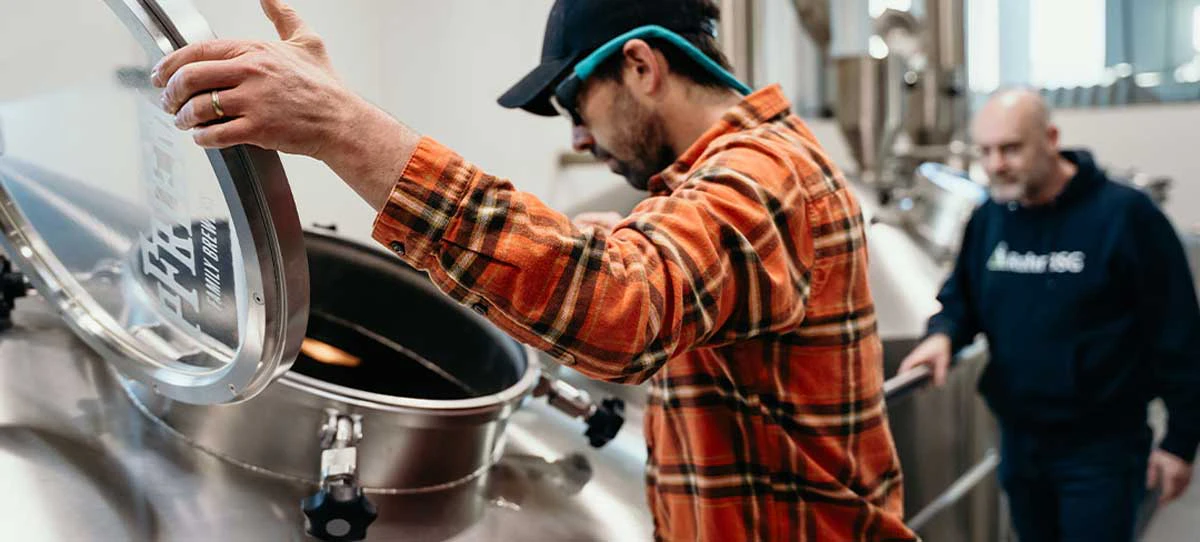
“To be honest, it wasn’t our concept to create a new malt,” says Campbell Morrissy, PhD, barley scientist and pFriem’s director of brewing operations. “The 2021 crop was kind of an eye-opening experience. We started seeing issues with pFriem Pilsner, which is a canary in the coal mine for the brewery. If things are going wrong with that beer, there are bigger-picture things going wrong. That created a lot of conversation, and we built a lot of trust with folks at RahrBSG, and from there it just kind of snowballed.”
“Those conversations became less about the past and more about the future—like, what do we want?” Josh says. “And what we wanted wasn’t necessarily on the market. But we were able to take it from brewing terms, and with Campbell’s background in barley breeding and genetics, we were able to translate it.”
“There were things that were very important to us, like very low color,” Josh says. “But also, very low DMS precursors and easy to brew with. We wanted it to be clean and flavorful, but not ‘noisy.’ We got real granular and nerdy around the different flavor components. We had to because our flagship beer, pFriem Pilsner, is so steady and … so naked.”
Maltsters Like Beer, Too
“When I think of the U.K. or Germany, malting is such an intrinsic part of brewing,” Campbell says. “They’re not like separate. And so, as a brewer you need to know malting, and as a maltster you need to know brewing. And I think that we as an industry in the U.S. kind of really focused just on the beer, and we miss some of that. But maltsters and brewers both like beer!”
Thanks to Campbell’s cross-disciplinary training (he holds an MSc in Brewing and Distilling from Herriot Watt and researches barley’s contribution to beer flavor at Dr. Pat Hayes’s Barley Project lab at Oregon State University), the pFriem team was able to explain their needs and wants in terms of malting and barley sourcing.
“We got to a point where we were looking for something very … specific to our needs,” Josh says. “And because of the relationship that we had, we were able to open up this transparent conversation and then, you know, really bring in Campbell’s expertise from a malting perspective.”
“Ultimately, that led us toward creating something new,” he says. “Campbell was able to work with Matt [Letki, RahrBSG’s senior director of bulk malt sales] to say, ‘Specifically, these are the specs that we would like to hit. Does this malt exist?’ And when we found out the malt didn’t already exist, Matt said …”
“… Let’s Take It to Alix!”
Rahr Malting Co.’s Canadian facility is situated at Alix, about two hours north of Calgary in the middle of Alberta’s prime barley-growing region. Built in 1993, the tower-style malthouse supplies western North America. Campbell remembers seeing it rise out of the prairie when the pFriem team visited. “It kind of comes out of nowhere.”

“And then beyond the sheer size of it, getting to see the quality control … what was really cool was the care. It’s a big, automated plant in the middle of the prairie that has all the trappings of something that could be very anonymous. But then [there are] these folks who’ll tell you, ‘I’ve been here 15 years, I’ve been here 30 years’ and they really know every little inch of that entire plant.”
Between Matt on the RahrBSG side and Campbell on the pFreim side, both of them with malt and brewing backgrounds, there was a project a team that could speak to both sides of the barley continuum.
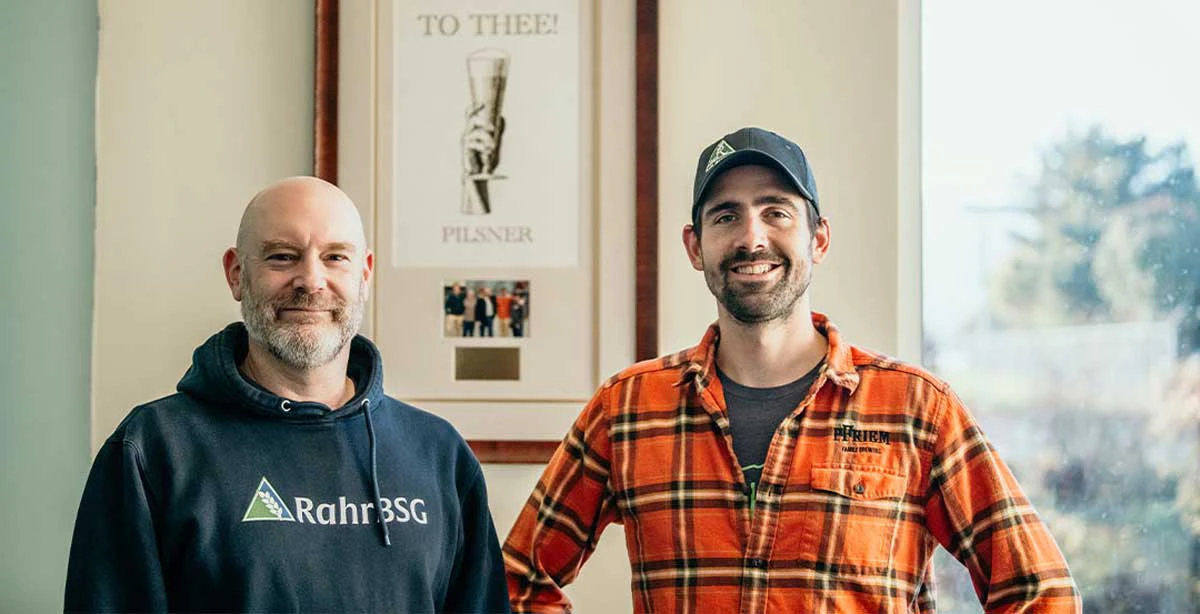
“So, Alix is a very, very capable malthouse for producing pilsner malts,” Matt says. “It’s also in a really great area for producing barley for pils malt. The high altitude and very dry conditions of Alberta really make a difference when you’re trying to make a world-class pils malt with that real delicate, pleasant flavor of this malt.”
That’s one part, Matt says. “But the other part is that barley varieties continue to develop. We’ve been very fortunate in the last 20 or so years in Canada that we’ve had some very high-quality barley varieties come through. So, the right barley variety, the right process, and then the partnership together kind of really helped us to build this malt.”
“It was so cool then to be able to go to Alix and really go deep into one of the more technical facilities in North America making malt,” Josh says. “Like Campbell said, the attention to detail of the team there—it’s on a very different scale, but still with that same soul and heart [that we bring to our product].”
Campbell says: “I’ve said a number of times that I always thought the Rahr pale ale that comes out of Alix is the best malt I’ve ever used. And then getting to collaborate on another malt that comes out of there … I’m pretty happy with what we get to work with.”
How It’s Going
After months of development, pFriem took delivery of their first shipment of To Thee in February 2025.

“What was it like to taste the beer with the new malt for the first time? A relief,” Campbell says. “It was like, there’s been so much work leading up to this—and then once it was off to the races.”
Walking us through the brewery on a day with multiple turns of pils and IPA running, Campbell and Josh talk about the beers that To Thee goes into and what it contributes.

“First and foremost,” Cambell says, “To Thee is the backbone of pFriem Pilsner. It’s two thirds of the malt bill (the other third being Weyermann®). It’s a really important piece because it’s got a nice, flavorful backbone, not too intense. It’s really clean, and it’s really stable from lot to lot. We’re also starting to use it as the backbone for our hoppy beers, especially some of our really lean and clean West Coast IPAs. And that’s really allowed that hop saturation to come through and really just make sure that the picture you’re painting is this really intense hop expression.”
Josh picks it up, “We wanted something that was very clean and allowed other parts to sing but still be a very supportive flavor. And I think that is where To Thee has offered us something unique and different than we brewed in the past. And now it’s become such an important part of our brewing program.”
pFriem’s brewmaster and cofounder concludes with one of his favorite phrases: “We’ve been using this malt for about a year. We’re continually blown away by its consistency, flavor, quality, and versatility. We’re winning a ton of medals with it. And beyond that, we’re stoked.”
You Too Can Be Stoked
Beginning in 2026, Rahr To Thee! Pils will be available in 55 lb (25 kg) bags as well as bulk—select RahrBSG warehouses in the western United States and Canada will stock it, with special order availability elsewhere.
Ask around and you’ll find it in the wild: Burgeon Brewing’s 9th anniversary collaboration brew, on tap at the RahrBSG booth during CBC 2026, and more to come. As always, reach out to your RahrBSG rep for more info and inspiration.
Addendum: What’s in a Name?
“I have to admit, the first time we heard the name, [To Thee!,] we were like ‘what is this about?’” Campbell says when we asked him about the initial reaction to the new malt’s name. “But then sitting down with Terry [Little, RahrBSG senior director of commercial operations] and hearing about the history of it and recognizing that throughline directly to our malt … we said, okay, this is actually really cool.”
What Terry explained is that “To Thee!” is an old Rahr family toast, going back through the generations to Rahr Malting Co.’s founding in 1847 (and maybe even beyond). Over the years, it’s been adopted by employees and migrated from the Rahr Shakopee campus bierstube out to events, meetings, and gatherings with colleagues and customers.
(It also happens to be the title of the company’s 100th anniversary yearbook from 1947, a woodcut from which served as inspiration for the new malt’s logo).
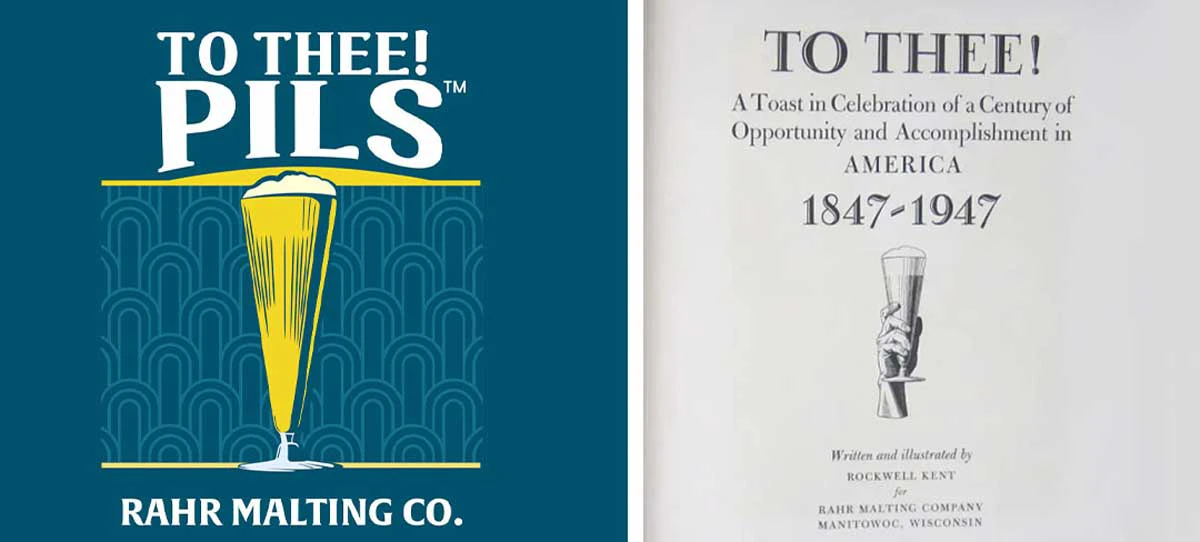
Campbell says, “It’s maybe reading into it too much, but it’s kind of speaking to that collaborative spirit of the whole brewing industry … this is how it should be done.”
Here’s how to toast, Rahr style:
- Glasses don’t have to be full, but they can’t be empty—refill if needed before proceeding to step 2.
- Make and maintain eye contact (this is very important).
- Clink glasses.
- Say (or yell, if so moved and the situation dictates) “To thee!”