

Brewing, it’s often said, is a blend of art and science. But humans have been making beer for far longer than we’ve been doing science.
While the ancient brewers of Mesopotamia didn’t understand yeast or biotransformation, they almost certainly strove to make each batch more palatable or more potent than the last. Staring into the turbid pools of funky brew, they may have thought, “I sure hope this batch tastes better than last season’s,” with only limited understanding of why some brews were better than others. Maybe a prayer to Ninkasi was the trick?
Thousands of years of brewing progressed from there, and beer got better, tastier, and more consistent. In looking for the moment when someone first fully integrated brewing and science, we might look to 1875. That’s when Carlsberg founder J. C. Jacobsen built the first dedicated brewery laboratory at his brewery outside Copenhagen, Denmark. The Carlsberg laboratory was at the cutting edge of organic chemistry, and it’s where they first isolated and identified a lager yeast strain.
A century and a half later, a brewery’s lab is still the engine that propels beer quality forward, and today’s tools and instruments are getting both more powerful and more approachable.
Brew Lab 101: Basic Beer Measurement
“You can’t optimize what you can’t measure,” says Chris O’Connor, VP of brewery operations at Denver’s Prost Brewing.
O’Connor says adding instrumentation to the brewery lab was a key part of the brewery’s expansion in late 2023. As Prost took on more contract-brewing clients, upgrading analytical facilities provided peace of mind.
“We open the aperture as wide as we can to see as much of the process as possible,” he says. “We’re using living things to make a product. We have to confirm what we get.”
Prost’s lab has all the toys, from brewery-specific instruments such as the CDR BeerLab, an analysis system that handles the wet chemistry tasks—measuring pH, total sulfur content, IBUs—to high-performance instruments such as the gas chromatograph, for detailed looks into the makeup of finished products.
That fancy gear is helpful, O’Connor says, but what’s more important are the mindset and approach. “Too many brewers make decisions based on vibes,” he says. Data should be driving more decisions, and brewers should try to strike a balance between sensory and analytical testing.
Data gathering in the brewery starts with the simple hydrometer. It’s the most basic piece of lab equipment in the brewery; the density measurements provide key markers for a fermentation’s progress, informing the brewer when wort or finished beer is out of expected spec.
Those simple tools not only supply the brewer with useful raw data, but they also help develop sound scientific practices in the brewery—such as taking good notes. The simple act of documenting the data generated on brew days and during fermentation is the foundation of a scientific approach, and a collection of historical data may be the most valuable by-product of the brewing process.
“You make sense of the sensory testing with a big data set,” O’Connor says.
When a brewery gets serious about gathering data and developing their lab, the first lab-specific equipment invested in is the microscope. It’s another simple tool, but it reveals the brewery’s precious microscopic workforce: the yeast. With individual cells now visible, they can be counted—with the help of the hemocytometer—and, once counted, they can be evaluated for vigor and vitality.
No longer does the brewer have to operate on vibes—they have data! Armed with these insights, the brewers can dial in precise pitching rates to tune fermentation profiles, harvest and repitch the used yeast—which are often better at their jobs a few generations in—and judge when to use a fresh pitch of yeast.
Cell counting and yeast management can lead to a leap forward in the quality of a brewery’s beer, and the microscope is only the first step in the lab’s influence on production.
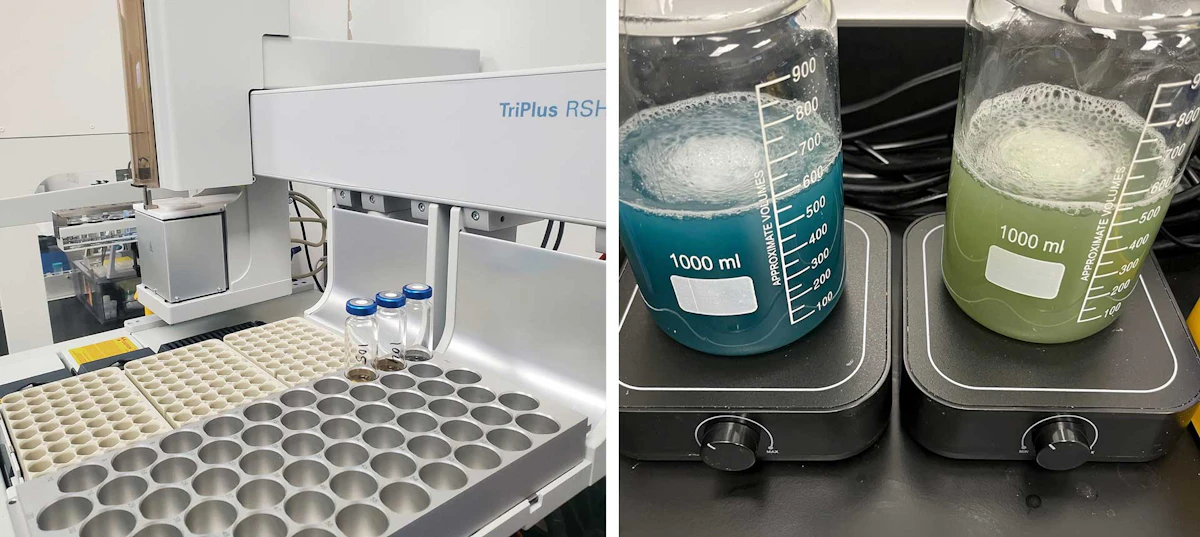
Left: The autosampler speeds up analytic work. Right: Samples on stir plates. Photos: Courtesy Prost Brewing
Brew Lab 201: Advanced Analyses
As any beer nerd knows, there are many more ways to quantify a beer than gravity measurements and pH levels.
Brewers measure a litany of stats, from the ABV, to IBUs, to SRM. These measurements aren’t academic; all these stats can be important indicators—among many others, as a brewery lab grows—of which processes can be tweaked or refined.
Even small improvements to processes can have a big impact on quality and consistency. While recipe design, tight processes, and careful sensory analysis are the cornerstones of high-quality beer, validation with lab testing can reveal where exactly to make those small improvements.
Jessie Smith developed her QC lab experience at Saint Arnold Brewing in Houston; she later started Queen City Quality Lab in her hometown of Buffalo, New York, to bring that experience to the small craft breweries. (Smith also is a regular columnist on QA/QC topics in the Brewing Industry Guide, a sister publication to Craft Beer & Brewing Magazine
Real-time PCR testing is a process for detecting specific DNA in a sample, and it’s a powerful tool for increasing microbial stability in finished beer. It’s a complex manipulation of molecular biology, wherein the test sample is treated with specific reagents and heated to induce the replication of DNA. Basically, a sample can be tested to confirm the presence of specific DNA from, say, the COVID-19 virus or brewer’s yeast. If you know which DNA you’re looking for, you can determine whether the sample contains some of that DNA.
The PCR instruments in the brewery simplify the testing by using prepared kits for detecting the major beer-spoilage organisms, such as Lactobacillus and Pediococcus. These instruments replace the time- and labor-intensive tasks of plating samples and watching for colony growth.
At 4 Noses Brewing in Broomfield, Colorado, a real-time PCR system supports a focus on microbial stability in the QC program. Amanda Oberbroeckling is the quality control director for all the brands under 4 Noses, including Odd13 and Wild Provisions. With styles ranging from traditional Czech-style lagers to nonalcoholic ales to gueuze-inspired sour beer and funky experiments across three facilities, Oberbroeckling says PCR testing is a way to monitor all the different microbes to ensure they don’t escape into parts of the breweries where they’re unwelcome.
“The technology for running PCR tests on beer has really improved over the last 10 years,” she says, and it’s streamlined and quick enough to run the instrument several times a day. The trick is you have to tell the system what genes to look for—you can test for Lactobacillus and Saccharomyces pastorianus, but a Pediococcus would go unreported unless you also tested for that microbe’s DNA.
Another instrument that’s become more common in the brewery lab is the Anton Paar Alcolyzer, especially as more breweries add NA options to their portfolios. The Alcolyzer looks like the fanciest air fryer, and a brewery can expand it with add-on modules to increase throughput or add supplementary measurements, such as pH or turbidity.
The Alcolyzer’s tech is based on near-infrared spectroscopy (NIR), which shines a specific wavelength of IR light into the sample—measuring how much transmits through the sample and how it refracts—to determine how much ethanol is present. The device is accurate and easy to run, and if a QC manager doesn’t have one in their lab, they probably have it on their upgrade wish list.
“Ethanol is volatile; you have to keep an eye on it,” says Drew Russey, the current QA/QC manager at Saint Arnold Houston. They run every batch of beer or cider through the Alcolyzer at least twice: once from the brite tank and again post-packaging to ensure accuracy. Russey also cites the tool’s usefulness when making R&D beers and developing new brands.
However, he has another favorite instrument.
“We have some relatively fancy equipment in the lab, but the Swiss Army knife tool is the spectrophotometer,” Russey says. Their benchtop unit made by Hach required a $9,000 investment, but its flexibility makes it essential not only for QC testing, but also as a research-and-development tool.
Day to day, they use the spectrophotometer to measure IBUs, SRM, and VDKs (vicinal diketones, the precursors of the buttery off-flavor, diacetyl). But it can also measure protein levels, polyphenol content, carbohydrates, and even alpha-acid content of a sample. Like the NIR unit, the spectrophotometer blasts a controlled beam of light through a sample, then it measures the quality of the light that comes out the other side. But where the Alcolyzer uses a specific wavelength to check for ethanol, the spectrophotometer uses a wider range of the spectrum and detects a wider range of molecules.
A Swiss Army knife may have an array of tools, but there’s always one that gets used more than the others (it’s the bottle opener). Likewise, the spectrophotometer can do many things, but it’s most often used in the brewery to detect VDKs. Detecting the presence of diacetyl and its precursors through a forced diacetyl test is a key step to determine whether a beer is fully fermented and ready for cold crash and packaging.
The spectrophotometer takes the human aspect out of that test, confirming the presence and amount of VDKs in a sample.
Brew Lab 301: Advanced Detection of VDKs
A trained palate is pretty good at detecting diacetyl—some people can perceive the molecule at just a few parts per billion. A forced VDK test converts those precursors into the offensive molecule by heating a sample before sensory evaluation. (See “Hunting for Diacetyl,” beerandbrewing.com.)
However, the human palate is fallible, and science always prefers objective data to subjective testing. So, as brewery labs mature, they supplement the human element with quantitative instruments such as the spectrophotometer. However, even those devices have weaknesses—for example, they don’t work well in turbid liquids, and false positives can occur in complex samples (such as beer).
VDKs are a fermentation by-product, and yeast usually reabsorb it in the final phases of fermentation. However, if a brewer crashes a fermenting beer too soon, the yeast won’t take up the diacetyl and VDKs before going dormant. Knowing exactly when the VDK levels drop saves time in the tank and prevents off-flavors in the can. Those offending flavor compounds can also occur during dry hopping; enzymes within the hops can kick off a secondary fermentation (hop creep) that produces more VDKs.
Larger breweries sensitive to VDK levels, including California stalwarts Sierra Nevada and Russian River, turn to gas chromatography to more accurately measure not only the presence of VDKs, but also the ratio of diacetyl to precursor molecules among the VDKs present.
There are various flavors of gas chromatographs (GCs), but this is the basic idea: an inert gas carries a sample into a heated separation column, which isolates different compounds based on how long it takes each to transit the column. A detector at the end measures the compounds and displays the data as a chromatogram, which shows peaks for each compound and how long they took to travel through the column. They’re relatively fast to run, with high sensitivity and high resolution, though they can be challenging to operate and maintain.
“We have a GC in our quality labs at both the Chico, California, and Mills River, North Carolina, breweries, which we primarily use for VDK analysis of our lagers to ensure they are chilled at the appropriate time in fermentation,” says Kimberly Bacigalupo, Sierra Nevada’s director of quality assurance and food safety. “While there are other, less costly methods for analyzing VDKs, the sample prep can be significantly more time-consuming than [running] the GC.”
At Russian River in Windsor, California, lab manager Sydney Zagger uses the GC to detect VDKs during dry hopping to monitor hop creep; she says the instrument removes the human variables of relying on sensory evaluation. They still run forced VDK tests with trained sensory panels, but a taster’s palate sensitivity can change from day to day. They are, by definition, subjective results. “The GC number is an indicator of truth,” she says.
GCs of various types are also important parts of the beer-ingredient supply chain, especially for hop research and breeding programs. Based in Tustin, California, Abstrax Hops provides hop-derived flavor additives for beer and other beverages. They use a set of GCs to analyze exactly which compounds different hop varieties bring to a flavor profile.
“Minor compounds have a major effect,” says Ben Disinger, Abstrax marketing director. “But if we can’t see it, we can’t use it.”
Using their array of instruments, Abstrax can offer flavors based on specific hop varieties or even specific lots of hops. From a brewer’s favorite lot of Citra to the fleeting freshness of wet hops to custom-built “franken-hops,” Abstrax uses the GC to reconstruct the flavor signature of all those low-threshold terpenes and other flavonoids.
And one tool that bridges the gap between machine detection and human sensory evaluation is the GC-O.
A combination gas chromatograph with an olfactometer, the GC-O splits the column’s output into two streams. One goes to the detector as normal, and the side-stream of gas goes to a “sniff port,” where an operator literally smells each gas as it comes off the column. The human detector then records notes of the aromas they smell, in sync with the GC’s detector, merging the machine’s data with subjective evaluation of the aromas.

Photos: Jessie Smith
Humans + Machines
More important than the capabilities of a lab’s instruments is the marriage of those instruments with the trained brewery staff who make up sensory panels.
“The lab is there to support the goals of consistency,” Oberbroeckling says, but machines aren’t the ones who are tasting finished beer in the taproom. “Analysis gives us objective checkboxes, but a beer can be perfect on paper and still fall short of our standards.” Russey agrees. “We are our best tools,” he says. “The instruments are a backup to the human equipment.” And flavor consistency is more important than hitting specs on paper, he says.
Brewers who establish a balance between subjective sensory evaluation and objective lab data don’t have to wonder whether the next batch will be as good as the last. They have data sets and well-defined parameters to hit. They can anticipate challenges, and they have the tools to address them at hand. Brewers who leverage technology and science to achieve their loftiest creative goals and highest quality standards invite the blessings of Ninkasi.
It’s no sin to brew on vibes alone—humans have been at it for millennia, and even today small breweries make a sea of excellent beer without the support of a robust laboratory. However, a vibes-based business is a lot harder to keep afloat than one that runs on hard numbers, and as soon as beer leaves the brewery and heads to the bar across town—or into distribution and onto store shelves—microbial and flavor stability become important to the viability of the product and, therefore, the business.
“You only get one crack at a new customer,” O’Connor says. The more consistent your beer, the more you can trust new customers to have a good first impression.
