
brewing process,
From The Oxford Companion to Beer
a term that, taken literally, should describe the entire process of making beer. However, among professional brewers this term has come to refer to the process used to produce sweet wort in the brewhouse.
The technical objective of brewhouse operation is to render soluble the insoluble components of malted barley and any other grains, to separate them from the spent grain husk, to boil the extracted sugary liquid with hops to add flavor and aroma, to remove off-flavors and troublesome material, and then to cool the wort to an appropriate temperature for enabling the action of yeast.
The malted barley and most other cereal grains must be crushed to expose the starch inside, enabling the solubilization in hot water of the endosperm of the grain. Milling is generally carried out in such a way as to avoid damaging the husk of the barley malt. This is because the husk contains several components detrimental to beer quality, but mainly because the husk acts as a filtration medium during the wort separation process. The resulting crushed malt is known as grist.
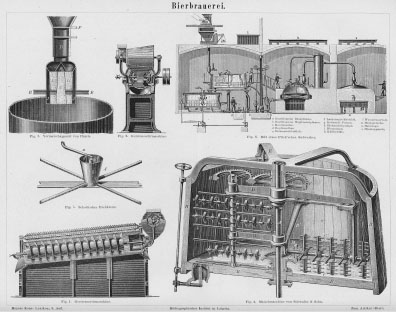
Mid-19th-century German etching depicting a brewery cross-section. pike microbrewery museum, seattle, wa
The grist is blended together with hot water (sometimes known as “brewing liquor”) in a mash vessel, creating a porridge called the mash. In a modern brewery the mash vessel will be jacketed, steam heated, and fitted with a stirring apparatus. In a more traditional British brewery, or in a small microbrewery or brewpub, it may simply be an insulated vessel with a false bottom fitted with screens. In this “infusion mash tun” the enzymatic starch conversion and the separation of the resulting wort occur in the same vessel. Regardless of which type of vessel is used, it is important at this stage to control the temperature of the mash because the heat-sensitive enzymes working to break down the barley starch into a range of fermentable and nonfermentable sugars have overlapping temperature ranges in which they are most effective. If the mash temperature is too low, then conversion will be very slow; if the temperature is too high, then the enzymes will be denatured and no conversion will occur. Although mash programs vary widely, the standard “optima” for enzymatic conversion of malt starches is approximately 65°C (149°F). Most of the enzyme action responsible for breaking barley starch down into fermentable and nonfermentable sugars ceases early during wort collection. Either the mash will be heated to a temperature that denatures the enzymes (this is called “mash-off” at approximately 76.5°C/170°F) or sparging (rinsing) at similar temperatures will accomplish the same goal. Any enzymes that remain active will later be denatured by heat in the kettle.
Once the endosperm of the barley is solubilized into sugars, then the wort must be recovered from the spent grains. This is achieved by draining the wort through the vessel false bottom using the intact barley husk as a filter medium. When a separate mash mixer is used for the mashing process (as opposed to the aforementioned infusion mash tun), the entire mash is transferred to a lauter tun, which is a specialized vessel designed to optimize the conditions for wort separation. It is essentially a large sieve that holds grain husk in place while the wort is rinsed away into the kettle. The separated spent grain is usually sold as cattle feed.
Once the wort is collected from the spent grains, it must be boiled. Boiling the wort is a vital part of the process, and how it is carried out affects the final beer quality and flavor in many ways. Although there are a great many reactions occurring during the kettle boil, the principal one of interest is the isomerization and subsequent solubilization of the bitter substance alpha acid from the added hops. Boiling the wort also essentially pasteurizes it, rendering it free from any bacterial contamination. Boiling completely ceases the enzyme activity and fixes the carbohydrate composition of the wort and hence the dextrin content of the final beer. Under the favorable conditions of wort boiling, proteins and other polypeptides present in the wort will combine with polyphenols or tannins. Boiling also can destroy a protein’s secondary and tertiary structure, causing it to become hydrophobic and insoluble. This is desirable because most of these proteins are unwanted in the finished beer. These compounds form a solid precipitate called “trub,” which is removed from the wort prior to fermentation.
The wort must be clarified and chilled prior to adding yeast for fermentation. Solid spent hop cones will be strained from the wort using a vessel with a false bottom known as a hop back, whereas smaller particles such as spent hop pellets and precipitated protein are separated using a vessel known as a whirlpool. The whirlpool works by pumping the wort into the vessel using a tangential inlet pipe about one-third of the way up the side of the vessel. This causes the wort to spin, and the forces acting in the rotating liquid cause solid particles to collect in a mound in the middle of the vessel bottom. Clear wort can then be drawn from an outlet close to the edge of the vessel bottom. Historically wort was then chilled by allowing it to cool naturally in large, shallow pans called cool ships. This method is still used for very specialized and rare beer styles. However, in modern breweries the wort is chilled by passing it through a counterflowing plate heat exchanger, which uses cold water to chill the hot wort down to temperatures suitable for the addition of yeast. In the case of ales, that temperature would be between 56°F and 68°F, whereas for lager styles it will be as cold as 46°F to 58°F. The water used for chilling the wort is heated by the heat exchanger, and so both the water and some of the heat are reclaimed. The cooled wort enters a fermentation vessel, where yeast is added. At this point it can be said that the “brewing process” has ended and the fermentation process has begun.
This definition is from The Oxford Companion to Beer, edited by Garrett Oliver. © Oxford University Press 2012.