
Hook Norton Brewery,
From The Oxford Companion to Beer
in the village of Hook Norton in Oxfordshire, England, was founded in 1849 by farmer and maltster John Harris. A family-owned brewery, it is run today by his great-great-grandson James Clarke. The brewery produces quintessential English ales and stouts, including Old Hooky, Hooky Gold, and Double Stout, and is fiercely proud that all of its draught beers are cask-conditioned and have never been filtered or pasteurized.
The brewery’s six-story tower was built in the late 1890s and was designed by William Bradford, who also drew up the plans for seventy other breweries, including Harvey’s of Lewes in Sussex, each bearing his signature of an ornate roof line in a Queen Anne style.
Hook Norton is widely considered to be among the most beautiful breweries in England. Tower breweries were a product of Victorian ingenuity; the movement of liquids through the brewery could easily be achieved if malt and water were winched and pumped to the top of the building, leaving gravity to do the work of transferring liquid down from one vessel to another.
The brewery’s motive power is still provided by the Buxton & Thornley 25 hp steam engine installed in 1899. It is last steam engine of its age still in regular use for its original purpose in the United Kingdom.
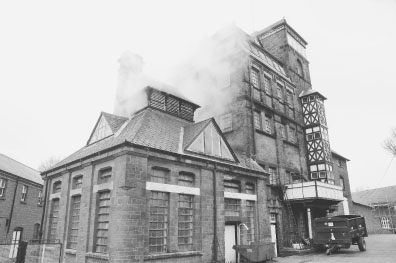
The Hook Norton Brewery in Oxfordshire, England, is one of the last working breweries to use a Victorian tower design, in which the brewing vessels used first are placed near the top, and those used last near the bottom. Once liquid is winched and pumped to the top of the six-story tower, gravity assists in moving it along from one vessel to the next. cath harries
It is not hard to imagine sweating brewery workers in the 20th century using this then-state of the art technology to haul the heavy sacks of malts needed up to the top floor of the brewery, where they would be poured into a grist mill, which is still used today.
But though the brewery has a past, it does not live in it, and over time most of the original vessels have been replaced. For as James Clarke says: “If my great-great-grandfather had known about stainless steel he would have used it.”
This definition is from The Oxford Companion to Beer, edited by Garrett Oliver. © Oxford University Press 2012.